Key takeaways
- PSI headroom: Match or exceed your washer’s output, then add margin. A gun rated at 5000 PSI on a 2300 PSI machine isn’t overkill — it’s a seal that won’t weep after a season of thermal cycling.
- Swivel placement: A true 360° swivel at the inlet is the single biggest upgrade for comfort. It lets the hose find its own path instead of transferring every twist into your forearm.
- Fitting language: Know your thread. Most residential units use M22-14mm; commercial and many modern electric models use 3/8″ quick connect. Guns that include both an adapter and a 1/4″ QC outlet spare you a hardware-store trip.
- Body length: Stubby designs excel in wheel wells, under railings, and along baseboards of exterior cladding. If you’re doing second-story siding, prioritize a model bundled with an extension wand instead.
- Foam cannon compatibility: If detailing is part of the plan, confirm the outlet accepts a soap cannon directly. Retrofitting later usually means buying a second gun.
What's inside
Anyone who has spent a Saturday resurfacing a bluestone patio knows the real bottleneck isn’t the machine. It’s the gun. Stock triggers that ship with most consumer washers are long, plastic-heavy, and hinged in a way that fights you the moment you angle into a corner or work low along a foundation line. Add a stiff hose that torques the handle every time you shift your stance, and a two-hour job stretches into an afternoon of wrist fatigue and uneven results.
Short-body guns solved this, and by 2026 the category has matured into something genuinely refined: brass-cored triggers, integrated 360° swivels, and quick-connect fittings that let you swap between a soap cannon and a 15° tip without breaking your rhythm. This guide breaks down the six models worth your attention, what specs actually matter versus what’s marketing gloss, and which one suits your setup — whether you’re maintaining a limestone entry, detailing a car in the driveway, or keeping composite decking looking like the day it was installed.
As an Amazon Associate we earn from qualifying purchases.



How to Choose a Pressure Washer Gun (2026)
- PSI headroom: Match or exceed your washer’s output, then add margin. A gun rated at 5000 PSI on a 2300 PSI machine isn’t overkill — it’s a seal that won’t weep after a season of thermal cycling.
- Swivel placement: A true 360° swivel at the inlet is the single biggest upgrade for comfort. It lets the hose find its own path instead of transferring every twist into your forearm.
- Fitting language: Know your thread. Most residential units use M22-14mm; commercial and many modern electric models use 3/8″ quick connect. Guns that include both an adapter and a 1/4″ QC outlet spare you a hardware-store trip.
- Body length: Stubby designs excel in wheel wells, under railings, and along baseboards of exterior cladding. If you’re doing second-story siding, prioritize a model bundled with an extension wand instead.
- Foam cannon compatibility: If detailing is part of the plan, confirm the outlet accepts a soap cannon directly. Retrofitting later usually means buying a second gun.
The Best Pressure Washer Guns (2026), Reviewed
TOOLCY Pro Short Pressure Washer Gun
The most complete package here: 5000 PSI rating, 3/8″ swivel inlet, an M22 adapter, and five nozzle tips out of the box. The swivel is smooth enough that hose drag essentially disappears, which makes this the pick for long sessions on driveways and pool surrounds.
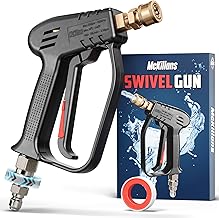
McKillans Short Pressure Washer Gun with Swivel
A tidy, well-machined handle with a 3/8″ male plug and 1/4″ quick coupler, built with foam cannon work in mind. Trigger pull is lighter than most competitors, which matters when you’re feathering pressure across softer surfaces like painted wood or stucco.
Swivel Power Washer Gun (4060 PSI)
The pragmatic choice. A 4060 PSI ceiling covers virtually every residential machine, and the smooth 3/8″ plus 1/4″ QC combination makes it a straightforward drop-in replacement for a failing OEM gun. No frills, no weak points.
MEKOH Short Pressure Washer Gun
Rated at 4000 PSI with a generous 10.5 GPM flow ceiling, this one handles higher-volume gas units without cavitating. The included M22-14mm adapter means it plays well with extension wands, so it scales from stubby detail work to reach jobs.
Tool Daily Short Gun with Foam Cannon
Best value if you don’t already own a cannon — the one-liter soap reservoir and five-tip set arrive together, so you’re set up for a full wash-and-rinse cycle immediately. Note it won’t thread onto a garden hose; this is a pressure-washer-only setup.
Frequently Asked Questions
Will a short gun reduce my cleaning power?
No. Pressure and flow are determined by your pump and nozzle orifice, not handle length. A shorter body simply changes ergonomics and reach.
Do I need the M22 adapter?
Only if your hose terminates in M22-14mm threads, which is common on consumer electric and mid-range gas units. Check your existing gun’s inlet before ordering.
Can these run a foam cannon?
Most can, provided the outlet is a 1/4″ quick connect. The Tool Daily and McKillans models are explicitly built for it.
Are they safe on delicate surfaces?
Yes, with the right tip. Use a 40° white nozzle and stand back further for painted trim, sealed stone, and composite decking.
Final Thoughts
For most homeowners, the TOOLCY Pro is the smartest buy — its pressure headroom, swivel quality, and complete adapter kit cover nearly every scenario. Choose the McKillans if detailing and foam work dominate your weekends, or the Hourleey if you need the extension wand for siding and gutter lines.