Key takeaways
- Noise level: Anything above roughly 80 dBA is a shop-only machine. If your workspace shares walls with living areas, look for a published dBA rating in the 60s and treat unlabeled units as loud.
- SCFM at 90 PSI: This is the number that determines whether a tool runs continuously or stalls while the pump catches up. Around 2.6 SCFM covers nailers and staplers comfortably; sanders and spray guns need considerably more.
- Pump design: Oil-free pumps skip maintenance entirely and start reliably in cold garages, which suits intermittent home use. Oiled pumps run quieter and last longer under daily load.
- Max PSI and tank shape: Higher pressure stores more usable air in the same tank. Pancake tanks stay stable and store flat; hot dog and twin-stack designs slide into tighter shelving.
- Realistic portability: A 30-pound pancake is genuinely carryable. Once you pass 50 pounds, wheels and a balanced handle stop being a bonus and become the deciding feature.
What's inside
Air compressors are one of the few tools that get bought on brand reflex rather than research, and it shows. Buyers walk into the decision comparing horsepower numbers that manufacturers define loosely, tank sizes that say little about actual output, and price tags that swing by hundreds of dollars for machines that do nearly identical work. The result is a garage full of regret: a unit too loud to run in a finished basement, or too slow to keep a brad nailer fed through a single afternoon of trim work.
That matters more now that workshops have moved indoors. The spare room turned studio, the garage with drywall and a decent floor, the utility closet doing double duty as a tool bay all sit close enough to living space that noise and footprint carry real weight. This guide looks at the brands that consistently deliver on the specs that count, then breaks down which specific models suit finish carpentry, tire duty, framing, and quiet indoor work.
As an Amazon Associate we earn from qualifying purchases.


How to Choose a/an Air Compressor Brand (2026)
- Noise level: Anything above roughly 80 dBA is a shop-only machine. If your workspace shares walls with living areas, look for a published dBA rating in the 60s and treat unlabeled units as loud.
- SCFM at 90 PSI: This is the number that determines whether a tool runs continuously or stalls while the pump catches up. Around 2.6 SCFM covers nailers and staplers comfortably; sanders and spray guns need considerably more.
- Pump design: Oil-free pumps skip maintenance entirely and start reliably in cold garages, which suits intermittent home use. Oiled pumps run quieter and last longer under daily load.
- Max PSI and tank shape: Higher pressure stores more usable air in the same tank. Pancake tanks stay stable and store flat; hot dog and twin-stack designs slide into tighter shelving.
- Realistic portability: A 30-pound pancake is genuinely carryable. Once you pass 50 pounds, wheels and a balanced handle stop being a bonus and become the deciding feature.
The Best Air Compressor Brands (2026) Reviewed
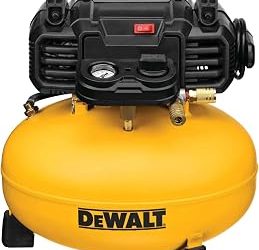
DEWALT 6-Gallon Pancake (DWFP55126)
The 165 PSI ceiling is the quiet advantage here, packing meaningfully more usable air into the same six gallons than the 150 PSI competition, which translates to fewer motor cycles during a run of baseboard. High-flow couplers and a maintenance-free pump make it the most sensible default for anyone buying one compressor for the next decade.
BOSTITCH 6-Gallon Oil-Free Kit (BTFP02012-WPK)
BOSTITCH built its reputation on quieter operation at this size, and the kit format means you unbox a working setup rather than a compressor plus a shopping list. A strong entry point for a first-time buyer outfitting a small home shop.
PORTER-CABLE 6-Gallon Pancake
Functionally the value play in the pancake category: the same 2.6 CFM at 90 PSI and oil-free pump as pricier siblings, with a slightly less refined build. If a compressor will see occasional weekend use rather than weekly duty, the savings are hard to argue with.
DEWALT 4.5-Gallon Wheeled (D55146)
A 225 PSI maximum in a compact wheeled tank is an unusual combination, and it means this unit holds air like something twice its size. The right answer for framing, extended trim runs, or any job where two nailers work at once.
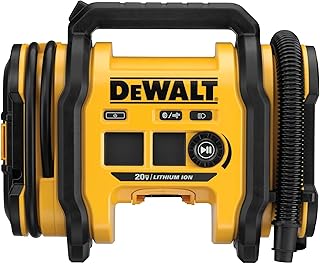
DEWALT 20V MAX Tire Inflator (DCC020IB)
Not a shop compressor, and not trying to be. It handles tires, sports gear, and inflatables on battery power with automatic shut-off at your target pressure, and it belongs in a car rather than on a bench.
Frequently Asked Questions
How quiet is quiet enough for indoor use?
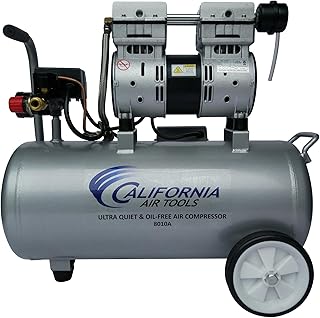
The California Air Tools 8010A sits at 60 dBA, roughly conversational volume, which is the threshold where you can run a compressor without clearing the room. Standard pancake units land closer to 78 to 82 dBA.
Do I need to worry about maintenance?
Oil-free pumps require none beyond draining the tank after each use to prevent internal rust. That single habit is the difference between a compressor that lasts fifteen years and one that fails in five.
Is six gallons enough for a home shop?
For nailers, staplers, blow guns, and inflation, yes. Continuous-draw tools like DA sanders and HVLP spray guns will outrun a six-gallon tank regardless of brand.
Does higher PSI mean a more powerful tool performance?
Not directly. PSI determines how much air the tank stores; SCFM determines how fast the compressor replaces it. Most air tools operate at 90 PSI regardless of tank capability.
Final Thoughts
For most home workshops, the DEWALT DWFP55126 remains the balanced choice, with its 165 PSI capacity doing quiet work you never notice. If your shop shares a wall with a bedroom, the California Air Tools 8010A is worth every dollar of the premium, and the DEWALT D55146 handles heavier framing and multi-tool days that pancakes struggle with.