Key takeaways
- Swing over guesswork: Swing is twice the throat distance, so a 12-inch press centers a hole 6 inches from the edge of your stock. Measure the widest panel you realistically drill into, then buy one size up — mid-panel shelf pin holes are where undersized machines fail you.
- Speed range and how you change it: Belt-change pulleys are reliable and cheap; variable-speed dials let you slow down for a 1-inch Forstner in white oak without stopping work. Low end matters more than high end for furniture, since large bits in hardwood want roughly 500 RPM or less.
- Cast iron mass: Weight is what kills vibration, and vibration is what leaves a torn, chattered hole rim. A cast iron head, column, and table will always outperform a lighter machine with better paper specs.
- Table geometry: Look for a table that tilts to 45 degrees for angled mortises and splayed legs, plus a rack-and-pinion height crank. Cranking beats loosening a collar and catching the table with your knee.
- Benchtop or magnetic: Wood, MDF, and plywood want a benchtop press. Drilling into steel beams, brackets, or fabricated bases in place calls for a magnetic drill that clamps itself to the workpiece.
What's inside
There’s a particular kind of frustration that shows up halfway through building a walnut console table: the pilot hole you drilled by hand is off by three degrees, and now the leg sits proud. Handheld drills are wonderful for assembly and terrible for precision. The moment your projects move from flat-pack furniture to actual joinery — dowelled frames, floating shelf hardware, drawer pulls that need to line up across six fronts — a drill press stops being a luxury and starts being the tool that decides whether your work looks made or looks improvised.
The catch is that drill press shopping is genuinely confusing. Spec sheets bury the numbers that matter under ones that don’t, “heavy-duty” gets applied to machines weighing thirty pounds, and the gap between a bench unit for hardwood and a magnetic drill for structural steel is rarely explained. This guide sorts through the benchtop and magnetic options worth considering in 2026, with an eye toward the person working in a garage, a spare room, or a corner of a studio — not a production shop.
As an Amazon Associate we earn from qualifying purchases.


How to Choose a Drill Press Best (2026)
- Swing over guesswork: Swing is twice the throat distance, so a 12-inch press centers a hole 6 inches from the edge of your stock. Measure the widest panel you realistically drill into, then buy one size up — mid-panel shelf pin holes are where undersized machines fail you.
- Speed range and how you change it: Belt-change pulleys are reliable and cheap; variable-speed dials let you slow down for a 1-inch Forstner in white oak without stopping work. Low end matters more than high end for furniture, since large bits in hardwood want roughly 500 RPM or less.
- Cast iron mass: Weight is what kills vibration, and vibration is what leaves a torn, chattered hole rim. A cast iron head, column, and table will always outperform a lighter machine with better paper specs.
- Table geometry: Look for a table that tilts to 45 degrees for angled mortises and splayed legs, plus a rack-and-pinion height crank. Cranking beats loosening a collar and catching the table with your knee.
- Benchtop or magnetic: Wood, MDF, and plywood want a benchtop press. Drilling into steel beams, brackets, or fabricated bases in place calls for a magnetic drill that clamps itself to the workpiece.
The Best Drill Press Best (2026)s Reviewed
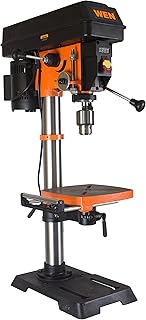
WEN 12-Inch Variable Speed Benchtop Drill Press (DP1263V)
The 6.2-amp variable-speed motor and full cast iron build make this the most capable benchtop option here for furniture work, letting you dial speed mid-cut instead of swapping belts. The laser crosshair and LED are pleasant extras, but the real value is 12 inches of swing and enough mass to keep a large Forstner bit from walking.
SKIL 10-Inch 5-Speed Benchtop Drill Press (DP9505-00)
SKIL’s 10-inch press pairs a 6.2-amp motor with unusually good ergonomics — the laser alignment system and integrated work light are better executed than most, and the controls feel considered rather than tacked on. A smart middle choice if 12 inches of swing is more than your bench can spare.
8-Inch Heavy-Duty Cast Iron Benchtop Drill Press
A 3.1-amp motor with a 620–3100 RPM five-speed range and a table that tilts to 45 degrees covers most small-project drilling in a compact footprint. Best suited to hardware holes, dowels, and dry fitting rather than large-diameter boring.
WEN 8-Inch 5-Speed Cast Iron Benchtop Drill Press (4206T)
The value pick, and a genuinely good first press — 2.3 amps and cast iron construction in a machine that fits on a crowded bench and won’t wobble through pilot holes. Its ceiling shows up with big bits in dense stock, so plan accordingly.
ZELCAN 1550W Portable Magnetic Drill Press
Entirely different tool, entirely different job: 2922 lbf of magnetic hold and stepless 0–580 RPM control for boring up to 2 inches into steel where the work can’t come to you. Worth it if your builds involve welded bases or structural brackets.
Frequently Asked Questions
Do I need a drill press for furniture projects?
For assembly, no. For repeatable, perpendicular holes — dowel joinery, shelf pins, hardware that must align across multiple pieces — it’s the difference between acceptable and clean.
Is variable speed worth the upgrade?
If you use bits above ½ inch or work in mixed materials, yes. Belt-change models are perfectly accurate, just slower to adjust, which in practice means you’ll drill at the wrong speed.
What’s a magnetic drill actually for?
Drilling steel in place. The electromagnet anchors the tool to the workpiece, so it handles beams and fabricated parts that will never fit on a benchtop table.
How much bench space should I plan for?
Allow the machine’s footprint plus clearance for the table at full height and its tilt arc. Bolting the base down also measurably reduces vibration.
Final Thoughts
For most home woodworkers, the WEN DP1263V is the one to buy — variable speed, 12-inch swing, and cast iron mass at a reasonable price. The SKIL DP9505-00 is the better fit for tighter benches, while the WEN 4206T remains the sensible entry point if you’re still figuring out how much drilling your projects really demand.