Key takeaways
- Rip capacity over blade size: A 10-inch blade sounds impressive, but the number that limits your projects is how far the fence travels right of the blade. Roughly 30 inches lets you break down a plywood sheet into two usable halves; 24 to 26 inches means you’ll be doing that step on a track saw or sawhorses first.
- Fence mechanism: Rack-and-pinion fences move on a geared track and stay parallel through their travel, which is why they’ve become the standard on serious jobsite saws. Older single-lock fences can rack slightly when you cam the lever down, and that small angle error shows up as a tapered rip.
- Real depth of cut at 45 degrees: Bevel cuts lose an inch or more of capacity. If you plan mitered case corners in 3/4-inch stock you’re fine, but check the 45-degree figure before assuming you can bevel through 2x material in one pass.
- Dust handling: Table saws throw fine dust in every direction, and a shrouded blade with a 2.5-inch port connected to a shop vac changes the character of an indoor workspace entirely. Treat a good collection design as a health feature, not a convenience.
- Stand and footprint: A rolling folding stand costs more and adds weight, but it means the saw leaves the floor between sessions. If your shop is a garage bay you also park in, this decides more about whether you use the tool than any spec on the motor plate.
What's inside
Most people who build furniture at home don’t start with a table saw. They start with a circular saw and a straightedge, and they live with it for a year or two, until the day they try to rip a 6-foot length of walnut for a bench seat and end up with an edge that wanders. That’s usually the moment the table saw stops being an aspirational purchase and becomes a practical one. The frustration isn’t power — it’s repeatability. Furniture-scale work demands that cut number twelve match cut number one, and that only happens when the blade and fence hold their relationship to each other.
The 2026 crop of portable and jobsite saws has closed much of the gap with cabinet saws in the areas that matter for home builders: fence accuracy, rip capacity, and dust control. What’s still highly variable is how much shop space each one demands and how honest the depth-of-cut specs are. This guide breaks down what to look for, then walks through six saws that suit different corners of a home workshop, from a folding-stand workhorse to a compact benchtop unit you can store vertically between projects.
As an Amazon Associate we earn from qualifying purchases.


How to Choose a/an Table Saw Woodworking (2026)
- Rip capacity over blade size: A 10-inch blade sounds impressive, but the number that limits your projects is how far the fence travels right of the blade. Roughly 30 inches lets you break down a plywood sheet into two usable halves; 24 to 26 inches means you’ll be doing that step on a track saw or sawhorses first.
- Fence mechanism: Rack-and-pinion fences move on a geared track and stay parallel through their travel, which is why they’ve become the standard on serious jobsite saws. Older single-lock fences can rack slightly when you cam the lever down, and that small angle error shows up as a tapered rip.
- Real depth of cut at 45 degrees: Bevel cuts lose an inch or more of capacity. If you plan mitered case corners in 3/4-inch stock you’re fine, but check the 45-degree figure before assuming you can bevel through 2x material in one pass.
- Dust handling: Table saws throw fine dust in every direction, and a shrouded blade with a 2.5-inch port connected to a shop vac changes the character of an indoor workspace entirely. Treat a good collection design as a health feature, not a convenience.
- Stand and footprint: A rolling folding stand costs more and adds weight, but it means the saw leaves the floor between sessions. If your shop is a garage bay you also park in, this decides more about whether you use the tool than any spec on the motor plate.
The Best Table Saw Woodworking (2026)s Reviewed
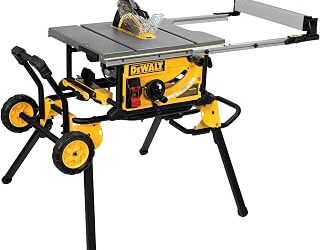
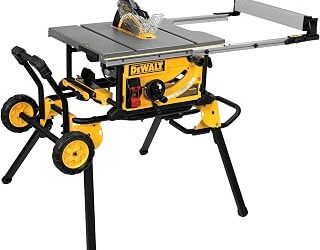
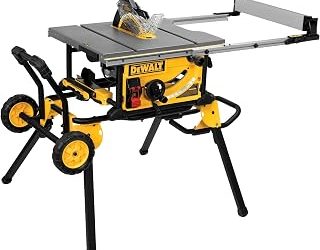
DEWALT DWE7491RS 10-Inch with Rolling Stand
The 32-1/2-inch rip capacity and rack-and-pinion fence make this the default recommendation for anyone building casework, because it handles sheet goods without a preliminary breakdown step. The folding rolling stand is genuinely good — it deploys in seconds and rolls over a door threshold, which matters more in a home shop than it does on a job site.
DOVAMAN DTS10A 10-Inch with Stand
A 15-amp copper-wound motor spinning 5,300 RPM and a one-side extension table give this saw more working surface than its price suggests, with 3.35 inches of cut at 90 degrees for thicker stock. It’s a sensible first table saw for someone moving up from a circular saw and unwilling to spend DEWALT money to find out if they’ll use it.
Evolution R10TS Jobsite Table Saw
Evolution ships this with a zero-clearance throat plate and a dado plate in the box, which is unusual and tells you the saw is aimed at people doing joinery rather than framing. The zero-clearance insert alone dramatically reduces tearout on veneered plywood and melamine — the exact materials that punish a stock throat plate.
DEWALT DWE7485 8-1/4-Inch Compact
The smaller blade and lighter body make this the pick for shops where the saw must live on a shelf and come down for use. You give up depth of cut and rip capacity compared to its 10-inch sibling, but the fence quality and build feel carry over, and for 3/4-inch furniture stock the reduced capacity rarely bites.
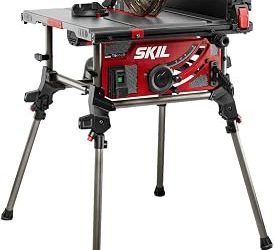
Table Saw with 98% Dust Collection System
The headline here is enclosed dust extraction, and it’s the right priority for anyone working in a basement, a shared garage, or any space where airborne fines end up in the rest of the house. Depth capacity tops out around 2.36 inches, so treat it as a sheet-goods and furniture-stock saw rather than a timber saw.
Frequently Asked Questions
Is a jobsite saw accurate enough for furniture?
Yes, provided you spend an hour aligning it. Check that the blade is parallel to the miter slot, then set the fence to the same reference. Most complaints about jobsite saw accuracy trace back to a factory setup that was never verified.
Do I still need a track saw or circular saw?
If your rip capacity is under about 28 inches, yes — you’ll want something to break full sheets down to manageable pieces before they reach the table saw. Above 30 inches you can usually skip that step with a helper or an outfeed support.
What blade should I put on it first?
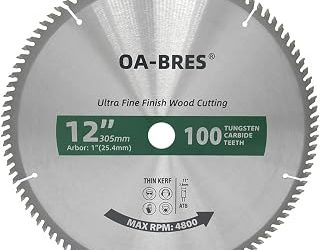
Swap the included general-purpose blade for a 40- to 50-tooth ATB combination blade. It’s the single cheapest upgrade to cut quality, and it reduces the sanding and edge-cleanup time on every project after.
Can I run a dado stack on these saws?
Only if the manufacturer says so — arbor length and motor design vary. The Evolution R10TS ships with a dado plate, which signals support; most compact saws with 8-1/4-inch blades do not accommodate stacked dado sets.
Final Thoughts
For most home furniture builders, the DEWALT DWE7491RS is the saw that removes the most friction from a project, thanks to its 32-1/2-inch rip capacity and a rolling stand that lets the tool disappear when you’re done. If you’re working in a finished or shared space, the enclosed 98% dust collection saw is worth choosing on air quality alone, and the Evolution R10TS makes a strong case for anyone who wants zero-clearance and dado capability without buying accessories separately.