Key takeaways
- Delivered air, not horsepower: SCFM at 90 PSI is the number that determines whether a tool runs continuously or in frustrating bursts. Nailers sip air at well under 1 CFM, while sanders, grinders, and spray guns can demand 4 to 6 CFM. Match the compressor to your thirstiest tool, then add roughly 30 percent of headroom.
- Tank size and recovery speed: A larger tank buffers demand so the motor cycles less often, but recovery rate is what keeps you working. A 20 to 30 gallon vertical tank paired with quick recovery is the sweet spot for most one-person shops.
- Noise, measured honestly: Anything in the 66 to 70 dB range is conversational, roughly a dishwasher. Standard direct-drive compressors often land above 85 dB, which is genuinely unpleasant in an attached garage or a basement below bedrooms.
- Oil-free versus oil-lubricated: Oil-free pumps skip the oil changes, start reliably in cold weather, and will not contaminate your air line before a paint job. Oil-lubricated units run cooler and last longer under punishing industrial cycles, which most home shops never reach.
- Footprint and air delivery: Vertical tanks reclaim floor space, and large wheels matter more than spec sheets suggest. Budget for a proper hose setup too, ideally a ceiling or wall mounted reel, so 50 feet of hose is not permanently coiled underfoot.
What's inside
A workshop compressor lives a strange double life. It is the least decorative object you will ever buy for a space you may have spent months styling, and it is also the thing that makes half your projects possible: the brad nailer that closes up a built-in bookcase, the sprayer that lays down a flawless finish on a cabinet door, the blow gun that clears sawdust off a walnut slab before you seal it. Most people shop for one in a hurry, buy on horsepower alone, and end up with a machine that either stalls mid-task or rattles the walls of an attached garage loud enough to end the conversation happening in the kitchen.
This guide approaches the problem the way we approach any piece of hardworking equipment in a home: performance first, but with real attention to noise, footprint, and how much maintenance it demands from you over a decade. Below you will find vertical tank compressors sized for genuine shop duty, an ultra-quiet option for finished garages and basements, a grab-and-go portable for trim work, and a retractable hose reel that keeps your floor clear. Each pick is judged on delivered air (CFM at 90 PSI), duty cycle, sound level, and how easy it is to actually live with.
As an Amazon Associate we earn from qualifying purchases.



How to Choose an Air Compressor For Shop (2026)
- Delivered air, not horsepower: SCFM at 90 PSI is the number that determines whether a tool runs continuously or in frustrating bursts. Nailers sip air at well under 1 CFM, while sanders, grinders, and spray guns can demand 4 to 6 CFM. Match the compressor to your thirstiest tool, then add roughly 30 percent of headroom.
- Tank size and recovery speed: A larger tank buffers demand so the motor cycles less often, but recovery rate is what keeps you working. A 20 to 30 gallon vertical tank paired with quick recovery is the sweet spot for most one-person shops.
- Noise, measured honestly: Anything in the 66 to 70 dB range is conversational, roughly a dishwasher. Standard direct-drive compressors often land above 85 dB, which is genuinely unpleasant in an attached garage or a basement below bedrooms.
- Oil-free versus oil-lubricated: Oil-free pumps skip the oil changes, start reliably in cold weather, and will not contaminate your air line before a paint job. Oil-lubricated units run cooler and last longer under punishing industrial cycles, which most home shops never reach.
- Footprint and air delivery: Vertical tanks reclaim floor space, and large wheels matter more than spec sheets suggest. Budget for a proper hose setup too, ideally a ceiling or wall mounted reel, so 50 feet of hose is not permanently coiled underfoot.
The Best Air Compressor For Shop (2026)s Reviewed
Klutch 20-Gallon Air Compressor
With 2 HP, 175 PSI, and 4.2 SCFM at 90 PSI on a 75 percent duty cycle, this is the well-judged middle of the market: enough air for impact tools and short sanding sessions without a 240V circuit. The vertical tank, large wheels, and easy-access drain make it a genuinely practical fixture in a two-car garage.
Klutch 29-Gallon Air Compressor
Stepping up to 2.5 HP and 5.1 CFM at 90 PSI buys you longer uninterrupted runs, which matters most for spray finishing and extended nailing work where pressure drop shows up in the result. It remains 120V and oil-free, so the added capability costs you nothing in wiring or upkeep.
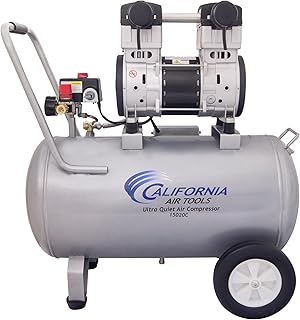
California Air Tools 15020C Ultra Quiet
At 70 dB, this 2.0 HP, 15-gallon unit is the one to buy if your shop shares walls with living space, and the oil-free pump means clean air for finish work straight out of the tank. You give up some peak pressure compared with the Klutch units, but the quality-of-life gain is difficult to overstate.
VEVOR 13-Gallon Quiet Compressor
A 66 dB rating alongside 4.6 SCFM at 90 PSI is an unusually good pairing at this size, covering tire inflation, woodworking, auto repair, and spray painting with a thickened steel body and wheels for repositioning. The 125 PSI ceiling is the tradeoff, so confirm your tools do not need more.
Craftsman 2-Gallon Hot Dog
This is not a shop compressor so much as a companion to one: 125 PSI, 0.5 CFM at 90 PSI, oil-free, and light enough to carry upstairs for baseboard or crown molding. Keep it for punch-list trim work and let a larger tank handle everything else.
Frequently Asked Questions
What size compressor do I need for a home shop?
For nailing, inflation, and blow-off work, 6 gallons is adequate. Once sanders, ratchets, or spray guns enter the picture, a 15 to 30 gallon tank delivering 4 to 5 CFM at 90 PSI is the realistic floor.
Are quiet compressors actually worth the premium?
In a detached shop, probably not. In an attached garage, finished basement, or anywhere near a home office, dropping from 85 dB to under 70 dB changes when and how often you are willing to work.
Do I need a 240V circuit?
Every compressor here runs on standard 120V household power. Dedicate a 15 or 20 amp circuit to it if you can, since startup surge on a shared circuit is a common cause of nuisance breaker trips.
Why does a hose reel matter?
A ceiling or wall mounted reel like the VEVOR 3/8 inch by 50 foot hybrid model rated to 300 PSI keeps air where you need it, protects the hose from being run over, and removes the single biggest tripping hazard in most garages.
Final Thoughts
For most home shops, the Klutch 29-Gallon is the pick that will not need replacing, delivering 5.1 CFM for spraying and sustained nailing at a genuinely reasonable footprint. If your workspace adjoins living areas, the California Air Tools 15020C at 70 dB is the more livable choice, and the Craftsman 2-Gallon Hot Dog earns its keep as the portable you carry to the far end of the house.