Key takeaways
- Match the system to what you store: Slatwall handles hangable, awkward items — anything with a handle, hook point, or loop. Shelving handles boxed, bagged, and stackable goods. Serious garages run both: panels above the workbench, shelves along the perimeter.
- Read load ratings per bracket, not per system: A “1,400 lb” shelf rating assumes even distribution across studs with every fastener seated. Concentrating an engine block on one corner is a different physics problem. Buy roughly double the capacity you think you need.
- Confirm your wall before you buy: Wood studs at 16 in. centers are the easy case. Concrete, block, or metal studs require different anchors, often sold separately. Locate and mark your studs first — that measurement determines which panel widths and shelf spans actually work.
- Prioritize moisture and corrosion resistance: Garages swing 40 degrees in a day and pull humidity through slab and door seals. PVC slatwall won’t absorb water or host mold, and powder-coated steel shelving resists the rust that eats bare metal brackets.
- Plan for adjustment, not permanence: Your storage needs will change. Slatwall’s continuous grooves let you relocate hooks in seconds, and modular shelf packs let you add runs later. Fixed, single-purpose racks tend to become the thing you work around.
What's inside
Most garages fail in the same quiet way: the floor becomes the storage plan. Bikes lean against drywall, bins stack four high until nothing at the bottom is reachable, and a leaf blower migrates to wherever there’s a gap. The square footage is there — it’s just standing on end, unused, from knee height to ceiling. Vertical wall systems solve this, but the category is genuinely confusing, because slatwall panels and wall-mounted shelving look like competitors when they actually do different jobs.
This guide sorts the 2026 field into two clear lanes. Slatwall paneling gives you an adjustable grid for hooks, baskets, and anything with a handle — rakes, extension cords, cordless drills, sports gear. Heavy-duty floating shelves give you flat, load-rated surfaces for bins, paint, and tool cases. Below you’ll find the panels and racks worth your wall space, plus a buying framework covering load ratings, wall type, and the installation details that decide whether a system holds for a decade or sags in a season.
As an Amazon Associate we earn from qualifying purchases.


How to Choose a Garage Wall Storage Systems (2026)
- Match the system to what you store: Slatwall handles hangable, awkward items — anything with a handle, hook point, or loop. Shelving handles boxed, bagged, and stackable goods. Serious garages run both: panels above the workbench, shelves along the perimeter.
- Read load ratings per bracket, not per system: A “1,400 lb” shelf rating assumes even distribution across studs with every fastener seated. Concentrating an engine block on one corner is a different physics problem. Buy roughly double the capacity you think you need.
- Confirm your wall before you buy: Wood studs at 16 in. centers are the easy case. Concrete, block, or metal studs require different anchors, often sold separately. Locate and mark your studs first — that measurement determines which panel widths and shelf spans actually work.
- Prioritize moisture and corrosion resistance: Garages swing 40 degrees in a day and pull humidity through slab and door seals. PVC slatwall won’t absorb water or host mold, and powder-coated steel shelving resists the rust that eats bare metal brackets.
- Plan for adjustment, not permanence: Your storage needs will change. Slatwall’s continuous grooves let you relocate hooks in seconds, and modular shelf packs let you add runs later. Fixed, single-purpose racks tend to become the thing you work around.
The Best Garage Wall Storage Systems (2026)s Reviewed
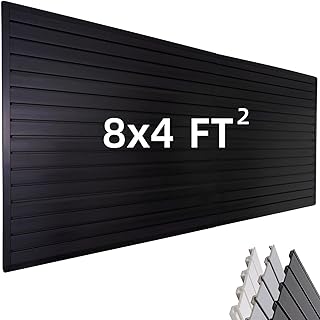
FRAYSCENT Slat Wall Paneling, 8 ft x 4 ft
A clean, full-coverage PVC slatwall kit in matte black that turns an entire wall section into a reconfigurable hanging grid — the most flexible foundation you can install. The 8×4 format covers ground fast with fewer seams, and the finish reads more design-forward than the beige garage organizers of the last decade.
Yuzzy Slat Wall Paneling, 4 x 8 ft
Heavy-duty PVC with a tight groove profile that grips accessories without wobble, making it a strong pick for heavier hand tools and garden equipment. Worth considering if you want slatwall coverage sized to a standard sheet layout for predictable, low-waste installation.
Jusgym Wall Mounted Garage Shelving, 4-Pack 2×3 ft
The integrated grid deck and seamless, no-splice structure are the standout here — no bolted midpoint means no flex point, which is why the 1,400 lb rating holds up in practice. Four smaller units give you placement freedom that one long shelf can’t, ideal for working around doors, windows, and panel boxes.
FLEXIMOUNTS Classic Series 2-Pack 2×6 ft Shelving
The reference standard for wall-mounted garage shelving: 24×72 in. decks, 1,400 lb capacity, and a genuinely floating profile that keeps the floor clear underneath. Installation hardware and instructions are well sorted, which matters more than spec sheets when you’re overhead with a drill.
FLEXIMOUNTS Lite Series 2-Pack 2×6 ft with 8 Hooks
The value entry in the same family, rated to 1,200 lbs with eight included hooks that let the shelf edge do double duty for cords and hand tools. Rustproof finish and identical footprint to the Classic — a smart choice when you’re outfitting a full perimeter on a budget.
Frequently Asked Questions
Do I need to hit studs, or will drywall anchors work?
Hit studs. Every load rating in this category assumes fasteners are anchored into structural framing. Drywall anchors are appropriate for a single lightweight hook, not for shelving or panels that will eventually hold hundreds of pounds.
Can slatwall panels install over bare concrete or block?
Yes, using masonry anchors, though many installers first fasten furring strips to the wall and mount the panels to those. The strips give you a level plane and a consistent fastening depth, which is worth the extra step on uneven block.
How high should wall shelving go?
Keep frequently used items between hip and shoulder height, and reserve above-shoulder shelves for light, seasonal storage. Leave at least 18 in. of clearance below the ceiling and check your garage door track travel before committing to the top row.
Is PVC slatwall strong enough for real tools?
Quality PVC panels handle typical garage loads well — hand tools, cordless kits, hoses, sports gear — and they won’t rot, rust, or swell like MDF slatwall. For very heavy single items like a full toolbox or engine hoist accessories, use steel shelving instead.
Final Thoughts
If you’re building one system to last, pair the FRAYSCENT 8×4 slatwall for everything that hangs with the FLEXIMOUNTS Classic Series shelves for everything that stacks — that combination covers roughly every storage problem a garage produces. For tighter or more irregular walls, the Jusgym 4-pack delivers the same load confidence in a more placeable format, and its seamless deck is the detail that separates it from cheaper bracket-and-panel racks.