Key takeaways
- Noise level: Airbrush-specific piston compressors typically land between 45 and 60 dB, roughly conversational volume. Anything advertised above 70 dB belongs in a garage, not a living room, and will end your painting sessions early.
- Tank or tankless: A small tank (1–3 liters) stores air so the motor cycles on and off instead of running continuously, which means cooler operation and pulse-free pressure. Tankless units are lighter and fine for nail art or makeup, less ideal for long gradient passes.
- Pressure range and regulator: Most decorative work happens between 15 and 40 PSI. What matters is a regulator that holds a low setting steadily, plus a readable gauge — not a high maximum PSI number.
- Moisture trap: Compressed air carries water vapor, and water in the line will bead and blow out mid-stroke. A built-in water trap or filter is non-negotiable for any finish you care about.
- Duty cycle and cooling: Oil-free pistons with a cooling fan handle back-to-back hours without thermal cutoff. If you’re refinishing furniture panels rather than painting miniatures, prioritize this over portability.
What's inside
Airbrushing has quietly become one of the most useful skills in a design-minded home: soft gradient washes on a thrifted dresser, hand-tinted ceramic vessels, refinished cabinet hardware, a mural above the console table. The bottleneck is almost never the airbrush. It’s the compressor. Most people start with whatever unit is cheapest, then discover that pulsing air ruins a fade, that moisture in the line spatters a finish they spent a weekend prepping, and that a compressor running at 85 decibels is unusable in an apartment or an open-plan living space where the studio corner shares a wall with everything else.
This guide looks at air compressors through the lens of a home studio rather than a garage — quiet operation, a footprint that can sit under a console or on a shelf, and clean, steady air at the low pressures that decorative work actually needs. Below are the models worth considering in 2026, from compact piston units built specifically for airbrush work to a small tank compressor that doubles for household jobs, plus the specs that genuinely matter when you’re comparing them.
As an Amazon Associate we earn from qualifying purchases.


How to Choose an Air Compressor For Airbrushing (2026)
- Noise level: Airbrush-specific piston compressors typically land between 45 and 60 dB, roughly conversational volume. Anything advertised above 70 dB belongs in a garage, not a living room, and will end your painting sessions early.
- Tank or tankless: A small tank (1–3 liters) stores air so the motor cycles on and off instead of running continuously, which means cooler operation and pulse-free pressure. Tankless units are lighter and fine for nail art or makeup, less ideal for long gradient passes.
- Pressure range and regulator: Most decorative work happens between 15 and 40 PSI. What matters is a regulator that holds a low setting steadily, plus a readable gauge — not a high maximum PSI number.
- Moisture trap: Compressed air carries water vapor, and water in the line will bead and blow out mid-stroke. A built-in water trap or filter is non-negotiable for any finish you care about.
- Duty cycle and cooling: Oil-free pistons with a cooling fan handle back-to-back hours without thermal cutoff. If you’re refinishing furniture panels rather than painting miniatures, prioritize this over portability.
The Best Air Compressor For Airbrushing (2026)s Reviewed
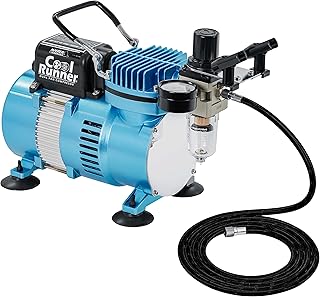
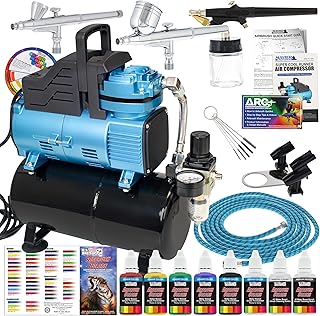
Master Airbrush TC-320 Cool Runner II
The most sensible default for a home studio: a 1/5 HP dual-fan compressor with an integrated regulator, water trap, and airbrush holder, bundled with a brush so you’re painting the day it arrives. The dual-fan cooling means it tolerates long sessions, and it stays quiet enough to run alongside music without competing.
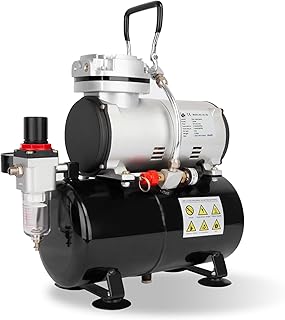
Timbertech AS186 with 3L Tank
A single-piston, oil-free unit with a genuine 3-liter tank, which is what separates it from the tankless minis — the motor rests between draws, so pressure stays flat through a full fade. It’s the pick if you want tank-buffered air without stepping up to professional pricing.
Timbertech ABPST08 Upgraded
Essentially the AS186 with a cooling fan added, and that fan is the reason to choose it if your projects run long: cabinet fronts, chair frames, anything measured in hours rather than minutes. Same 3L tank, regulator, and moisture trap, with better thermal headroom.
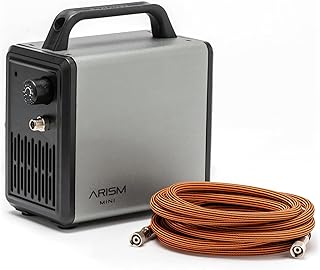
Sparmax ARISM Mini
The most refined object of the group, and the one that looks at home on an open shelf rather than hidden in a closet. It’s oil-free, notably quiet, with adjustable pressure, a built-in brush holder and braided hose — ideal for detail work, makeup, and nail design where portability outweighs sustained output.
Stealth SAQ-1234 2-Gallon Ultra Quiet
The crossover choice: a 3/4 HP oil-free compressor rated under 60 dB with a 2-gallon tank and 125 max PSI, so it airbrushes at low pressure and still drives a brad nailer or inflates tires. Pair it with an inline moisture filter and it becomes the only compressor a DIY-heavy household needs.
Frequently Asked Questions
What PSI should I use for airbrushing?
Start around 15–20 PSI for thin inks and fine detail, and 25–40 PSI for thicker acrylics or larger surface coverage. Adjust at the regulator with the trigger open, since pressure reads differently under flow.
Do I really need a tank?
For detail work, no. For anything requiring a continuous even pass — furniture panels, backdrops, gradient walls — a tank makes a visible difference by eliminating the faint pulse of a piston cycling.
Can I use a hardware-store compressor instead?
Yes, if it’s quiet, has a regulator that holds low pressure, and you add a moisture trap. Loud pancake compressors technically work but make sustained studio sessions unpleasant.
How much maintenance is involved?
Oil-free units need almost none: drain the tank after use to prevent internal rust, empty the water trap, and keep the intake free of dust. That’s the routine.
Final Thoughts
For most home studios, the Master Airbrush TC-320 is the balanced starting point — quiet, complete, and immediately usable. Step up to the Timbertech ABPST08 if your work runs long and you want tank-buffered air with active cooling, or choose the Stealth SAQ-1234 if you’d rather own one compressor that handles both decorative finishes and household projects.