Key takeaways
- Match the job to the pressure: High PSI ratings around 150 to 160 handle car and truck tires, while low-volume inflatables need a wide-nozzle unit instead. A tire inflator will take an hour to fill an air bed; know which task you are buying for.
- Check the battery platform: If you already own DEWALT, Milwaukee, or Ryobi tools, a bare-tool inflator on that same platform saves money and charger clutter. Standalone units with built-in lithium cells are simpler but leave you with one more thing to keep topped up.
- Look for dual power: A 12V DC adapter turns the battery into a backup rather than a single point of failure, which matters on a roadside shoulder in February. Cordless-only units are fine for household use and less reliable in emergencies.
- Consider the noise floor: Anything under roughly 70 dB can run inside without clearing the room. Small tank compressors rated near 65 dB are the quiet exception; most compact inflators are louder and better suited to short bursts.
- Prioritize auto shut-off and gauge accuracy: Set the target pressure, walk away, and let the unit stop itself. A backlit digital readout is the difference between confident inflation and guesswork in a dark driveway.
What's inside
Every home has a small inventory of things that quietly lose air: the guest room air mattress that sags by morning, the bike tires in the hall closet, the patio umbrella base with an inflatable bladder, the car in the driveway flashing a low-pressure light on the first cold night of the season. The old solution was a garage-bound tank compressor with a cord long enough to trip over, or a gas-station hose that never quite reads accurately. Neither fits the way most people actually live now, especially in apartments and townhouses where there is no garage to dedicate to a machine.
Battery-powered compressors solved that problem by shrinking the whole category down to something that stores next to the vacuum. This guide looks at the 2026 field from a livability standpoint: how quietly each unit runs, how much space it takes on a shelf, whether the battery platform matches tools you already own, and whether it can handle real jobs beyond topping off a basketball. Below are the models worth considering, followed by the specs that separate a genuinely useful tool from a novelty.
As an Amazon Associate we earn from qualifying purchases.


How to Choose a Battery-Powered Air Compressor (2026)
- Match the job to the pressure: High PSI ratings around 150 to 160 handle car and truck tires, while low-volume inflatables need a wide-nozzle unit instead. A tire inflator will take an hour to fill an air bed; know which task you are buying for.
- Check the battery platform: If you already own DEWALT, Milwaukee, or Ryobi tools, a bare-tool inflator on that same platform saves money and charger clutter. Standalone units with built-in lithium cells are simpler but leave you with one more thing to keep topped up.
- Look for dual power: A 12V DC adapter turns the battery into a backup rather than a single point of failure, which matters on a roadside shoulder in February. Cordless-only units are fine for household use and less reliable in emergencies.
- Consider the noise floor: Anything under roughly 70 dB can run inside without clearing the room. Small tank compressors rated near 65 dB are the quiet exception; most compact inflators are louder and better suited to short bursts.
- Prioritize auto shut-off and gauge accuracy: Set the target pressure, walk away, and let the unit stop itself. A backlit digital readout is the difference between confident inflation and guesswork in a dark driveway.
The Best Battery-Powered Air Compressors (2026) Reviewed
DEWALT 20V MAX Tire Inflator (DCC020IB)
The most dependable pick if you already have DEWALT batteries on hand, with a high-pressure hose, a threaded chuck that seals properly, and an integrated LED that makes it usable after dark. Sold as a bare tool, so budget for a battery if this is your first 20V MAX purchase.
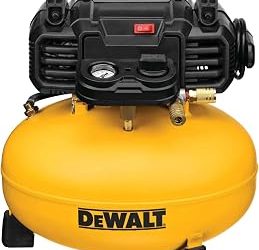
Cordless 0.26-Gallon Tank Compressor for DEWALT 20V
The outlier here and the only one suited to brad nailers and sustained airflow, thanks to a small reservoir and an oil-free pump rated around 65 dB. Quiet enough for indoor trim work in a finished room, which is rare in this category.
AVID POWER 20V Cordless Tire Inflator
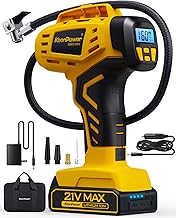
A well-balanced self-contained option at roughly 30 LPM, with a 12V adapter as backup and a clear digital gauge. The bright yellow housing is easy to spot in a trunk organizer, and the footprint is small enough for a closet shelf.
21V Dual Power 160PSI Tire Inflator
The highest ceiling of the compact units at 160 PSI, with auto shut-off and both battery and DC operation. A sensible all-purpose choice for a household juggling car tires, bikes, and sports equipment.
OlarHike 12000mAh Heavy Duty Tire Inflator
Built for larger tires, with a substantial battery and enough output to make SUV, truck, and RV duty realistic rather than aspirational. Heavier than the others, but the runtime justifies the extra weight if your vehicle is bigger than a sedan.
Frequently Asked Questions
Can a battery inflator fill a car tire from flat?
Yes, though it will take several minutes and drain a meaningful share of the battery. Larger-capacity models like the OlarHike handle full inflation more comfortably than compact units designed for topping off.
Will these work with air mattresses and pool floats?
Only with the right nozzle. Tire inflators are high-pressure and low-volume, so they fill slowly. Most include tapered adapters, but a dedicated inflatable pump is faster for guest bedding.
How should I store one at home?
Keep it indoors at moderate temperature rather than in the trunk year-round, since extreme heat and cold shorten lithium battery life. A labeled bin in a hall closet works well.
Is a tank compressor worth it for household use?
If you plan to run nailers or air tools for gallery walls, trim, or furniture projects, yes. For inflation alone, a tankless unit is lighter and easier to store.
Final Thoughts
For most homes, the DEWALT DCC020IB is the safest long-term investment, particularly alongside existing 20V MAX tools. The AVID POWER 20V is the better standalone buy for anyone starting fresh, and the 0.26-gallon cordless tank compressor is the one to choose if your projects involve air tools rather than tires.