Key takeaways
- Throat depth vs. resaw height: Throat depth (8″, 9″, 10″) caps how wide a panel you can swing past the frame; resaw height caps how thick a board you can slice. Curve work lives and dies by throat depth, while anyone milling their own veneer or bookmatched panels should prioritize the taller cutting height.
- Blade speed, and whether it changes: Single-speed saws around 1800–2500 FPM handle softwoods and hardwoods fine. Dual-speed or variable-speed models earn their keep the moment you introduce acrylic, aluminum trim, or PVC, all of which melt or grab at wood speeds.
- Table material and tilt: A cast aluminum or cast iron table stays flat and damps vibration in a way stamped steel never will. A 0–45° tilt is non-negotiable if you plan on beveled edges, angled joinery, or wedge-shaped legs.
- Guide and fence quality: Blade drift is the number one complaint in band saw reviews, and it almost always traces back to sloppy guide bearings or a fence that won’t hold square. Double-sided fence assemblies with a low profile option are a real advantage for resawing.
- Bench footprint and dust management: Benchtop saws are compact but top-heavy. Check the base dimensions against your bench, and confirm there’s a usable dust port — band saws throw a surprising volume of fine sawdust straight down into the cabinet.
What's inside
Curved backs on dining chairs, tapered legs, a walnut cutting board with a soft radius — these are the details that separate furniture you buy from furniture you make. They also happen to be the details a table saw simply cannot produce. The band saw is the quiet workhorse behind almost every organic line in modern woodworking, and yet it’s usually the last machine people bring into a home shop, long after they’ve spent months fighting jigsaws and coping saws to get a clean curve.
The obstacle is rarely enthusiasm. It’s noise: dozens of benchtop models with near-identical spec sheets, wildly inconsistent build quality, and listings that bury the numbers that actually matter. This guide cuts through it. Below you’ll find the benchtop band saws worth considering in 2026, what each one genuinely does well, and a short framework for matching throat capacity, resaw height, and blade speed to the kind of work sitting on your bench right now.
As an Amazon Associate we earn from qualifying purchases.



How to Choose a/an Wood Band Saw (2026)
- Throat depth vs. resaw height: Throat depth (8″, 9″, 10″) caps how wide a panel you can swing past the frame; resaw height caps how thick a board you can slice. Curve work lives and dies by throat depth, while anyone milling their own veneer or bookmatched panels should prioritize the taller cutting height.
- Blade speed, and whether it changes: Single-speed saws around 1800–2500 FPM handle softwoods and hardwoods fine. Dual-speed or variable-speed models earn their keep the moment you introduce acrylic, aluminum trim, or PVC, all of which melt or grab at wood speeds.
- Table material and tilt: A cast aluminum or cast iron table stays flat and damps vibration in a way stamped steel never will. A 0–45° tilt is non-negotiable if you plan on beveled edges, angled joinery, or wedge-shaped legs.
- Guide and fence quality: Blade drift is the number one complaint in band saw reviews, and it almost always traces back to sloppy guide bearings or a fence that won’t hold square. Double-sided fence assemblies with a low profile option are a real advantage for resawing.
- Bench footprint and dust management: Benchtop saws are compact but top-heavy. Check the base dimensions against your bench, and confirm there’s a usable dust port — band saws throw a surprising volume of fine sawdust straight down into the cabinet.
The Best Wood Band Saw (2026)s Reviewed
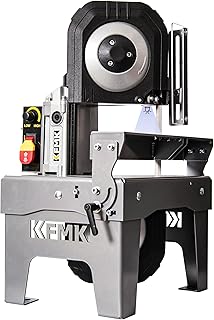
10-Inch Dual-Speed Band Saw, 1/2 HP
The most versatile pick here, thanks to a genuine 1/2 HP motor and two speeds (1515 and 3280 FPM) that let it move between hardwood curves and plastics without complaint. The 10-inch throat gives you meaningful room for larger panels, and the double-sided fence plus miter gauge means less shop-made jigging out of the box.
SEESII Benchtop Band Saw, 8″ Cutting Width
Built for detail work — inlay, small-radius scrollwork, tight template cuts — with a 3-1/8″ cutting height that still handles most furniture stock. The 0–45° tilting worktable is smooth and repeatable, making it a natural fit for anyone building smaller case pieces or decorative accents.
WOODSKIL 9-Inch Band Saw
The best-balanced spec sheet in this group: a cast aluminum table, steel base, 2500 FPM blade speed, and a 3-1/2″ cutting depth in a 9-inch frame. That cast table is the tell — it keeps cuts flat and vibration low, which matters more over a long session than any headline number.
PioneerWorks 8-Inch Bandsaw
A sensible entry point at 1800 FPM with a removable safety key, which is worth real money in a shared or family workspace. Expect to spend a few minutes tuning the guides on arrival; once dialed in, it tracks well through 3/4″ hardwood.
Variable-Speed Metal & Wood Band Saw, 5″ Capacity
The specialist. With a 10-amp motor, 137–472 FPM variable speed, and a liftable worktable, this handles brass hardware stock, aluminum extrusion, and PVC alongside wood — deeply useful if your furniture work involves mixed materials or custom metal detailing.
Frequently Asked Questions
Can a benchtop band saw resaw lumber?
Within limits. Most benchtop models top out around 3 to 3-1/2 inches of cutting height, which covers 4/4 and 8/4 stock but not wide slabs. Use a wide, low-tooth-count blade and feed slowly.
What blade should I start with?
A 1/4″ 6 TPI blade is the most useful all-rounder for furniture work — tight enough for curves, aggressive enough for general ripping. Add a 1/2″ blade later specifically for resawing.
Why is my saw leaving burn marks?
Usually a dull blade, too slow a feed rate, or a fence that isn’t parallel to the blade’s natural drift line. Check drift first, since it’s free to fix.
Do I need a dust collector?
A shop vacuum connected to the dust port handles benchtop volumes well. Fine wood dust is a genuine respiratory concern, so don’t skip it entirely.
Final Thoughts
For most home furniture makers, the 10-Inch Dual-Speed Band Saw is the smartest single purchase — capacity, power, and speed flexibility in one machine. The WOODSKIL 9-Inch is the value standout thanks to its cast aluminum table, while the SEESII benchtop is the right call if your work leans toward small-scale detail and tight curves.