Key takeaways
- Swing and quill travel: Swing is half the distance from the column to the bit, so a 10-inch press reaches 5 inches into a panel. Quill travel matters more for furniture: 2 inches handles most joinery, while 3 inches or more lets you bore deep leg mortises without repositioning.
- Speed range and how you change it: Belt-and-step machines are simple, durable, and cheap to maintain. A variable-frequency drive gives you dial-in control and, critically, lets you drop below 500 RPM for large Forstner bits and metal — a genuine capability difference, not a convenience feature.
- Table tilt, size, and height lock: A 0–45° tilting cast-iron table opens up angled chair legs and splayed stretchers. Check that the height crank is a rack-and-pinion rather than a bare collar clamp; the latter slips under load and makes repeat setups tedious.
- Mass and runout: Cast iron heads and bases absorb vibration that sheet metal transmits into your workpiece. Heavier is steadier, and low spindle runout is what keeps a 1/4-inch hole actually 1/4 inch instead of a rough oval.
- Chuck, lighting, and the honest extras: A quality keyed chuck holds better than a bargain keyless. An LED work light earns its keep on dark walnut; a laser crosshair is helpful but no substitute for a proper fence and stop block.
What's inside
Every home workshop hits the same wall: the moment you commit to building your own casework, floating shelves, or a walnut side table, hand-drilling stops being good enough. A cordless drill wanders. Dowel holes drift out of square, shelf-pin rows lose their line, and hardware that should sit flush ends up proud by a hair you can feel with a fingertip. A bench drill press is the fix, and it is the least glamorous machine that will most visibly improve your finished pieces.
The trouble is that spec sheets for benchtop presses read like a shouting match — amps, horsepower, RPM ranges, lasers, LED lights — with very little said about the things that actually matter to furniture work: quill travel, spindle runout, table rigidity, and how honestly the speed is delivered. This guide cuts through it. Below are the benchtop presses worth your bench space in 2026, what separates them, and how to match one to the kind of work you make.
As an Amazon Associate we earn from qualifying purchases.


How to Choose a Bench Drill Press (2026)
- Swing and quill travel: Swing is half the distance from the column to the bit, so a 10-inch press reaches 5 inches into a panel. Quill travel matters more for furniture: 2 inches handles most joinery, while 3 inches or more lets you bore deep leg mortises without repositioning.
- Speed range and how you change it: Belt-and-step machines are simple, durable, and cheap to maintain. A variable-frequency drive gives you dial-in control and, critically, lets you drop below 500 RPM for large Forstner bits and metal — a genuine capability difference, not a convenience feature.
- Table tilt, size, and height lock: A 0–45° tilting cast-iron table opens up angled chair legs and splayed stretchers. Check that the height crank is a rack-and-pinion rather than a bare collar clamp; the latter slips under load and makes repeat setups tedious.
- Mass and runout: Cast iron heads and bases absorb vibration that sheet metal transmits into your workpiece. Heavier is steadier, and low spindle runout is what keeps a 1/4-inch hole actually 1/4 inch instead of a rough oval.
- Chuck, lighting, and the honest extras: A quality keyed chuck holds better than a bargain keyless. An LED work light earns its keep on dark walnut; a laser crosshair is helpful but no substitute for a proper fence and stop block.
The Best Bench Drill Presses (2026), Reviewed
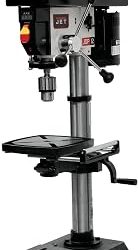
JET JWDP-12 Benchtop Drill Press
The most refined machine here, with a variable-speed head that changes without touching a belt and the kind of fit and finish that makes daily use pleasant rather than tolerable. If you build furniture regularly and want a press you will not outgrow or replace, this is the one to buy once.
VEVOR 12-Inch Benchtop Drill Press
A 1 HP head, 530–3140 RPM variable speed, and a full 12-inch swing make this the best value for mixed wood-and-metal work in a small shop. The laser and LED are useful additions, and the tilting worktable handles angled joinery without shimming.
BUCKTOOL 10-Inch Bench Drill Press
A well-executed 5-speed classic with a genuinely solid cast-iron base and a work light where you actually need it. Belt changes take a moment, but the trade-off is mechanical simplicity that will still be running long after fancier electronics have failed.
10-Inch Variable Speed Drill Press with VFD (White)
The 50–3000 RPM range from its 0.4 kW variable-frequency drive is the widest on this list, and that low end is exactly what large-diameter Forstner bits and brass hardware want. The white finish is a rare bit of visual restraint if your bench lives in a shared space.
8-Inch Benchtop Drill Press, 5-Speed
The compact, budget-conscious entry: 620–3100 RPM across five belt positions, a cast-iron head, and a tilting height-adjustable table. Ideal for shelf pins, dowels, and small-part work where an 8-inch swing is genuinely enough.
Frequently Asked Questions
Is a benchtop press enough for real furniture work?
For most home builders, yes. Benchtop presses handle joinery, hardware, and panel work comfortably. Step up to a floor model like the 13-inch, 7.5-amp variable-speed press only if you routinely bore tall assembled pieces or thick stock.
What speed should I use?
Broadly: faster for small bits and softwoods, slower for large bits, hardwoods, and metal. A 1-inch Forstner in white oak wants a few hundred RPM; a 1/8-inch twist bit in pine is happy at full speed.
Do I need the laser and LED light?
The LED is a real quality-of-life gain on dark timber. The laser is a nice-to-have — accurate repeat holes come from a fence and stop block, not a projected line.
How do I stop it from walking on the bench?
Bolt it down. Every press here has base holes for a reason, and a machine lag-bolted to a solid bench cuts cleaner and quieter than the same machine sitting loose.
Final Thoughts
If budget allows, the JET JWDP-12 is the machine that disappears into your process and simply works, year after year. The VEVOR 12-inch is the smartest value for anyone splitting time between wood and metal, and the BUCKTOOL 10-inch remains the honest, mechanically simple pick for a shop that prizes durability over dials.