Key takeaways
- Rip capacity: The number that quietly decides what you can build. Anything under 24 inches means you’ll be breaking down full sheets with a circular saw first. Around 30 inches lets you rip a 4×8 sheet down the center in one pass — the difference between a weekend project and a workaround.
- Fence quality: Blade accuracy is table stakes; fence accuracy is what separates saws. Look for a rack-and-pinion mechanism that stays parallel when you lock it down. A fence that drifts a sixteenth over 20 inches shows up as a visible gap in every mitered corner you cut.
- Stand and footprint: Rolling stands earn their keep in shared garages — you can wheel the saw out, work, and tuck it back against the wall. If your space is fixed, a benchtop unit on a sturdy bench cuts just as well for less money and less bulk.
- Cut depth at 45 degrees: Almost everyone checks the 90-degree depth and forgets the bevel. Tilting the blade costs you roughly an inch of capacity, which matters the moment you’re cutting a mitered edge on 2x stock.
- Dust collection and guarding: A functional port that fits a shop vac hose keeps fine dust out of your lungs and your sightline clear. Confirm the riving knife and guard are easy to remove and reinstall — hardware that fights you gets left off, and that’s how accidents happen.
What's inside
Buying a first table saw is where a lot of promising home workshops stall out. The listings all read the same — fifteen amps, ten-inch blade, folding stand — and none of them tell you the thing you actually want to know: will this saw cut a straight, repeatable line in a plywood sheet on a Saturday afternoon in a one-car garage? Spec sheets reward the manufacturer, not the buyer. Meanwhile the real decision points are quieter: how square the fence stays after it’s been knocked around, whether the stand rolls over a door threshold, how much of the table you lose when you tilt the blade.
This guide is built around the projects most people actually start with — floating shelves, a plywood media console, trim replacement, a bed frame with clean shoulders. Six saws, ranging from a jobsite workhorse that will outlast your first three projects down to a benchtop unit for model-scale work. Below each pick you’ll find what the saw is genuinely good at, where it asks for patience, and who should skip it. No brand loyalty, no padding.
As an Amazon Associate we earn from qualifying purchases.



How to Choose a Starter Table Saw (2026)
- Rip capacity: The number that quietly decides what you can build. Anything under 24 inches means you’ll be breaking down full sheets with a circular saw first. Around 30 inches lets you rip a 4×8 sheet down the center in one pass — the difference between a weekend project and a workaround.
- Fence quality: Blade accuracy is table stakes; fence accuracy is what separates saws. Look for a rack-and-pinion mechanism that stays parallel when you lock it down. A fence that drifts a sixteenth over 20 inches shows up as a visible gap in every mitered corner you cut.
- Stand and footprint: Rolling stands earn their keep in shared garages — you can wheel the saw out, work, and tuck it back against the wall. If your space is fixed, a benchtop unit on a sturdy bench cuts just as well for less money and less bulk.
- Cut depth at 45 degrees: Almost everyone checks the 90-degree depth and forgets the bevel. Tilting the blade costs you roughly an inch of capacity, which matters the moment you’re cutting a mitered edge on 2x stock.
- Dust collection and guarding: A functional port that fits a shop vac hose keeps fine dust out of your lungs and your sightline clear. Confirm the riving knife and guard are easy to remove and reinstall — hardware that fights you gets left off, and that’s how accidents happen.
The Best Starter Table Saws (2026) Reviewed
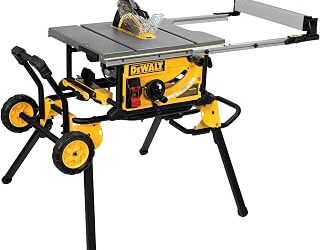
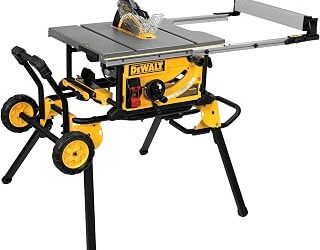
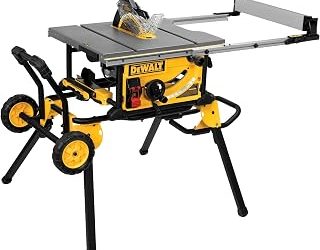
DEWALT DWE7491RS 10-Inch with Rolling Stand
The default recommendation for good reason: a 32-1/2-inch rip capacity handles full sheet goods, and the rack-and-pinion fence holds square through years of being loaded in and out of a truck bed. It’s the heaviest saw here and priced accordingly, but it’s the one you won’t outgrow.
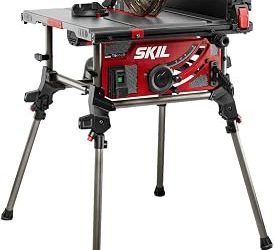
SKIL TS6307-00 Portable Jobsite Saw
SKIL’s standout feature is a foot-activated stand that deploys without wrestling, plus a rack-and-pinion fence that punches above its price bracket. Slightly less rip capacity than the DEWALT, and a strong value if you’re not ripping full sheets weekly.
Evolution R10TBLX Jobsite Saw
Ships with a zero-clearance throat plate and a dado plate included — accessories you’d otherwise buy separately, and the zero-clearance insert meaningfully reduces tearout on veneered plywood. The 26-inch rip capacity is the tradeoff for a competitive package price.
DEWALT DWE7485 8-1/4-Inch Compact
The smart pick for tight spaces and apartment-adjacent workshops. The 8-1/4-inch blade trims cut depth to roughly 2-1/2 inches, so thick hardwood is out, but for cabinet parts, trim, and plywood it’s precise and genuinely liftable by one person.
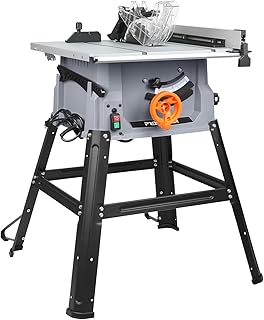
Prostormer 10-Inch Table Saw with Stand
The most affordable full-size entry here, with a 10-inch blade, 5000 RPM motor, and 45-degree bevel. Expect to spend an hour dialing in the fence and blade alignment out of the box — do that, and it cuts respectably for occasional DIY work.
Frequently Asked Questions
Is a 10-inch blade necessary, or will 8-1/4 inches do?
For most furniture work, 8-1/4 inches is sufficient — it clears 3/4-inch plywood and standard 2x lumber. Step up to 10 inches if you plan to cut thick hardwood, rip 4×4 posts, or use a dado stack.
What should I buy alongside the saw?
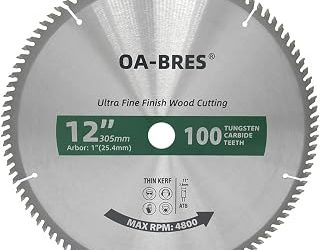
A quality 40-tooth combination blade (stock blades are usually the weak link), push blocks, a shop vac, and hearing protection. A crosscut sled is the best afternoon you’ll ever spend improving your cut quality.
Do I need a cabinet saw eventually?
Most home builders never do. A well-tuned jobsite saw with a good blade and reliable fence produces furniture-grade cuts; a cabinet saw buys you power, mass, and less vibration, which matters for volume work.
What about the mini precision saw?
The 96W mini table saw is a different tool entirely — built for balsa, PCB, acrylic, and model-scale parts with a 1/2-inch cut depth. Excellent for miniatures and hobby work, unsuitable for furniture.
Final Thoughts
If your budget allows one good purchase, the DEWALT DWE7491RS is the saw that ends the search — full sheet capacity, a fence that stays honest, and a stand that makes a shared garage workable. Tight on space or lifting it solo? The compact DWE7485 gives up depth, not accuracy. And the SKIL TS6307-00 remains the sharpest value of the group for anyone easing into the craft.