Key takeaways
- Match the length to your saw, not the listing: 93″ and 93-1/2″ blades suit most 14″ floor-standing saws, while 64-1/2″ is the standard for portable 4×6 cutoff saws and benchtop models like the Wen 3970. Check the manual before ordering, as a half inch is enough to make a blade unusable.
- Choose pitch by wall thickness: Keep at least three teeth engaged in the cut at all times. Thin-wall tubing and angle under 1/8″ want 24 TPI. General mixed work sits comfortably at 10/14. Solid bar and heavier sections cut faster with 8/12 or 5/8.
- Insist on bi-metal M42, not carbon steel: Carbon blades are cheaper and fine for softwood, but they lose their edge almost immediately in steel. M42 handles the friction heat that metal cutting generates and lasts several times longer per dollar.
- Favor variable tooth spacing: Blades marked 10/14 or 8/12 vary the gap between teeth to break up harmonic vibration. The practical result is a quieter cut, less chatter through the workpiece, and a cleaner edge on hollow sections.
- Slow the saw down: Metal wants roughly 100 to 250 surface feet per minute, a fraction of wood speed. If your saw has a single speed rated for timber, expect shorter blade life and consider a step-pulley or variable-speed conversion.
What's inside
Steel has quietly become a staple in residential interiors: hairpin legs on a walnut bench, a blackened tube frame around a plaster coffee table, brass-toned uprights on an open shelving run. What nobody mentions in the mood boards is the moment you actually have to cut the stock. A wood blade in a metal cut chatters, work-hardens the material, and leaves a burred edge that no amount of filing makes look intentional. The teeth strip within minutes, and the piece you were making becomes scrap.
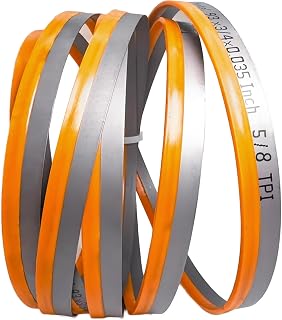
This guide covers the band saw blades that hold up to mild steel, stainless, aluminum, and thin-wall tubing in a home shop or studio setting. Every option below is bi-metal M42, which pairs cobalt high-speed-steel teeth to a flexible alloy backing, so the blade resists heat without snapping under tension. We’ve grouped picks by length, tooth pitch, and the kind of material a furniture maker realistically works with, then answered the questions that come up once the blade is on the wheels.
As an Amazon Associate we earn from qualifying purchases.


How to Choose a/an Band Saw Blade For Metal (2026)
- Match the length to your saw, not the listing: 93″ and 93-1/2″ blades suit most 14″ floor-standing saws, while 64-1/2″ is the standard for portable 4×6 cutoff saws and benchtop models like the Wen 3970. Check the manual before ordering, as a half inch is enough to make a blade unusable.
- Choose pitch by wall thickness: Keep at least three teeth engaged in the cut at all times. Thin-wall tubing and angle under 1/8″ want 24 TPI. General mixed work sits comfortably at 10/14. Solid bar and heavier sections cut faster with 8/12 or 5/8.
- Insist on bi-metal M42, not carbon steel: Carbon blades are cheaper and fine for softwood, but they lose their edge almost immediately in steel. M42 handles the friction heat that metal cutting generates and lasts several times longer per dollar.
- Favor variable tooth spacing: Blades marked 10/14 or 8/12 vary the gap between teeth to break up harmonic vibration. The practical result is a quieter cut, less chatter through the workpiece, and a cleaner edge on hollow sections.
- Slow the saw down: Metal wants roughly 100 to 250 surface feet per minute, a fraction of wood speed. If your saw has a single speed rated for timber, expect shorter blade life and consider a step-pulley or variable-speed conversion.
The Best Band Saw Blade For Metal (2026)s Reviewed
Imachinist S933414 M42 93″ x 3/4″ x 10/14 TPI
The most versatile blade on this list and the one we’d keep mounted by default. The 10/14 variable pitch moves confidently through 1/4″ flat bar and square tube alike, and the 3/4″ width tracks straight enough for long rip cuts on stock you plan to weld into a visible frame.
Imachinist S93121224 M42 93-1/2″ x 1/2″ x 24 TPI
A fine-pitch blade for delicate work: brass rod, aluminum extrusion, thin-wall tubing for lighting or slim table bases. The narrower 1/2″ body also navigates tighter radii, which helps when you’re shaping curved brackets rather than cutting to length.
FOXBC 93″ x 3/4″ x 10/14 TPI Bi-Metal M42
Functionally a close cousin to the Imachinist 10/14, with weld quality that has been consistent in our experience. Worth ordering if you want a spare in the drawer from a second supplier, since band saw downtime tends to arrive mid-project.
Imachinist S9334812 M42 93″ x 3/4″ x 8/12 TPI
Step up to this when your material gets thicker: solid round bar, heavy angle, structural offcuts for a bench base. The coarser variable pitch clears chips faster, so the cut runs cooler and you spend less time leaning on the workpiece.
FOXBC 64-1/2″ x 1/2″ x 24 TPI, 2-Pack
The right answer for portable 4×6 cutoff saws and the Wen 3970, where 93″ blades simply won’t fit. The 24 TPI pitch pairs naturally with the tubing and sheet most benchtop owners are cutting, and the two-pack means a broken blade is an inconvenience rather than a stopped project.
Frequently Asked Questions
Can I cut metal on a standard woodworking band saw?
Often yes, provided you can lower the blade speed. Fit a bi-metal blade, reduce to metal-appropriate SFM if your saw allows, and clear all sawdust first, since hot sparks and fine wood debris are a genuine fire risk.
What does 10/14 TPI actually mean?
It’s a variable pitch: tooth spacing alternates between 10 and 14 teeth per inch across the blade. That irregularity cancels resonance, which reduces noise and gives a smoother finish than a uniform pitch of the same average density.
Do I need cutting fluid?
Not for short cuts in mild steel or aluminum, but a wax stick or light cutting oil noticeably extends blade life on stainless and on any cut lasting more than a few seconds. Aluminum in particular tends to load the gullets without lubrication.
Why did my new blade break so quickly?
Usually tension or break-in. Tension to your saw’s spec, then run the first few cuts at reduced feed pressure to hone the fresh teeth gradually. Twisting the workpiece mid-cut and over-tight guide bearings are the other common culprits.
Final Thoughts
For most furniture and lighting work on a 14″ saw, the Imachinist 93″ 10/14 is the blade to start with, with the 8/12 variant on hand for heavier bar stock. If you’re working thin tubing or running a benchtop saw, the FOXBC 64-1/2″ 24 TPI two-pack is the practical, low-drama choice.