Key takeaways
- Length is non-negotiable: Measure your existing blade or check the manual before anything else. A 10-inch Craftsman or Rikon typically takes 70-1/2 inches, most 14-inch cast-iron saws take 93-1/2 inches, and larger stationary machines run 80 inches or more. Guessing here wastes money.
- Width sets your radius: Wide blades track straight and resist deflection; narrow blades turn. A 3/4-inch blade is a resawing tool, 1/2 inch is the versatile middle ground for furniture, and anything tighter than a 2-inch radius wants 1/4 inch or less.
- Match TPI to stock thickness: Keep three to six teeth in the cut. Roughly 3–4 TPI clears chips in thick hardwood without loading up, while 6 TPI leaves a finer face on stock under an inch. Too many teeth in deep cuts means heat, smoke, and hardened resin.
- Steel and tooth set matter more than price: Hardened-tooth carbon blades hold an edge far longer than plain flexback and cost little extra. Low-tension silicon steel blades run truer on lighter machines that can’t crank down hard.
- Respect your machine’s tension limit: A benchtop saw that can’t properly tension a 3/4-inch blade will produce worse cuts than a well-tensioned 1/2-inch one. Buy for the saw you own, not the one you want.
What's inside
A band saw is really just a frame that holds a blade in tension. The blade does all the work, which is why two woodworkers with identical 14-inch saws can get wildly different results: one pulls off a clean bookmatched panel with a glue-ready face, the other fights barrel cuts, burn streaks, and a kerf that wanders off the line halfway through a walnut slab. Most of that gap comes down to picking a blade by length alone and ignoring width, tooth geometry, and how much tension the machine can actually hold.
This guide covers six blades worth stocking for furniture work, from tight-radius chair parts to full-height resawing, plus one option for anyone running a portable mill. Below you’ll find how to read the length-width-TPI spec, which combination suits which cut, and honest notes on where each blade fits in a small shop.
As an Amazon Associate we earn from qualifying purchases.

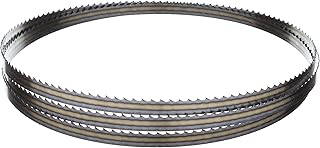


How to Choose a Band Saw Blades For Wood (2026)
- Length is non-negotiable: Measure your existing blade or check the manual before anything else. A 10-inch Craftsman or Rikon typically takes 70-1/2 inches, most 14-inch cast-iron saws take 93-1/2 inches, and larger stationary machines run 80 inches or more. Guessing here wastes money.
- Width sets your radius: Wide blades track straight and resist deflection; narrow blades turn. A 3/4-inch blade is a resawing tool, 1/2 inch is the versatile middle ground for furniture, and anything tighter than a 2-inch radius wants 1/4 inch or less.
- Match TPI to stock thickness: Keep three to six teeth in the cut. Roughly 3–4 TPI clears chips in thick hardwood without loading up, while 6 TPI leaves a finer face on stock under an inch. Too many teeth in deep cuts means heat, smoke, and hardened resin.
- Steel and tooth set matter more than price: Hardened-tooth carbon blades hold an edge far longer than plain flexback and cost little extra. Low-tension silicon steel blades run truer on lighter machines that can’t crank down hard.
- Respect your machine’s tension limit: A benchtop saw that can’t properly tension a 3/4-inch blade will produce worse cuts than a well-tensioned 1/2-inch one. Buy for the saw you own, not the one you want.
The Best Band Saw Blades For Wood (2026) Reviewed
AYAO 70-1/2″ x 1/2″ x 4 TPI Hardened Tooth
Purpose-built for 10-inch saws like the Craftsman 921400 and Rikon 10-305, this is the sensible everyday blade for a compact shop. The hardened teeth stay sharp through hardwood far longer than the factory blade most of these saws ship with, and 1/2 inch at 4 TPI handles both gentle curves and light resawing.
Timber Wolf 1/2″ x 72″, 4 TPI
Timber Wolf’s low-tension silicon steel is the classic upgrade for saws with modest tensioning hardware, and it shows up as noticeably quieter cuts and less drift. Confirm you need 72 inches rather than 70-1/2, since the two are easy to mix up.
Timber Wolf 70-1/2″ x 1/2″ x 4 TPI
The same silicon steel formula in the standard 10-inch saw length, and the one I’d reach for on figured maple or cherry where surface quality decides whether you sand or scrape. It’s a finesse blade that rewards proper setup and slow feed rates.
BOSCH BS80-6H 80″ 6 TPI
Built for larger stationary saws, the 6 TPI count leaves a cleaner edge on thinner stock, which makes it a strong pick for casework parts, drawer components, and joinery cleanup. Skip it for deep resawing, where the tighter tooth spacing will struggle to clear chips.
FOXBC 93-1/2″ x 3/4″ x 4 TPI
If you own a 14-inch Delta, Jet, Grizzly, Rikon, or Ridgid, this is the resawing blade to keep on the wheels. The 3/4-inch width resists deflection through tall stock, producing the consistent veneers and bookmatched panels that make a tabletop worth looking at.
Frequently Asked Questions
How do I find the right blade length?
Check the manual first, or measure your current blade by laying it flat in a loop and measuring the circumference. If neither is available, rotate the wheels to their mid-position, measure center-to-center distance, double it, and add the circumference of one wheel.
What TPI is best for resawing?
Three to four TPI. Deep cuts generate a lot of sawdust, and widely spaced teeth with a deep gullet carry it out of the kerf instead of packing it in and overheating the blade.
Are low-tension blades worth it?
On lighter or older saws, yes. Silicon steel blades cut accurately at lower tension, which reduces stress on bearings and wheel bushings while still tracking straight.
Do I need a sawmill blade like the 158-inch DoubleHard?
Only if you run a portable bandmill. Those 158-inch five-packs are for breaking down logs into lumber, not for anything happening on a shop-floor band saw.
Final Thoughts
For most furniture makers, two blades cover almost everything: the FOXBC 93-1/2″ x 3/4″ for resawing on a 14-inch saw, and a 1/2-inch 4 TPI for general shaping. If you’re on a 10-inch machine, the AYAO hardened-tooth blade is the practical daily driver, with the Timber Wolf 70-1/2″ as the finish-cut upgrade when the grain deserves it.