Key takeaways
- Airflow over pressure: Nearly every unit claims 150 PSI, so that number tells you little. CFM is what determines whether four 35-inch tires take twelve minutes or forty. Dual-cylinder pumps in the 10 to 12.35 ft³/min range are the sweet spot for larger truck tires; 7 CFM is plenty for stock SUVs and mid-size trucks.
- Duty cycle and heat: A compressor that overheats halfway through the third tire is worse than useless. Look for a stated 100% duty cycle or at minimum a thermal-protection spec, and give the motor housing airflow while it runs.
- Power delivery: Direct battery clamps handle high-draw dual-cylinder pumps properly. Cigarette-lighter plugs are limited by fuse ratings and will bottleneck anything serious. Cordless models trade some raw speed for zero setup.
- Controls and shut-off: Digital presets with auto shut-off let you set a target PSI and walk away — genuinely useful when you are airing up four tires and want to pack the cooler at the same time.
- Storage footprint: A hard case with molded compartments keeps hoses, chucks, and clamps together instead of migrating around your cargo area. Measure your under-seat or rear-cubby space before buying; the biggest pumps are genuinely bulky.
What's inside
Deflating tires for a sand run is the easy part. The reckoning comes at the trailhead exit, sun dropping, four tires sitting at 15 PSI, and a gas-station pump twenty miles of pavement away. Most people discover the gap in their kit exactly once, and it is a long, slow drive home on soft rubber. A capable compressor is not an accessory in that moment; it is the thing that turns a two-hour recovery into a fifteen-minute stop.
We approach garage gear the same way we approach anything that lives in a home: it should work hard, store cleanly, and not become clutter you resent. This guide covers what actually matters in a 12V off-road compressor for 2026 — real airflow versus marketing airflow, duty cycle, how it clamps to a battery, and how it packs away between trips. Below are the models worth your money, plus the specs to check before you commit.
As an Amazon Associate we earn from qualifying purchases.



How to Choose a Off Road Air Compressor (2026)
- Airflow over pressure: Nearly every unit claims 150 PSI, so that number tells you little. CFM is what determines whether four 35-inch tires take twelve minutes or forty. Dual-cylinder pumps in the 10 to 12.35 ft³/min range are the sweet spot for larger truck tires; 7 CFM is plenty for stock SUVs and mid-size trucks.
- Duty cycle and heat: A compressor that overheats halfway through the third tire is worse than useless. Look for a stated 100% duty cycle or at minimum a thermal-protection spec, and give the motor housing airflow while it runs.
- Power delivery: Direct battery clamps handle high-draw dual-cylinder pumps properly. Cigarette-lighter plugs are limited by fuse ratings and will bottleneck anything serious. Cordless models trade some raw speed for zero setup.
- Controls and shut-off: Digital presets with auto shut-off let you set a target PSI and walk away — genuinely useful when you are airing up four tires and want to pack the cooler at the same time.
- Storage footprint: A hard case with molded compartments keeps hoses, chucks, and clamps together instead of migrating around your cargo area. Measure your under-seat or rear-cubby space before buying; the biggest pumps are genuinely bulky.
The Best Off Road Air Compressors (2026) Reviewed
ALL-TOP Dual Cylinder 12V Kit (12.35 ft³/Min)
This is the benchmark for anyone running oversized tires — the dual-cylinder head moves serious air, and the included hose length and battery clamps mean you are not repositioning the truck mid-job. It is heavy and it is loud, and both are the price of that airflow.
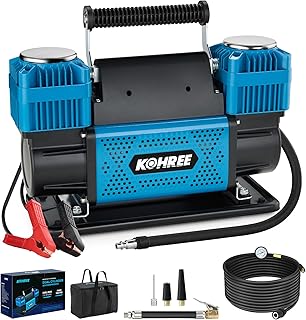
Kohree 12V Dual Cylinder Air Compressor
Matches the 12.35 ft³/min output at a friendlier price, with solid build quality and a case that keeps the kit organized. A strong value pick if you want dual-cylinder speed without paying a premium for the name.
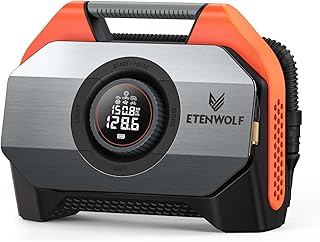
ETENWOLF VORTEX S6 Cordless Tire Inflator
The 19200mAh pack and 100% duty cycle make this the most convenient unit here — no clamps, no hood popping, and the LED backlight earns its place during after-dark airups. Best suited to moderate tire sizes and top-up duty rather than airing four 37s from single digits.
Off-road 12V Inflator with Digital Preset (10.6 CFM)
The preset-and-walk-away workflow is the standout feature: dial in your street pressure, connect, and it stops on its own. At 10.6 CFM it sits just below the dual-cylinder heavyweights while being noticeably easier to stow.
ALL-TOP 12V Portable Inflator (7.06 CFM)
The right call for stock-to-mildly-lifted SUVs, overland trailers, and RV duty, where 7.06 CFM is entirely sufficient. Same rugged case and clamp setup as its bigger sibling in a package that actually fits under a rear seat.
Frequently Asked Questions
How much CFM do I actually need?
For tires up to 33 inches, 7 CFM is comfortable. Between 33 and 35 inches, aim for 10 CFM. Above that, or if you air down frequently, go dual-cylinder at 12 CFM and up.
Can I run one of these from the cigarette lighter?
Only the smaller units, and even then you risk popping a fuse. Any dual-cylinder compressor should connect directly to the battery terminals with the supplied clamps.
Should the engine be running during airup?
Yes. High-draw pumps pull enough current to drain a battery meaningfully over four tires, and idling keeps the alternator supplying the load.
Is a cordless model good enough for off-road use?
For top-ups, trailer tires, and moderate airing up, absolutely. For repeatedly bringing four large tires from 12 to 35 PSI, a hardwired dual-cylinder pump is faster and less likely to need a recharge mid-trip.
Final Thoughts
If you run big tires and air down often, the ALL-TOP Dual Cylinder 12.35 ft³/Min kit is the one to buy, with the Kohree dual-cylinder close behind at better value. For lighter duty, quick top-ups, and anyone who would rather skip the battery clamps entirely, the ETENWOLF VORTEX S6 is the most livable option on this list.