Key takeaways
- CFM over PSI: Nearly every unit claims 150 PSI, but airflow determines speed. Look for 2–3 CFM for 31-inch tires, and 7 CFM or more if you’re running 35s or a full-size truck. PSI ratings alone tell you almost nothing about how long you’ll be standing there.
- Duty cycle: This is the spec that separates trail tools from toys. A 100% duty cycle or dual-cylinder design means you can inflate all four tires back to back without waiting for the motor to cool.
- Power source: Direct-to-battery clamps deliver the most current and the fastest fills. Cordless models trade some speed for freedom from the engine bay, which matters if you already own a battery platform.
- Hose length and fittings: Anything under 16 feet means repositioning the vehicle. Look for braided hose, brass couplers, and a screw-on chuck that won’t leak while you walk away.
- Storage and case: A molded bag with cut-outs for the hose and clamps keeps everything together and keeps your gear drawer from turning into a tangle. Cheap nylon sacks fail first.
What's inside
Airing down is the easy part. You drop to 15 PSI at the trailhead, float over slickrock all afternoon, and then reality arrives: four tires, a long stretch of pavement ahead, and whatever compressor you tossed in the cargo area last spring. The wrong one turns a twenty-minute reset into an hour of listening to a motor labor and shut down on thermal overload. The right one is quietly one of the most useful objects you own — the kind of well-made tool that earns its shelf space in a garage you actually care about.
We look at gear the same way we look at a chair or a light fixture: build quality, honest materials, and whether it still works beautifully on year five. This guide covers portable 12V off-road compressors and cordless inflators worth keeping, from dual-cylinder units that refill 35-inch tires in minutes to compact battery pumps that live in a door pocket. Below you’ll find what actually matters in a spec sheet, followed by hands-on notes on the five best options for 2026.
As an Amazon Associate we earn from qualifying purchases.




How to Choose a Air Compressor For Off Roading (2026)
- CFM over PSI: Nearly every unit claims 150 PSI, but airflow determines speed. Look for 2–3 CFM for 31-inch tires, and 7 CFM or more if you’re running 35s or a full-size truck. PSI ratings alone tell you almost nothing about how long you’ll be standing there.
- Duty cycle: This is the spec that separates trail tools from toys. A 100% duty cycle or dual-cylinder design means you can inflate all four tires back to back without waiting for the motor to cool.
- Power source: Direct-to-battery clamps deliver the most current and the fastest fills. Cordless models trade some speed for freedom from the engine bay, which matters if you already own a battery platform.
- Hose length and fittings: Anything under 16 feet means repositioning the vehicle. Look for braided hose, brass couplers, and a screw-on chuck that won’t leak while you walk away.
- Storage and case: A molded bag with cut-outs for the hose and clamps keeps everything together and keeps your gear drawer from turning into a tangle. Cheap nylon sacks fail first.
The Best Air Compressor For Off Roading (2026)s Reviewed
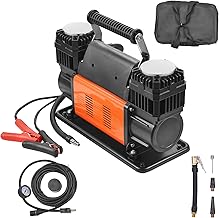
ALL-TOP Dual Cylinder 12V Kit (12.35 CFM)
This is the benchmark for serious rigs — 12.35 CFM through twin cylinders means 37-inch tires come back to street pressure faster than you can coil the hose. The all-metal build, generous braided line, and honest battery clamps make it the pick for anyone running big meats on a heavy 4×4 or RV.
VEVOR 10.6 CFM Heavy Duty Compressor
VEVOR undercuts most dual-cylinder rivals while still delivering roughly 30-second-per-tire inflation on mid-size trucks. The included adapter set covers everything from air lockers to inflatables, and the carry case is better organized than the price suggests.
ETENWOLF VORTEX S6 Cordless Inflator
A 19,200mAh pack, dual cylinders, and a true 100% duty cycle make this the most convenient way to air up without popping the hood. The LED backlight and clean orange housing also make it the rare tool you don’t mind leaving visible on a shelf.
ALL-TOP 12V Portable Inflator (7.06 CFM)
The smaller ALL-TOP is the sweet spot for stock-to-33-inch setups: still a single powerhouse motor, still direct-to-battery, but noticeably lighter and easier to stow. If your tires are under 34 inches, the extra CFM of the dual-cylinder model is money you don’t need to spend.
DEWALT 20V MAX Tire Inflator (DCC020IB)
Best in class for automatic shut-off accuracy, and if you already own DEWALT 20V batteries it’s the most practical everyday inflator here. It’s a top-off tool rather than a trail air-up machine — excellent for pressure checks, slow for going from 12 to 35 PSI on four large tires.
Frequently Asked Questions
How much CFM do I actually need?
Match it to tire size: 2–3 CFM handles 31-inch tires acceptably, 5–7 CFM is comfortable for 33s, and 10 CFM or more is worth it for 35-inch tires and up. More airflow simply means less standing around.
Can a cordless inflator handle off-road use?
The good ones can. Look for dual cylinders and a stated 100% duty cycle, like the VORTEX S6 — single-cylinder cordless pumps will overheat before the fourth tire.
Should I wire it to the battery or use a 12V socket?
Battery clamps, always, for anything above 2 CFM. Cigarette-lighter sockets are typically fused at 10–15 amps and can’t feed a high-output compressor without tripping.
Do these work with air lockers or air tools?
They can seat beads and run small tools, but they’re not tank-fed systems. For consistent locker actuation, pair a high-CFM unit with a small air tank.
Final Thoughts
For big tires and a rig you take seriously, the ALL-TOP Dual Cylinder Kit is the one to buy and stop thinking about. The VEVOR 10.6 CFM delivers nearly the same speed for less, and the ETENWOLF VORTEX S6 is the smartest choice if you’d rather skip the clamps entirely.