Key takeaways
- Inner diameter: A 1/4-inch bore covers brad nailers, tire inflation, blow guns, and most household air tools. Step up to 3/8-inch if you run an impact wrench, framing nailer, or anything that gulps volume, since the wider bore prevents pressure drop over distance.
- Material: Hybrid polymer and polyurethane are the two worth your money. Hybrid stays supple in cold and lies flat without coil memory; polyurethane is the lightest option and resists abrasion well. Rubber is durable but heavy, and standard PVC turns rigid and awkward in winter.
- Length versus storage: Longer is not automatically better. A 25-foot hose in a single-bay garage stores easily on a wall hook and stays out of your walking path. Reach for 50 or 100 feet only if you’re crossing a driveway or working on a vehicle far from the outlet.
- Fittings: Solid brass fittings thread cleanly and resist corrosion in humid spaces. Look for integrated bend restrictors at both ends — that’s where nearly every hose eventually fails, and a restrictor buys years.
- Pressure rating: 300 PSI working pressure is the sensible baseline for home compressors, which typically top out around 150. The headroom means the hose isn’t operating anywhere near its limit.
What's inside
Air hoses are the unglamorous infrastructure of a well-run home. They live in the garage, the basement workshop, the corner of the mudroom where the bikes lean — and they get judged almost entirely on how much they frustrate you. The wrong one coils into a stubborn spiral memory, stiffens the moment temperatures drop below fifty, kinks behind a workbench leg, and drags a slick of PVC residue across whatever it touches. For anyone treating the utility side of a home with the same intentionality as the living side, that friction adds up fast.
This guide looks at air compressor hoses the way we’d assess any working object in a considered home: how it handles, how it stores, how it ages. We’ve focused on six hoses spanning recoil, hybrid polymer, and reinforced polyurethane builds in the lengths most homeowners actually need — 25, 50, and 100 feet — with notes on fittings, cold-weather behavior, and which diameter suits your tools. No filler, no hoses that only make sense on a commercial job site.
As an Amazon Associate we earn from qualifying purchases.



How to Choose a/an Air Hose For Air Compressor (2026)
- Inner diameter: A 1/4-inch bore covers brad nailers, tire inflation, blow guns, and most household air tools. Step up to 3/8-inch if you run an impact wrench, framing nailer, or anything that gulps volume, since the wider bore prevents pressure drop over distance.
- Material: Hybrid polymer and polyurethane are the two worth your money. Hybrid stays supple in cold and lies flat without coil memory; polyurethane is the lightest option and resists abrasion well. Rubber is durable but heavy, and standard PVC turns rigid and awkward in winter.
- Length versus storage: Longer is not automatically better. A 25-foot hose in a single-bay garage stores easily on a wall hook and stays out of your walking path. Reach for 50 or 100 feet only if you’re crossing a driveway or working on a vehicle far from the outlet.
- Fittings: Solid brass fittings thread cleanly and resist corrosion in humid spaces. Look for integrated bend restrictors at both ends — that’s where nearly every hose eventually fails, and a restrictor buys years.
- Pressure rating: 300 PSI working pressure is the sensible baseline for home compressors, which typically top out around 150. The headroom means the hose isn’t operating anywhere near its limit.
The Best Air Hose For Air Compressor (2026)s Reviewed
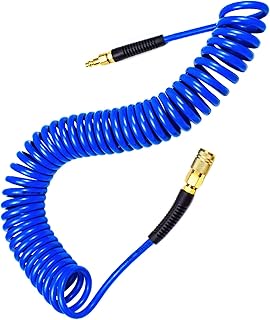
YOTOO Polyurethane Recoil Air Hose, 1/4″ x 25′
The recoil design retracts on its own, which makes it the tidiest option for anyone who resents coiling hose by hand. Best suited to short-reach tasks near the compressor — tire top-offs, trim work — since the spring tension does create mild drag at full extension.
Heavy Duty Hybrid Air Hose, 1/4 in x 25 ft
A well-judged everyday hose: light enough to carry one-handed, flexible in cold weather, and fitted with solid brass male ends plus bend restrictors. The 25-foot length and 1/4-inch bore make it the right default for a single-car garage running light pneumatic tools.
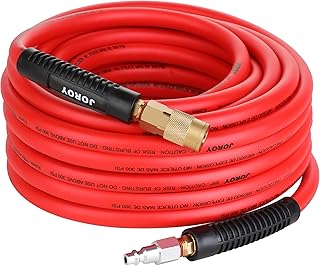
Hybrid Air Hose, 3/8-Inch x 50 Feet
The wider 3/8-inch bore keeps airflow steady across fifty feet, so impact wrenches and framing nailers don’t stutter mid-job. It ships with a brass coupler and plug, meaning you can connect and work without a separate hardware run.
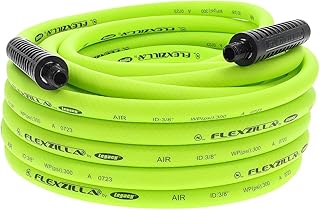
Flexzilla Air Compressor Hose, 3/8 in. x 50 ft.
Flexzilla’s hybrid polymer remains the benchmark for genuine no-kink behavior — it lies flat from the first uncoiling and stays pliable in the cold better than anything else at this price. The ZillaGreen colorway also happens to be a real safety feature in a dim garage.
25FT Reinforced Polyurethane Braided Air Hose
Braided reinforcement under a polyurethane jacket gives this one excellent abrasion resistance for a hose that gets dragged across concrete. Quick-connect fittings come installed, and at 25 feet it’s light enough that fatigue never enters the picture.
Frequently Asked Questions
Does hose length affect air pressure?
Yes. Every additional length introduces friction loss, and the effect is more pronounced on narrow 1/4-inch hose. At 100 feet, expect a measurable drop — which is why longer runs benefit from a 3/8-inch bore.
Is hybrid polymer actually better than rubber?
For home use, generally yes. Hybrid weighs roughly a third less, resists coil memory, and stays flexible in cold. Rubber still wins on extreme heat and abrasion tolerance in industrial settings.
What do bend restrictors do?
They’re the tapered sleeves where the hose meets each fitting. They spread stress over a longer span instead of letting it concentrate at one point, which is where hoses typically split.
How should I store a hose long term?
Drain residual moisture, coil it loosely in wide loops, and hang it on a broad hook rather than a narrow nail. Keep it out of direct sun, which degrades polymer jackets over time.
Final Thoughts
For most homes, the 25-foot hybrid in 1/4-inch is the honest answer — light, cold-tolerant, and easy to store. If your tools demand more volume or your workspace sprawls, the Flexzilla 3/8-inch x 50 ft. is the one that earns its premium through sheer handling quality, with the YOTOO recoil hose making a strong case for anyone who wants zero cleanup after a five-minute job.