Key takeaways
- Duty rating: Add your body weight, clothing, tools, and whatever you’re carrying up. Type IA (300 lbs) suits most households; Type IAA (375 lbs) gives real margin if you’ll be hauling paint cans or a cordless tool kit.
- Working height vs. total length: Your usable reach is roughly the ladder’s height minus three to four feet, since the top rungs are off-limits. A 16-foot ladder realistically services a 12-foot ceiling, not a 16-foot one.
- Collapsed footprint: Telescoping models retract to around three feet and stand upright in a closet or fit behind a car seat. Traditional extension ladders need wall or garage-rafter storage — plan for it before you buy.
- Material: Aluminum is lighter and easier to reposition solo. Fiberglass is non-conductive and the only responsible choice near service drops, panels, or any wiring you can’t fully rule out.
- Stability hardware: Stabilizer bars widen the base and stop side-to-side sway; leg levelers correct for sloped driveways and stair treads. On uneven ground, these features matter more than raw height.
What's inside
Double-height entryways, stairwell gallery walls, and oversized pendants all share a design blind spot: the moment you actually need to reach them. A room can be styled to perfection at eye level and still leave you improvising with a dining chair when a bulb burns out fourteen feet up. That improvisation is how most home accidents happen, and it is also why so many beautifully finished spaces end up with dusty crown molding and cobwebbed light fixtures nobody wants to admit are there.
An extension ladder is infrastructure for the way modern homes are built — tall, open, and vertical. The trick is choosing one that earns its storage space. This guide breaks down the specs that genuinely matter (duty rating, collapsed footprint, stabilizer design, material), then walks through the ladders worth considering in 2026, from compact telescoping models made for apartment closets to full-size fiberglass workhorses for anyone touching an exterior wall.
As an Amazon Associate we earn from qualifying purchases.


How to Choose an Extension Ladder (2026)
- Duty rating: Add your body weight, clothing, tools, and whatever you’re carrying up. Type IA (300 lbs) suits most households; Type IAA (375 lbs) gives real margin if you’ll be hauling paint cans or a cordless tool kit.
- Working height vs. total length: Your usable reach is roughly the ladder’s height minus three to four feet, since the top rungs are off-limits. A 16-foot ladder realistically services a 12-foot ceiling, not a 16-foot one.
- Collapsed footprint: Telescoping models retract to around three feet and stand upright in a closet or fit behind a car seat. Traditional extension ladders need wall or garage-rafter storage — plan for it before you buy.
- Material: Aluminum is lighter and easier to reposition solo. Fiberglass is non-conductive and the only responsible choice near service drops, panels, or any wiring you can’t fully rule out.
- Stability hardware: Stabilizer bars widen the base and stop side-to-side sway; leg levelers correct for sloped driveways and stair treads. On uneven ground, these features matter more than raw height.
The Best Extension Ladders of 2026, Reviewed
Little Giant Skyscraper 17 ft Adjustable Extension Stepladder
The Skyscraper is the specialist for tall interiors — it opens into a self-supporting A-frame at heights where most stepladders quit, so you can work over a stairwell or under a vaulted ceiling without leaning on drywall. Type IAA rating and 375 lbs of capacity make it the most confidence-inspiring pick here for genuinely high indoor work.
Little Giant Velocity 18 ft Multi-Position Ladder
The Velocity is the versatile one: A-frame, extension, 90-degree, and staircase configurations from a single ladder, with integrated leg levelers that dial out uneven terrain in seconds. It’s the ladder to buy if you’d rather own one well-engineered tool than three mediocre ones.
Louisville Ladder 16 ft Fiberglass Extension Ladder (FE3216)
A straightforward, no-drama Type IA fiberglass extension ladder built for exterior work — gutters, siding, soffits, and anything within reach of electrical service. The non-conductive rails and 300-lb rating are the reason contractors keep buying this line, and the rigidity underfoot is noticeably better than budget aluminum.
SocTone 12.5 ft Telescoping Ladder with Stabilizers
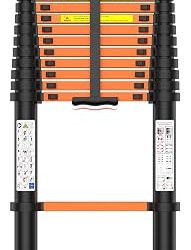
For apartments, condos, and RVs, this is the sweet spot: it collapses to a carryable block, extends rung by rung to exactly the height you need, and includes a stabilizer bar for a steadier base than most telescoping ladders offer. The 330-lb capacity is generous for something this compact.
Soctone 17.5 ft A-Frame Multi-Position Ladder
This one splits the difference between telescoping convenience and multi-position flexibility, converting to an A-frame or extension setup with a stabilizer bar included. The orange rails aren’t subtle, but the visibility is a genuine safety feature on a job site or a dim garage.
Frequently Asked Questions
How tall a ladder do I need for a two-story home?
Most two-story rooflines sit 18 to 20 feet up, and safe practice puts three feet of ladder above your contact point. A 24-foot extension ladder is the usual answer for exterior work; 16 to 18 feet handles gutters on a single-story or interior heights in an open-plan home.
Are telescoping ladders as safe as traditional ones?
Quality telescoping ladders from reputable brands meet the same ANSI duty ratings, so the safety difference comes down to setup. Confirm every rung has audibly locked, extend only to the height you need, and retract with hands clear of the rails.
Do I really need fiberglass?
If you’ll be anywhere near overhead lines, a meter, or an electrical panel, yes — aluminum conducts, and the consequences aren’t recoverable. For strictly interior painting and fixture work, aluminum’s lighter weight is the better trade.
What’s the difference between Type IA and Type IAA?
Type IA is rated to 300 lbs, Type IAA to 375 lbs. The heavier rating usually means thicker rails and a stiffer feel underfoot, which is worth having if you’re tall, carrying gear, or simply prefer a ladder that doesn’t flex.
Final Thoughts
For most homes, the Little Giant Velocity 18 ft is the one ladder that covers nearly every scenario, thanks to its multi-position frame and built-in leg levelers. Choose the Little Giant Skyscraper 17 ft if tall interior ceilings and stairwells are your recurring problem, or the Louisville FE3216 if fiberglass safety near exterior wiring is non-negotiable. Tight on storage? The compact SocTone 12.5 ft and the LANBITOU 14 ft folding model both tuck away where a full-size ladder never could.