Key takeaways
- CFM before horsepower: Match delivered CFM at 90 PSI to your thirstiest tool, then add roughly 30 percent headroom. A die grinder or DA sander can demand 5 CFM or more continuously, while an impact wrench works in short bursts. Horsepower ratings vary in honesty; CFM does not.
- Noise as a design constraint: In a garage sharing walls with living space, decibels matter as much as output. Anything near 58 to 75 dB stays conversational. Conventional direct-drive units run 85 dB and up, which effectively closes the room while the motor cycles.
- Vertical footprint: Tall, narrow tanks reclaim floor area that horizontal units waste. A 29 or 30 gallon vertical fits against a wall in roughly the space of a trash can, leaving the bay clear.
- Voltage and circuit reality: Confirm your panel before you commit. 120V units plug into what you already have; 220V machines deliver more sustained air but require a dedicated circuit and, often, an electrician.
- Oil-free versus oil-lubed: Oil-free pumps skip maintenance and tolerate cold starts, ideal for intermittent use. Oil-lubed pumps run cooler and last longer under heavy daily cycling. Choose based on hours, not preference.
What's inside
Most shop upgrades fail for the same reason: the equipment arrives before the space has been planned around it. An air compressor is the clearest example. Buyers fixate on horsepower and tank size, then discover the unit occupies the one corner they needed for a workbench, drowns out conversation whenever the motor kicks on, and trips a breaker the first time an impact wrench asks for real volume. In a working automotive shop that doubles as part of the house, those tradeoffs are not minor annoyances. They dictate whether the room stays usable.
This guide approaches the compressor as a fixture rather than a tool: footprint, acoustics, duty cycle, and electrical demand weighted alongside raw output. Below are six units that span the realistic range, from a cabinet-enclosed quiet machine suited to an attached garage to a full vertical stack built for continuous tool work, plus a cordless inflator for the jobs that never justify firing up the big tank.
As an Amazon Associate we earn from qualifying purchases.


How to Choose a/an Air Compressor For Automotive Shop (2026)
- CFM before horsepower: Match delivered CFM at 90 PSI to your thirstiest tool, then add roughly 30 percent headroom. A die grinder or DA sander can demand 5 CFM or more continuously, while an impact wrench works in short bursts. Horsepower ratings vary in honesty; CFM does not.
- Noise as a design constraint: In a garage sharing walls with living space, decibels matter as much as output. Anything near 58 to 75 dB stays conversational. Conventional direct-drive units run 85 dB and up, which effectively closes the room while the motor cycles.
- Vertical footprint: Tall, narrow tanks reclaim floor area that horizontal units waste. A 29 or 30 gallon vertical fits against a wall in roughly the space of a trash can, leaving the bay clear.
- Voltage and circuit reality: Confirm your panel before you commit. 120V units plug into what you already have; 220V machines deliver more sustained air but require a dedicated circuit and, often, an electrician.
- Oil-free versus oil-lubed: Oil-free pumps skip maintenance and tolerate cold starts, ideal for intermittent use. Oil-lubed pumps run cooler and last longer under heavy daily cycling. Choose based on hours, not preference.
The Best Air Compressor For Automotive Shop (2026)s Reviewed
Klutch 29-Gallon Vertical, 2.5 HP
The most sensible all-rounder here: 5.1 CFM at 90 PSI on standard 120V power, delivered from a vertical oil-free tank that recovers quickly between demands. Large wheels and an accessible tank drain make it genuinely maintainable, which is more than most compressors in this class can claim.
California Air Tools 20040CAD, 20 Gallon
A 4.0 HP dual-piston pump running at 75 dB is the rare combination of serious output and tolerable acoustics, and the automatic drain valve removes the maintenance step owners skip most often. It needs 220V, so treat the wiring as part of the purchase price.
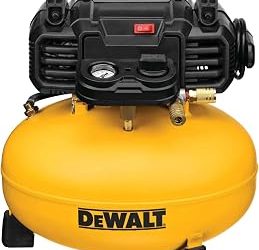
DEWALT 30 Gallon Vertical, 175 PSI
The oil-lubricated pump is the argument for this one: it runs cooler and shrugs off long sessions with air-hungry tools that would push an oil-free unit into thermal cutoff. Loud, unapologetically so, but the right choice for a detached shop with real daily hours.
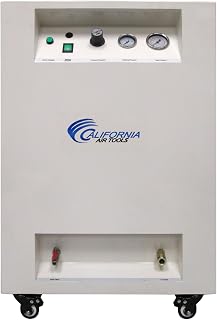
California Air Tools 10020SPC, 10 Gallon
At 58 dB inside a sound-proof cabinet, this is quieter than most dishwashers and the only unit here that disappears acoustically in an attached garage. The 10 gallon tank limits sustained sanding work, but for inflation, blowouts, and air ratchets it is remarkably civilized.
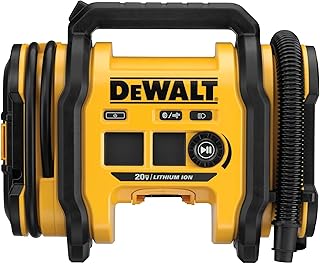
DEWALT 20V MAX Tire Inflator (DCC020IB)
Not a shop compressor and not meant to be, but it handles the small tasks that otherwise mean waking a 30 gallon tank. Automatic shutoff at a set pressure and an LED work light make it the tool that lives in the vehicle, not on the wall.
Frequently Asked Questions
What tank size does an automotive shop actually need?
Twenty to thirty gallons covers most single-bay work. Tank volume buys you runtime between motor cycles; CFM determines whether the tool works at all. Undersized pumps on large tanks simply run constantly.
Is a quiet compressor worth the premium?
In any shop attached to living space, yes. Quiet units use slower-turning pumps, which typically extend service life alongside the noise benefit. You are paying for two improvements, not one.
Can I run a compressor on a standard household outlet?
Most 120V units up to roughly 2.5 HP can, provided the circuit is not shared with other loads. Anything above that generally wants 220V and dedicated wiring.
How often should I drain the tank?
After every substantial session. Condensate corrodes tanks from the inside and contaminates air lines. Models with automatic drain valves handle it for you, which is worth seeking out.
Final Thoughts
For most shops, the Klutch 29-Gallon strikes the cleanest balance of output, footprint, and 120V simplicity. Choose the California Air Tools 20040CAD if you have 220V available and want sustained volume without the noise penalty, or the 10020SPC if your garage sits under a bedroom and quiet operation outranks everything else. Keep the DEWALT DCC020IB in the vehicle regardless of which one anchors the wall.