Key takeaways
- Blade width: Go as wide as your saw’s wheels and guides allow, typically 1/2″ on 10″ benchtop machines and 3/4″ on a 14″ cast-iron saw. Width is what keeps the cut from bowing under feed pressure.
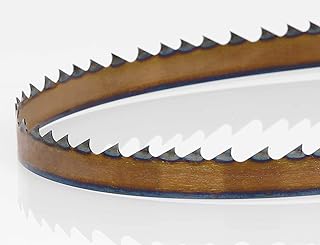
- Tooth count: Stay between 2 and 4 TPI for resawing. Fewer, larger gullets carry sawdust out of a 6″ deep cut instead of packing it in and burning your stock.
- Tooth material: Carbon steel is inexpensive and cuts beautifully until it dulls, which happens fast in hardwood. Carbide-tipped blades cost several times more and last roughly ten to twenty times longer, making them cheaper per cut if you resaw regularly.
- Length and gauge: Measure your saw’s required loop length precisely, then check the recommended gauge. A 0.032″ body handles tension well without straining smaller wheels the way heavier stock can.
- Tooth geometry: Hook tooth blades have a positive rake and deep gullets, so they pull themselves through hardwood with less feed force. Skip tooth is the gentler alternative for softwoods and figured stock.
What's inside
Resawing is where a band saw stops being a curve-cutting toy and becomes a lumber mill. It’s also where most blades quietly fail you. You feed a 6″ wide piece of white oak into the throat, and forty seconds later the cut is wandering, the kerf is closing on the blade body, and what should have been two clean book-matched panels is now a pair of wedges destined for the offcut bin. The blade is almost always the culprit, not the saw.
Deep vertical cuts demand something specific: a wide blade to resist deflection, a low tooth count so gullets can clear a long chip, and a body that runs true at tension without work-hardening into a crack. This guide breaks down the blades worth your money in 2026, from a low-tension silicon steel favorite to carbide-tipped workhorses that hold an edge through hundreds of board feet, plus a budget assortment for anyone still dialing in their setup.
As an Amazon Associate we earn from qualifying purchases.



How to Choose a Band Saw Blade For Resawing (2026)
- Blade width: Go as wide as your saw’s wheels and guides allow, typically 1/2″ on 10″ benchtop machines and 3/4″ on a 14″ cast-iron saw. Width is what keeps the cut from bowing under feed pressure.
- Tooth count: Stay between 2 and 4 TPI for resawing. Fewer, larger gullets carry sawdust out of a 6″ deep cut instead of packing it in and burning your stock.
- Tooth material: Carbon steel is inexpensive and cuts beautifully until it dulls, which happens fast in hardwood. Carbide-tipped blades cost several times more and last roughly ten to twenty times longer, making them cheaper per cut if you resaw regularly.
- Length and gauge: Measure your saw’s required loop length precisely, then check the recommended gauge. A 0.032″ body handles tension well without straining smaller wheels the way heavier stock can.
- Tooth geometry: Hook tooth blades have a positive rake and deep gullets, so they pull themselves through hardwood with less feed force. Skip tooth is the gentler alternative for softwoods and figured stock.
The Best Band Saw Blade For Resawing (2026)s Reviewed
Timber Wolf 3423VPC 93.5″ x 3/4″ Low Tension Resaw Blade
Timber Wolf’s silicon steel body runs at meaningfully lower tension than standard carbon blades, which spares the bearings on older 14″ saws and delivers a glass-smooth surface that often needs nothing more than a light scraping. The variable pitch also cuts down on the harmonic whine that makes long resaw sessions unpleasant.
Dark Stone 111″ Carbide-Tipped Resaw Blade, 3/4″ x 2 TPI
This is the blade to buy if you resaw hardwood every week rather than every season. The carbide teeth shrug off hard maple and exotic species that would round over a steel blade in an afternoon, and the hook geometry tracks straight enough to take veneer off a wide board with real confidence.
Dark Stone 131-1/2″ Carbide-Tipped Resaw Blade, 3/4″ x 2 TPI
Same excellent carbide tooth and hook profile as its shorter sibling, sized for larger 17″ and 18″ saws with taller resaw capacity. The 0.032″ gauge is the sweet spot here: rigid enough for deep cuts, flexible enough to avoid fatigue cracking around bigger wheels.
AYAO 70-1/2″ x 1/2″ x 4TPI Hardened Teeth Blade
Purpose-sized for the Craftsman 921400 and Rikon 10-305, this hardened-tooth blade turns a modest 10″ benchtop saw into a credible resaw tool for narrower stock. AYAO makes a 72″ version for the Wen 10″ saw as well, so check your loop length before ordering.
SK5 Carbon Steel Bandsaw Blade 4-Pack, 93-1/2″
A sensible starting point for a new 14″ saw owner: two 1/2″ 6TPI blades for general work plus 1/4″ and 1/8″ options for curves. The 6TPI pitch is finer than ideal for deep resawing, but for stock under 4″ it cuts cleanly and the value is hard to argue with.
Frequently Asked Questions
Is carbide worth the extra cost?
If you resaw more than a few dozen board feet a month, yes. Cost per cut drops sharply and you stop losing time to blade changes and re-tuning your fence mid-project.
Why does my cut still drift with a wide blade?
Usually blade drift, not blade failure. Every blade cuts at a slight angle relative to the fence, so make a test cut, note the angle, and shim your fence to match before committing good lumber.
How much resaw height can a 10″ benchtop saw handle?
Realistically 3″ to 4″, even if the spec sheet claims more. Motor power and wheel size become the limiting factors well before blade quality does.
Should I run a resaw blade slower?
Keep the blade speed high and moderate your feed rate instead. Push too hard and the gullets pack; too lightly and you burnish and burn the face.
Final Thoughts
For serious hardwood work on a 14″ saw, the Dark Stone 111″ carbide-tipped blade is the clear investment, with the 131-1/2″ version covering larger machines. If you’d rather stay in steel, the Timber Wolf 3423VPC gives you the cleanest surface finish per dollar, while the AYAO 70-1/2″ keeps compact benchtop saws genuinely useful.