Key takeaways
- Tooth count: Think in bands. 24–40 teeth for framing and fast crosscuts, 60–80 for plywood, MDF, and trim, 80–120 for veneered panels and hardwood show faces. More teeth means a slower feed rate and more heat, so oversized counts on thick stock cause burning rather than preventing it.
- Grind geometry: ATB (alternate top bevel) teeth slice wood fibers cleanly and are the default for crosscutting. TCG (triple chip grind) uses a flat raker between chamfered teeth and is what you want for aluminum, plastics, and laminate — it shears rather than tears.
- Arbor and diameter: Match both exactly. Most 10-inch saws use a 5/8-inch arbor; many 12-inch saws step up to a 1-inch bore. Never shim a blade to fit, and never install a larger diameter than your saw’s rating allows.
- Plate quality and kerf: A tensioned, laser-cut plate with expansion slots stays flat under heat, which is what keeps a 45-degree miter from wandering. Thin-kerf blades reduce load on smaller motors; full-kerf plates track straighter in dense hardwood.
- RPM rating: Check the blade’s maximum speed against your saw’s no-load RPM. Most 10-inch miter saws spin around 5,000 RPM, so a blade rated to 7,000 leaves comfortable headroom.
What's inside
The blade that shipped with your miter saw was never meant to be the last one. Most factory blades carry 24 to 40 teeth — fine for framing lumber, punishing on anything you intend to look at afterward. Run a length of white oak or a pre-finished baseboard through one and you get the same story every time: fuzzy shoulders, chipped veneer, and a joint that reads as almost-right from across the room. For anyone building furniture, fitting trim, or assembling a walnut floating shelf that has to sit flush against plaster, the blade is the finish. Everything downstream — sanding, filling, touch-up paint — is just compensation for the wrong tooth count.
This guide looks at miter saw blades through the lens of the work most home builders actually do: casing and crown, cabinet doors, mitered boxes, table aprons, the occasional aluminum extrusion. We cover what tooth geometry means in practice, when a 100-tooth blade is overkill, why arbor size trips people up, and which blades are worth keeping in rotation. The picks below range from single-purpose finish blades to multi-packs that let you swap between rough and refined work without overthinking it.
As an Amazon Associate we earn from qualifying purchases.


How to Choose a Saw Blade For Miter Saw (2026)
- Tooth count: Think in bands. 24–40 teeth for framing and fast crosscuts, 60–80 for plywood, MDF, and trim, 80–120 for veneered panels and hardwood show faces. More teeth means a slower feed rate and more heat, so oversized counts on thick stock cause burning rather than preventing it.
- Grind geometry: ATB (alternate top bevel) teeth slice wood fibers cleanly and are the default for crosscutting. TCG (triple chip grind) uses a flat raker between chamfered teeth and is what you want for aluminum, plastics, and laminate — it shears rather than tears.
- Arbor and diameter: Match both exactly. Most 10-inch saws use a 5/8-inch arbor; many 12-inch saws step up to a 1-inch bore. Never shim a blade to fit, and never install a larger diameter than your saw’s rating allows.
- Plate quality and kerf: A tensioned, laser-cut plate with expansion slots stays flat under heat, which is what keeps a 45-degree miter from wandering. Thin-kerf blades reduce load on smaller motors; full-kerf plates track straighter in dense hardwood.
- RPM rating: Check the blade’s maximum speed against your saw’s no-load RPM. Most 10-inch miter saws spin around 5,000 RPM, so a blade rated to 7,000 leaves comfortable headroom.
The Best Saw Blade For Miter Saw (2026)s Reviewed
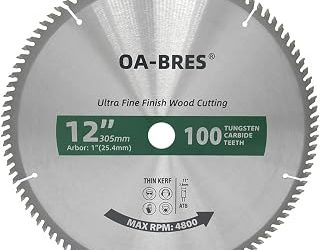
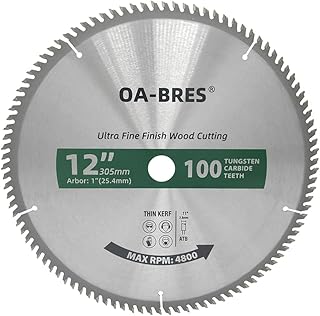
12-Inch 100-Tooth ATB TCT Fine Finish Blade
Built for 12-inch saws with a 1-inch arbor, this is the blade to mount when you’re cutting wide crown or trimming pre-finished panels and cannot afford tear-out on the visible face. The 100-tooth ATB grind leaves a surface that needs little more than a scuff-sand, though you’ll want a slow, steady feed to keep the carbide cool.
10-Inch 120-Tooth TCG Aluminum Blade
The TCG geometry here is the whole point: it handles aluminum angle, tube, and channel without grabbing, and it cuts acrylic and laminate cleanly enough for edge-lit or exposed-fastener details. Use a lubricant stick on aluminum and let the blade do the work rather than pushing through the cut.
KENDO 10-Inch 40T + 60T 2-Pack
A sensible pairing for a shop that does both structure and surface — 40 teeth for ripping and quick dimensional cuts, 60 for plywood, MDF, and laminate where the edge shows. Both run a 5/8-inch arbor and an ATB grind, making this the low-friction way to stop compromising with one general-purpose blade.
10-Inch 80-Tooth Carbide Fine Finish Blade
Rated to 7,000 RPM with tungsten carbide teeth, this sits in the sweet spot for furniture work: clean enough for mitered corners and drawer fronts, fast enough that you’re not babysitting every cut. The 80-tooth count is the most versatile single choice for hardwood crosscutting on a 10-inch saw.
10-Inch 32T / 60T / 80T 3-Pack
Three blades covering framing, fine finish, and ultra-fine finish means you can stop asking one blade to do three jobs — and stop dulling a good finish blade on construction lumber. Worth it for a first real blade upgrade or for anyone moving between rough carpentry and cabinet work in the same project.
Frequently Asked Questions
Does a higher tooth count always mean a cleaner cut?
Only up to a point. Beyond about 80 teeth on a 10-inch blade, gullets get small and struggle to clear chips in thick stock, which builds heat and can scorch the cut. High counts shine on thin material, veneered sheet goods, and moldings.
Can I use a table saw blade on my miter saw?
Usually yes, if diameter, arbor, and RPM rating match — most 10-inch blades are marketed for both. The exception is blades with aggressive positive hook angles, which can climb or self-feed on a sliding miter saw. Look for a low or negative hook angle for miter use.
Why are my miters still showing gaps?
A finish blade fixes surface quality, not alignment. Check your saw’s detents and fence squareness, confirm the blade plate isn’t warped, and support long stock so it doesn’t lift mid-cut. A blade that flexes under load will read as a bad miter.
When should I replace rather than sharpen?
Carbide-tipped blades in the mid range are often cheaper to replace than to have professionally sharpened. Higher-tooth-count and larger 12-inch blades are worth resharpening once or twice, provided the plate is flat and no teeth are missing.
Final Thoughts
If you own one 10-inch saw and want a single upgrade that changes the quality of your work, the 10-inch 80-tooth carbide finish blade is the clearest choice. Add the KENDO 40T/60T 2-pack if your projects swing between framing and finish work, and step up to the 12-inch 100-tooth ATB blade if you’re running a larger saw and cutting wide, visible profiles where the edge has to be right the first time.