Key takeaways
- Tooth count first: Fewer, larger teeth clear waste fast — 24T to 32T is framing and rough stock territory. For finish work, 60T is the everyday sweet spot, 80T gives you glass-smooth edges in hardwood, and 100T+ is reserved for veneered plywood, melamine, and delicate moldings where any tearout is fatal.
- Confirm arbor and diameter: Most miter saws take a 5/8-inch (16mm) arbor. Match the diameter your saw is rated for rather than sizing up — a 12-inch blade on a 10-inch saw will not clear the guard, and a smaller blade robs you of cut capacity.
- Look for a negative hook angle: Blades ground for chop and slide cuts pull down and back instead of grabbing the workpiece. It’s the single biggest safety and finish difference between a true miter blade and a table saw blade pressed into service.
- Judge the carbide, not the coating: Micro-grain carbide tips with a clean, thick braze hold an edge far longer than thin tips on a painted plate. Expansion slots and a tensioned body keep the blade running true as it heats.
- Buy in sets if you’re starting out: A three-blade kit costs less than two premium singles and teaches you what tooth count does. Swap deliberately — one blade for structure, one for show surfaces.
What's inside
Ask anyone who has installed their own casing or built a walnut console table: the miter saw gets the credit, but the blade does the work. A stock blade is almost always a compromise part — a general-purpose grind meant to survive shipping and cut a 2×4 without complaint. Run it through quartersawn oak or prefinished baseboard and you get the telltale evidence: fuzzy edges, chipped veneer, burn lines on the shoulder of a miter that should have closed tight. Sanding it out is time you did not budget for, and on a mitered corner, sanding changes the angle.
This guide is written for people making things that live in a room, not just framing behind drywall. Below you’ll find the blades worth owning in 2026, what tooth count actually does to your cut quality, and how to build a small rotation so you’re not asking one disc to rip pine and crosscut white oak trim. We’ve focused on 10-inch and 12-inch carbide-tipped options with standard 5/8-inch arbors, the sizes that fit the overwhelming majority of sliding and compound miter saws.
As an Amazon Associate we earn from qualifying purchases.


How to Choose Saw Blades for Miter Saws (2026)
- Tooth count first: Fewer, larger teeth clear waste fast — 24T to 32T is framing and rough stock territory. For finish work, 60T is the everyday sweet spot, 80T gives you glass-smooth edges in hardwood, and 100T+ is reserved for veneered plywood, melamine, and delicate moldings where any tearout is fatal.
- Confirm arbor and diameter: Most miter saws take a 5/8-inch (16mm) arbor. Match the diameter your saw is rated for rather than sizing up — a 12-inch blade on a 10-inch saw will not clear the guard, and a smaller blade robs you of cut capacity.
- Look for a negative hook angle: Blades ground for chop and slide cuts pull down and back instead of grabbing the workpiece. It’s the single biggest safety and finish difference between a true miter blade and a table saw blade pressed into service.
- Judge the carbide, not the coating: Micro-grain carbide tips with a clean, thick braze hold an edge far longer than thin tips on a painted plate. Expansion slots and a tensioned body keep the blade running true as it heats.
- Buy in sets if you’re starting out: A three-blade kit costs less than two premium singles and teaches you what tooth count does. Swap deliberately — one blade for structure, one for show surfaces.
The Best Saw Blades for Miter Saws, Reviewed
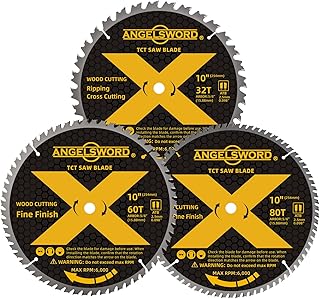
10-Inch 3-Pack (32T, 60T, 80T)
This is the most practical first purchase for a home shop, because it hands you the whole range at once: 32T for framing and deck stock, 60T for trim and casework, 80T when you need an edge that goes straight to finish. Keeping the rough blade out of your hardwood is what preserves the good one.
WEN BL1080 10-Inch 80-Tooth
The best all-around finish blade here for 10-inch saws — 80 carbide-tipped teeth leave a cut clean enough for exposed joinery in oak, maple, and poplar. Feed it slowly and let the tooth count do the work; rushing an 80T blade is how you get burn marks.
WEN BL1280 12-Inch 80-Tooth
The same fine-finish grind scaled up for 12-inch sliders, which means crown molding, wide baseboard, and nested cuts in one pass. If you build furniture with anything over 4 inches of face width, this is the blade that stops you from flipping stock mid-cut.
WEN BL1060 10-Inch 60-Tooth
The workhorse of the group and the blade that will live on your saw. At 60 teeth it crosscuts hardwood cleanly without the heat buildup of higher counts, making it the right default for shelving, table aprons, and general trim.
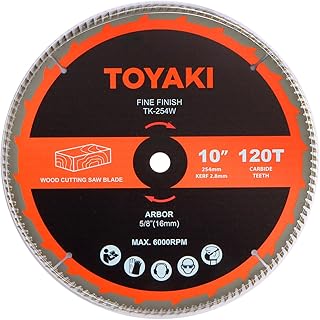
10-Inch 120-Tooth Fine-Finish Blade
A specialist, and worth owning as your second blade rather than your first. At 120 teeth it’s built for veneered plywood, melamine shelving, and prefinished trim where a single chipped fiber shows — use light pressure and keep it off construction lumber.
Frequently Asked Questions
Can I use a table saw blade in a miter saw?
Sometimes, if the diameter and arbor match, but it’s not ideal. Table saw blades often have a positive hook angle that makes a miter saw grab and climb the workpiece. Choose blades rated for both, or dedicated miter blades.
Is a higher tooth count always better?
No. More teeth mean smaller gullets and less room for chips, so high-count blades bog down and burn in thick stock. Match tooth count to material thickness and finish requirements.
How do I know when a blade is dull?
Watch for increased feed effort, burning, a rougher edge than the blade used to produce, and more tearout on the underside. Quality carbide blades can be professionally sharpened several times.
Do thin-kerf blades help?
They remove less material, so they cut with less resistance and are gentler on smaller motors. The tradeoff is a slightly more flexible plate, so keep your feed rate steady.
Final Thoughts
If you’re outfitting a shop from scratch, start with the 10-inch 3-pack and let the 32T, 60T, and 80T blades teach you the difference. If you already own a decent saw and want one upgrade that shows up immediately in your finished work, the WEN BL1060 for daily crosscutting or the WEN BL1280 for wide 12-inch molding cuts will earn their place fastest.