Key takeaways
- SCFM at 90 PSI: This single number tells you which tools will run continuously. Roughly 4 SCFM handles brad nailers, staplers, and inflation with ease; ratchets, sanders, and HVLP spray guns want everything you can get.
- Measured noise level: Standard induction motors land near 85–90 dB, loud enough to clear a room. Ultra-quiet models in the 66–70 dB range change the experience entirely and make an attached garage workable without hearing protection.
- Duty cycle: A 75 percent rating means the pump can run three minutes out of four. Anything lower forces you to work in bursts, which is fine for trim nailing and frustrating for anything sustained.
- Tank orientation and wheels: Vertical tanks claim about two square feet of floor and slide against a wall. Horizontal and pancake designs are easier to move and store overhead but eat bench or floor space when parked.
- Drain access and pump type: Oil-free pumps skip the maintenance schedule. An automatic or front-mounted drain valve is the difference between clearing condensate weekly and quietly rusting the tank from the inside.
What's inside
An air compressor is the one tool that refuses to be discreet. It lives in the garage, the basement workshop, or the corner of a converted mudroom, and it announces itself every time the motor kicks on. For anyone who has spent real effort on the rest of the house, that matters. A 20-gallon tank sits at the sweet spot where a compressor becomes genuinely useful for finish carpentry, upholstery work, and auto projects, but it is also the size where footprint, noise, and electrical draw stop being trivial. Buyers get stuck comparing horsepower numbers that mean almost nothing while ignoring the two specs that actually determine whether a tool will keep running.
This guide approaches the category the way we approach any piece of equipment that has to coexist with a considered space: performance first, then how it lives in the room. Below you will find the models worth shortlisting for 2026, a short buying framework built around airflow and sound rather than marketing figures, and answers to the questions that come up once the crate is open. A few smaller tanks are included because not every project needs twenty gallons, and a compact unit that tucks under a bench is often the smarter choice.
As an Amazon Associate we earn from qualifying purchases.



How to Choose a/an 20 Gallon Air Compressor (2026)
- SCFM at 90 PSI: This single number tells you which tools will run continuously. Roughly 4 SCFM handles brad nailers, staplers, and inflation with ease; ratchets, sanders, and HVLP spray guns want everything you can get.
- Measured noise level: Standard induction motors land near 85–90 dB, loud enough to clear a room. Ultra-quiet models in the 66–70 dB range change the experience entirely and make an attached garage workable without hearing protection.
- Duty cycle: A 75 percent rating means the pump can run three minutes out of four. Anything lower forces you to work in bursts, which is fine for trim nailing and frustrating for anything sustained.
- Tank orientation and wheels: Vertical tanks claim about two square feet of floor and slide against a wall. Horizontal and pancake designs are easier to move and store overhead but eat bench or floor space when parked.
- Drain access and pump type: Oil-free pumps skip the maintenance schedule. An automatic or front-mounted drain valve is the difference between clearing condensate weekly and quietly rusting the tank from the inside.
The Best 20 Gallon Air Compressor (2026)s Reviewed
Klutch 20-Gallon Vertical Air Compressor
With 4.2 SCFM at 90 PSI, a 175 PSI ceiling, and a 75 percent duty cycle on standard household 120V, this is the most capable all-around pick here and the one we would put in a working shop. The vertical tank and oversized wheels keep it out of the way, and the easy-access drain means you will actually remember to use it.
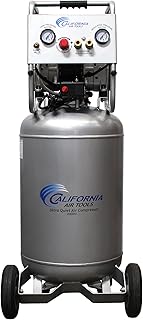
California Air Tools 20020AD Ultra Quiet
At 70 dB, this 2.0 HP oil-free unit runs at roughly the volume of a dishwasher, which makes it the obvious answer for basements, attached garages, and any space adjacent to living areas. The automatic drain valve handles the chore most owners neglect, and the slower-turning motor should outlast louder direct-drive competitors.
VEVOR 13-Gallon Quiet Compressor
A smaller tank with the best airflow in this lineup at 4.6 SCFM, running near 66 dB inside a thickened steel body. If your work leans toward spray finishing and woodworking rather than long tool runs, the higher flow rate matters more than the missing seven gallons.
Craftsman 2-Gallon Hot Dog
Oil-free, light enough to carry in one hand, and rated to 125 PSI, this is a trim-and-inflation companion rather than a shop compressor. At 0.5 CFM at 90 PSI it will keep up with a brad nailer and little else, which is exactly the point.
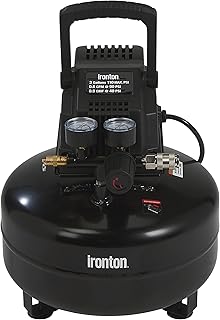
Ironton 3-Gallon Pancake
The most storable option on the list, with a low-profile pancake tank that slides onto a shelf and a maintenance-free pump that tolerates long gaps between uses. Best reserved for tire pressure, blow-off, and occasional pin nailing.
Frequently Asked Questions
Is 20 gallons enough to run a spray gun?
For touch-up and small-panel work, yes. Full HVLP spraying of cabinets or a car panel draws 8 SCFM or more continuously, so plan on working in sections and letting the tank recover.
Do I need a dedicated circuit?
A 2 HP 120V compressor draws heavily at startup and should have a 15 or 20 amp circuit to itself. Sharing with a shop vac or space heater is the most common cause of nuisance breaker trips.
Are quiet compressors actually slower?
Not meaningfully. Low-noise models use larger, slower-turning pumps that deliver comparable airflow with less vibration, though they are typically heavier and cost more upfront.
How often should I drain the tank?
After every session in humid conditions, and at minimum weekly with regular use. Trapped water corrodes the tank from the inside, which is the failure mode that ends most compressors.
Final Thoughts
For a shop that sees regular use, the Klutch 20-Gallon delivers the most usable air per dollar and its 75 percent duty cycle keeps you working. If the compressor shares a wall with a bedroom or living room, the California Air Tools 20020AD is worth the premium for its 70 dB output and automatic drain. And for finish work where airflow beats capacity, the VEVOR 13-Gallon is the quiet, high-flow specialist.