Key takeaways
- Slot fit and zero play: Confirm your saw uses a standard 3/4″ x 3/8″ T-slot, then prioritize a bar with adjustable set screws or expansion discs. A gauge you can dial in to a snug, drag-free slide is the single largest factor in repeatable cuts.
- Fence length versus shop size: Extendable fences reaching 32 to 38 inches support wide panels and shelf ends, but they need room to swing. If you work in a garage bay or against a wall, a fixed 18-inch fence is often the smarter, faster tool.
- Flip stop quality: The stop is what turns one good cut into forty. Look for a stop that locks without deflecting and includes micro-adjust, so you can creep up on a shoulder by a fraction of a millimeter instead of re-measuring.
- Angle indexing: Positive stops at common angles let you jump to 45 degrees and back without a protractor. More detents help with polygon work, hexagonal tabletops, and segmented staves; fewer detents are fine for straightforward crosscuts and standard miters.
- Build and hardware: Extruded aluminum bodies with steel bars resist the flex that shows up mid-cut in thick stock. Check that scales are engraved rather than printed, and that the fence face is flat enough to trust as a reference surface.
What's inside
Anyone who has built a run of drawer fronts knows the moment: five cuts look identical on the bench, then you clamp them up and the mitered corner opens like a hairline crack you cannot unsee. The culprit is almost never the blade. It is the stamped miter gauge that shipped in the box with the saw, rattling a few thousandths inside the slot and reading angles off a scale printed for rough carpentry, not casework. In furniture work, where a picture frame, a plinth, or a tapered leg has to close on all four faces, that slop is the difference between a piece that reads as handmade and one that reads as unfinished.
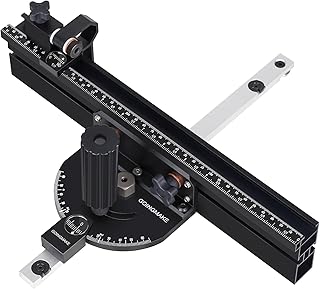
A dedicated aftermarket miter gauge is one of the least glamorous and most transformative upgrades in a small shop. This guide looks at the models worth installing in 2026, all built around the standard 3/4″ x 3/8″ T-slot found on most contractor and hybrid saws. We compare fence reach, flip-stop repeatability, angle indexing, and how each one eliminates play in the runner, so you can match the gauge to the kind of furniture you actually build.
As an Amazon Associate we earn from qualifying purchases.


How to Choose a Miter Gauge for Your Table Saw (2026)
- Slot fit and zero play: Confirm your saw uses a standard 3/4″ x 3/8″ T-slot, then prioritize a bar with adjustable set screws or expansion discs. A gauge you can dial in to a snug, drag-free slide is the single largest factor in repeatable cuts.
- Fence length versus shop size: Extendable fences reaching 32 to 38 inches support wide panels and shelf ends, but they need room to swing. If you work in a garage bay or against a wall, a fixed 18-inch fence is often the smarter, faster tool.
- Flip stop quality: The stop is what turns one good cut into forty. Look for a stop that locks without deflecting and includes micro-adjust, so you can creep up on a shoulder by a fraction of a millimeter instead of re-measuring.
- Angle indexing: Positive stops at common angles let you jump to 45 degrees and back without a protractor. More detents help with polygon work, hexagonal tabletops, and segmented staves; fewer detents are fine for straightforward crosscuts and standard miters.
- Build and hardware: Extruded aluminum bodies with steel bars resist the flex that shows up mid-cut in thick stock. Check that scales are engraved rather than printed, and that the fence face is flat enough to trust as a reference surface.
The Best Table Saw Miter Gauges of 2026, Reviewed
O’SKOOL PTA026 Miter Gauge with 22–36 in Extension Fence
The most complete package here, pairing a 27-detent index plate with a reversible fence that can be set for either crosscutting or narrow offcut support, plus a zero-play fit adjustment that takes real slop out of the runner. If you build casework with mixed angles, this is the gauge that reduces setup time most.
GOINGMAKE Miter Gauge with 18–32 in Extendable Fence
A well-judged middle ground: enough fence to handle shelf and rail stock, 13 angle stops covering the angles furniture actually calls for, and a micro-adjust flip stop that makes duplicate parts genuinely painless. The best default choice for most hybrid saws.
GOINGMAKE Miter Gauge with Long 21–38 in Fence
Built for panel work, with the longest reach in this group and the same 13-hole index plate and micro-adjust stop as its siblings. Worth it if you regularly break down cabinet sides or tabletop blanks, though it demands clearance on both sides of the blade.
VEVOR Precision Miter Gauge with 19–35 in Fence
A spring-loaded plunger and removable disc give this one a satisfyingly positive feel at each of its 15 angle stops, and the aluminum alloy body holds its calibration well. A solid, no-drama option for shops that want precision without a long feature list.
GOINGMAKE Compact Miter Gauge with 360mm Fence
The pick for tight spaces and smaller saws, with a fixed 360mm fence, positive angle stops, and a multifunction flip stop that punches above its footprint. Ideal for frames, boxes, and small-scale furniture where a long fence is more nuisance than help.
Frequently Asked Questions
Will these fit my table saw?
All the gauges reviewed here are made for the standard 3/4″-wide by 3/8″-deep T-slot used by most contractor, jobsite, and hybrid saws. Measure your slot before ordering, since a handful of older and imported saws use non-standard dimensions.
Do I still need a crosscut sled?
A quality miter gauge with an extended fence covers most furniture crosscuts and miters, and it stores far more easily. A sled remains better for very wide panels and for zero-clearance support on delicate veneered stock.
How do I check the angles are accurate?
Trust a machinist square or reliable digital angle finder over the printed scale. Set the gauge to 90 degrees, make a test cut in scrap, flip one half over, and butt the cut edges together; any gap reveals twice your error.
Is micro-adjust worth paying for?
For repeat parts, yes. It lets you shift a stop by hairline increments to sneak up on a final length, which matters when drawer parts or rails have to match within a fraction of a millimeter.
Final Thoughts
For most furniture makers, the O’SKOOL PTA026 is the gauge to buy, combining a reversible extension fence with the widest range of positive angle stops. The GOINGMAKE 18–32 inch model is the value pick and handles the vast majority of cabinet and table work, while the compact GOINGMAKE 360mm version is the right answer for small shops and small-scale pieces where fence length is a liability rather than an asset.