Key takeaways
- Noise level: Anything above 80 dBA belongs in a detached garage. Units rated 56 to 70 dBA can run indoors near living space, which matters enormously if you’re finishing a room rather than building a house.
- Air delivery, not tank size: SCFM at 90 PSI tells you whether a tool can run continuously. Brad nailers and staplers sip air; framing nailers, ratchets, and small sanders drink it. Match the number to your thirstiest tool.
- Tank format and portability: Pancake tanks are stable and stow flat under a bench. Twin-stack designs hold more air in a narrower footprint. Aluminum resists corrosion and cuts weight, which you feel on every stair.
- Oil-free pumps: No oil changes, no drips on hardwood, and no seasonal maintenance ritual. For occasional home use, the tradeoff in pump lifespan is almost always worth it.
- Duty cycle and recovery: A pump that recovers quickly lets you work without pauses. Look for a genuine 50 percent or higher duty cycle if you plan on longer sessions like upholstery or a full run of baseboard.
What's inside
Anyone who has assembled a wall of floating shelves, tacked trim around a built-in banquette, or upholstered a headboard knows the moment the project stalls: the manual brad nailer that won’t sink flush, the staple gun that bruises the fabric, the tire on the cargo trailer that’s soft the morning of a pickup. An air compressor solves all three, but the buying process is where most home makers get stuck. Spec sheets talk in SCFM and duty cycles, showroom units sound like a leaf blower, and the models built for auto shops are simply too loud and too large to live anywhere near a finished room.
This guide approaches compressors the way we’d approach any other object that has to share space with your furniture: quietly, with attention to footprint, finish, and how it actually behaves in a home. Below are six compressors worth considering in 2026, spanning ultra-quiet aluminum-tank units that can run in a hallway without a conversation stopping, classic pancake models sized for framing and trim, and a cordless inflator that lives in a car boot. We’ve also included a short framework for matching capacity to the work you actually do, so you’re not paying for air you’ll never use.
As an Amazon Associate we earn from qualifying purchases.



How to Choose a/an Air Tool Compressor (2026)
- Noise level: Anything above 80 dBA belongs in a detached garage. Units rated 56 to 70 dBA can run indoors near living space, which matters enormously if you’re finishing a room rather than building a house.
- Air delivery, not tank size: SCFM at 90 PSI tells you whether a tool can run continuously. Brad nailers and staplers sip air; framing nailers, ratchets, and small sanders drink it. Match the number to your thirstiest tool.
- Tank format and portability: Pancake tanks are stable and stow flat under a bench. Twin-stack designs hold more air in a narrower footprint. Aluminum resists corrosion and cuts weight, which you feel on every stair.
- Oil-free pumps: No oil changes, no drips on hardwood, and no seasonal maintenance ritual. For occasional home use, the tradeoff in pump lifespan is almost always worth it.
- Duty cycle and recovery: A pump that recovers quickly lets you work without pauses. Look for a genuine 50 percent or higher duty cycle if you plan on longer sessions like upholstery or a full run of baseboard.
The Best Air Tool Compressor (2026) Reviewed
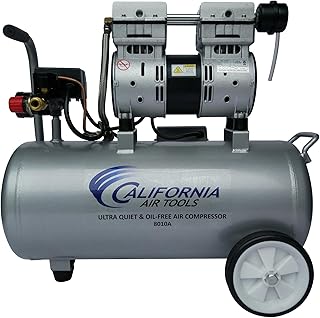
California Air Tools 8010A Ultra Quiet 8-Gallon
At 60 dBA with an 8-gallon aluminum tank on wheels, this is the compressor to buy if the work happens inside the house. The reserve is generous enough for extended trim and cabinet installs, and the low-RPM pump means you can hold a conversation while it refills.
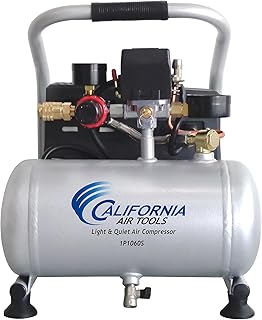
California Air Tools CAT-1P1060S Light & Quiet
A 1-gallon, 56 dBA unit that weighs little enough to carry up a ladder in one hand. It is the right tool for pin nailing, upholstery staples, and small finish work in an occupied apartment, though the tiny tank means near-constant cycling on anything demanding.
California Air Tools CAT-4610AC Twin Tank
The sweet spot for most furniture-focused makers: 4.6 gallons split across twin aluminum tanks, so it stores narrow and rolls easily. You get meaningful air capacity without the mass of an 8-gallon unit or the noise of a conventional pump.
DEWALT Pancake Compressor 6-Gallon (DWFP55126)
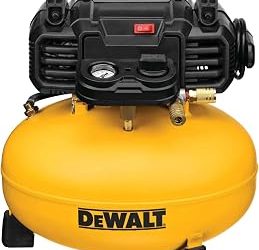
The reliable workhorse. With 165 max PSI and 2.6 SCFM at 90 PSI, it handles framing, roofing, and heavy trim runs that quiet units can’t sustain. Expect real noise, so plan on garage or outdoor use.
BOSTITCH 6-Gallon Kit (BTFP02012-WPK)
A sensible entry point that arrives with hose and nailer, so a first-time buyer is working the same afternoon. It’s quieter and lighter than most pancakes in its class, with 150 PSI that covers everything short of continuous framing.
Frequently Asked Questions
Can I run a compressor inside a finished room?
Yes, if it’s rated around 60 dBA or below and the pump is oil-free. Place it on a mat to reduce vibration transfer through hardwood or tile, and keep the drain valve accessible.
Do I need 6 gallons for brad nailing?
No. A 1 to 2 gallon tank comfortably runs a brad or pin nailer. Larger tanks matter when a tool consumes air continuously, like a sander or an impact wrench.
How much maintenance is involved?
With an oil-free pump, essentially just draining condensation from the tank after each use. Skipping that step is the fastest way to shorten a tank’s life.
Is a cordless inflator worth owning separately?
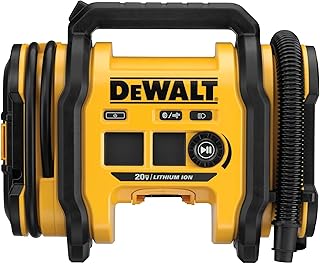
If you already have 20V MAX batteries, yes. The DEWALT DCC020IB handles tires, air mattresses, and sports gear with automatic shutoff, and it saves you from dragging a tank to the driveway.
Final Thoughts
For most people furnishing and finishing a home, the California Air Tools CAT-4610AC is the best-balanced choice: quiet, compact, and capable enough for real trim and cabinet work. Step up to the 8010A if you want reserve capacity for longer indoor sessions, or choose the DEWALT DWFP55126 if your projects lean structural and live in the garage.