Key takeaways
- Swing and throat depth: Swing is twice the distance from column to chuck center, so a 12-inch machine reaches the middle of a 12-inch panel. For case work and wide tabletops, that extra reach matters far more than motor amperage.
- Spindle travel: Look for at least 2 inches of quill stroke, ideally 3-plus. Dowel holes, dust-collection ports, and deep mortises all live or die by how far the bit can descend in one clean plunge.
- Speed range: Large Forstner and hole-saw bits want 250 to 600 RPM in hardwood, while small twist bits like 2,000-plus. Variable-speed dials adjust mid-cut; stepped-pulley machines mean opening the head and moving a belt.
- Table and tilt: A cast-iron table with a 45-degree bevel handles splayed chair legs and angled joinery. Check for slots or holes to bolt on a sacrificial wooden fence, which you will want by week two.
- Chuck and runout: A quality keyed 1/2-inch chuck holds better than a keyless one under woodworking side loads. Minimal runout keeps hole walls crisp, which is exactly what a glued dowel joint needs.
What's inside
A drill press is the tool most furniture makers put off buying, and it’s usually the tool that would have saved the last three projects. Hand drills wander. Even with a brad-point bit and a steady grip, a shelf-pin hole drifts a degree or two, a chair-leg mortise opens up off-axis, and suddenly a joint that should have closed cleanly needs shims and apologies. The problem isn’t skill; it’s that a handheld drill has no reference surface. Nothing is holding the bit perpendicular except your wrist and optimism.
This guide looks at benchtop drill presses through the lens of furniture work specifically: repeatable perpendicular holes, controlled depth for dowels and shelf pins, slow speeds for large Forstner bits in hardwood, and a table that tilts when you need an angled leg socket. We’ve weighted quill travel, speed range, chuck quality, and cast-iron mass over headline horsepower, because in a home shop the machine that stays put is the machine that stays accurate. Below are the models worth your bench space in 2026, plus one clever alternative for anyone who genuinely doesn’t have the square footage.
As an Amazon Associate we earn from qualifying purchases.


How to Choose a Drill Press Woodworking (2026)
- Swing and throat depth: Swing is twice the distance from column to chuck center, so a 12-inch machine reaches the middle of a 12-inch panel. For case work and wide tabletops, that extra reach matters far more than motor amperage.
- Spindle travel: Look for at least 2 inches of quill stroke, ideally 3-plus. Dowel holes, dust-collection ports, and deep mortises all live or die by how far the bit can descend in one clean plunge.
- Speed range: Large Forstner and hole-saw bits want 250 to 600 RPM in hardwood, while small twist bits like 2,000-plus. Variable-speed dials adjust mid-cut; stepped-pulley machines mean opening the head and moving a belt.
- Table and tilt: A cast-iron table with a 45-degree bevel handles splayed chair legs and angled joinery. Check for slots or holes to bolt on a sacrificial wooden fence, which you will want by week two.
- Chuck and runout: A quality keyed 1/2-inch chuck holds better than a keyless one under woodworking side loads. Minimal runout keeps hole walls crisp, which is exactly what a glued dowel joint needs.
The Best Drill Press Woodworking (2026)s Reviewed
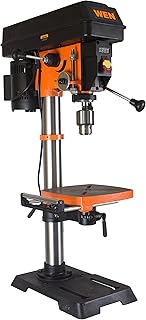
WEN 12-Inch Variable Speed Drill Press (DP1263V)
The infinitely variable 6.2-amp motor is the standout here: dial down to Forstner speeds without touching a belt, then climb back up for pilot holes. Twelve inches of swing plus a laser crosshair and LED work light make this the most complete furniture-shop choice at the price.
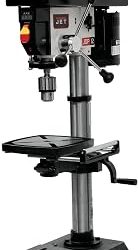
JET 12-Inch Benchtop Drill Press (JWDP-12)
JET builds this one for people who use a drill press daily, and it shows in the fit of the quill and the smoothness of the variable-speed adjustment. It costs more than the field, but the runout and rigidity reward anyone cutting precision joinery in dense hardwoods.
SKIL 10-Inch 5-Speed Benchtop Drill Press (DP9505-00)
SKIL’s laser alignment system is genuinely useful rather than gimmicky, projecting a crosshair that survives table tilts. Ten inches of swing and a bright work light make it a sensible mid-size pick for small furniture, boxes, and drawer hardware.
WOODSKIL 8-Inch 5-Speed Drill Press
The 1/3 HP induction motor runs quieter than brushed alternatives, and the keyed 1/2-inch chuck with a 45-degree beveling cast-iron table punches above the compact footprint. A strong first drill press for apartment shops and hobby benches.
WEN 8-Inch 5-Speed Cast Iron Drill Press (4206T)
This is the value benchmark, and the cast-iron head and base give it more stability than its size suggests. Two inches of spindle travel is the limiting factor, so treat it as a shelf-pin, dowel, and hardware machine rather than a deep-mortise one.
Frequently Asked Questions
Is a benchtop drill press enough for furniture making?
For most home furniture work, yes. Benchtop machines handle shelf pins, dowel joinery, angled leg sockets, and hardware mortises easily. Floor-standing models mainly buy you swing and stroke for oversized panels.
What speed should I use for Forstner bits?
Slow. A 1-inch Forstner in oak or maple wants roughly 500 RPM, and larger diameters want less. Too fast burns the rim and dulls the cutter quickly.
Do I need a variable speed model?
Not strictly, but it changes how often you actually reach for the tool. Belt-change machines work fine if you batch operations by bit size; variable speed suits mixed work with frequent bit swaps.
What if I don’t have bench space?
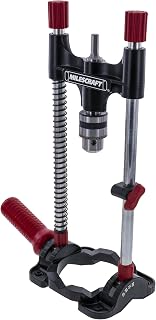
The Milescraft DrillMate portable drilling guide clamps to your existing drill and delivers perpendicular or angled holes with a 3/8-inch chuck. It’s not a substitute for cast iron, but it solves the wandering-bit problem in a drawer-sized package.
Final Thoughts
For most home furniture builders, the WEN DP1263V hits the right balance of swing, variable speed, and price, making it the default recommendation. Step up to the JET JWDP-12 if precision joinery is your main output and you want a machine that stays true for decades, or start with the WEN 4206T if you’re testing whether a drill press earns its place on your bench. All three will end the era of almost-square holes.