Key takeaways
- Decibel rating in context: Anything at or under 60 dBA lets you hold a conversation beside the tank. The 68 to 75 dBA range is still far quieter than a standard pancake unit, but you will notice it through a shared wall.
- CFM before tank size: Tank capacity buys you runtime; CFM at 90 PSI determines whether a tool works at all. Impact wrenches and sanders need roughly 4 to 5 SCFM sustained, while brad nailers and inflation get by on well under 2.
- Oil-free versus lubricated: Oil-free pumps skip the maintenance and never spit oil mist onto a fresh finish, which matters if you paint or refinish furniture. Lubricated pumps run cooler over long duty cycles but demand routine oil changes.
- Footprint and mobility: Vertical tanks reclaim floor space in a tight bay; horizontal aluminum tanks are easier to roll and lift. Check wheel size against door thresholds and any gravel or grass you plan to cross.
- Duty cycle and recovery: A 75 percent duty cycle rating means the motor can work most of the hour without thermal cutout. Slower quiet motors also refill more gradually, so a slightly larger tank pays off in comfort.
What's inside
An air compressor is one of the few garage tools that can undo the calm of an entire house. Fire up a conventional oil-lubricated unit in an attached garage and the sound travels through shared walls, up stairwells, and into whatever room someone is trying to work or nap in. For anyone treating the garage as a genuine extension of the home rather than a sealed-off utility box, decibels matter as much as PSI.
The good news is that low-noise compressors have matured. Slow-turning induction motors, oil-free pumps, and better vibration isolation now deliver 60 to 70 dBA at working pressure, roughly the level of ordinary conversation. Below, we look at six quiet compressors sized for home garages in 2026, from one-gallon inflators that live on a shelf to twenty-gallon vertical tanks that can keep a framing nailer or spray gun fed all afternoon.
As an Amazon Associate we earn from qualifying purchases.



How to Choose a Quiet Air Compressor For Home Garage (2026)
- Decibel rating in context: Anything at or under 60 dBA lets you hold a conversation beside the tank. The 68 to 75 dBA range is still far quieter than a standard pancake unit, but you will notice it through a shared wall.
- CFM before tank size: Tank capacity buys you runtime; CFM at 90 PSI determines whether a tool works at all. Impact wrenches and sanders need roughly 4 to 5 SCFM sustained, while brad nailers and inflation get by on well under 2.
- Oil-free versus lubricated: Oil-free pumps skip the maintenance and never spit oil mist onto a fresh finish, which matters if you paint or refinish furniture. Lubricated pumps run cooler over long duty cycles but demand routine oil changes.
- Footprint and mobility: Vertical tanks reclaim floor space in a tight bay; horizontal aluminum tanks are easier to roll and lift. Check wheel size against door thresholds and any gravel or grass you plan to cross.
- Duty cycle and recovery: A 75 percent duty cycle rating means the motor can work most of the hour without thermal cutout. Slower quiet motors also refill more gradually, so a slightly larger tank pays off in comfort.
The Best Quiet Air Compressor For Home Garage (2026)s Reviewed
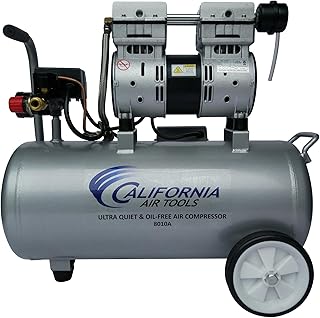
California Air Tools 8010A Ultra Quiet 8-Gallon
The 8010A remains the reference point for quiet home-garage air: a 1.0 HP motor spinning at low RPM for a genuine 60 dBA, paired with a rust-immune aluminum tank that keeps the whole package light enough to move one-handed. It is the natural pick for finish nailing, tire work, and light spraying where noise discipline outranks raw output.
Stealth 20-Gallon Ultra Quiet, 1.8 HP
With 5 CFM at 90 PSI and 150 PSI maximum pressure, this is the smallest quiet compressor here that credibly runs air-hungry tools like ratchets and DA sanders. At 68 decibels it is not silent, but the vertical tank and generous reserve mean the motor cycles far less often than a small unit chasing the same job.
Klutch 20-Gallon, 2 HP Oil-Free Vertical
Klutch aims this one squarely at shop work: 4.2 SCFM at 90 PSI, 175 PSI in the tank, and a 75 percent duty cycle that tolerates sustained use rather than short bursts. Thoughtful details like the easy-access drain and oversized wheels make it the most workshop-literate option on the list.
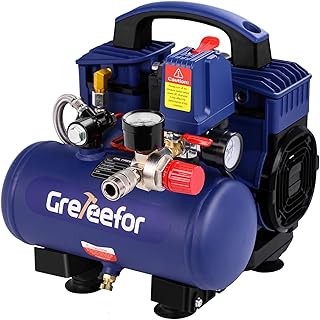
6.4-Gallon Ultra Quiet, 2 HP
A well-judged middle ground, this 60 dBA unit pushes strong airflow through a compact 6.4-gallon tank, which suits spray painting and auto repair in a garage that doubles as living space. Treat the headline CFM figure as a peak rating and size your tools with a margin.
Stealth 2-Gallon Oil-Free (SAQ-1234)
Under 60 dB and small enough to store on a shelf, the 2-gallon Stealth is built for inflation, brad nailing, and blowing out dust rather than continuous tool use. For apartment garages and light DIY, it is the least intrusive way to have air on hand.
Frequently Asked Questions
How quiet is 60 dBA in practice?
Roughly the level of a normal conversation or a dishwasher in an adjacent room. You can talk over it without raising your voice, and it rarely carries through an insulated wall.
Do I need 20 gallons for a home garage?
Only if you run continuous-draw tools such as sanders, grinders, or spray guns. For inflation, nailing, and cleaning, a 1 to 8 gallon tank is usually the smarter use of floor space.
Is oil-free durable enough?
Modern oil-free pumps handle intermittent home use for years. They wear faster than lubricated pumps under heavy daily loads, which is the trade you accept for zero maintenance and clean air.
Can I use one for spray painting furniture?
Yes, provided the compressor meets your gun’s CFM requirement at its rated pressure and you add a moisture and particulate filter. Oil-free designs remove one contamination risk from the equation.
Final Thoughts
For most home garages, the California Air Tools 8010A hits the sweet spot of true 60 dBA operation, useful capacity, and easy portability. Step up to the Stealth 20-Gallon if you need real tool-driving airflow with a modest noise penalty, or the Klutch 20-Gallon if long duty cycles and shop-grade hardware matter more than the last few decibels.