Key takeaways
- Footprint before capacity: Measure the opening, then subtract for airflow and door swing. A 15-inch built-in that sits flush reads as cabinetry; a 19-inch freestanding unit crammed into the same gap reads as an appliance that lost an argument. Freestanding models generally need two to three inches of rear and side clearance to vent properly.
- Shelf geometry over can counts: A “120 can” rating assumes standard 12 oz cans stacked in a way nobody actually uses. Look for at least two removable or fully adjustable shelves so you can clear a tall lane for wine, growlers, or 750 ml mixers.
- Temperature range for what you actually store: Beverage coolers typically hold in the mid-30s to mid-60s Fahrenheit. If wine is in the mix, you want a range that reaches into the 50s rather than a unit that only knows how to run cold.
- Noise and placement: Compressor units are efficient and cold but audible. In an open kitchen or a bedroom-adjacent office, prioritize models marketed as low-noise, and avoid placing the unit against a shared drywall partition where the hum will amplify.
- Finish and light quality: Matte black disappears into dark millwork; white and stainless read cleaner against pale cabinetry. Warm LED interiors flatter labels and glass. Cool blue-white lighting turns a curated shelf into a vending machine.
What's inside
A glass door mini fridge is one of the few appliances that has to earn its place twice: once for how it works, and once for how it looks. Most buyers discover this the hard way. The unit arrives, gets pushed into a corner of the kitchen or the end of a hallway, and suddenly a glowing box of half-empty cans becomes the loudest object in the room. The specs looked fine online. What nobody mentioned was hinge clearance, the buzz at 11 p.m., the shelf spacing that refuses to hold a tall bottle upright, or the way cheap LED strips wash everything in blue.
This guide approaches the category the way we’d approach any piece of visible furniture: proportion first, then finish, then performance. Below you’ll find the models worth considering in 2026, with notes on where each one actually belongs in a home — under a counter, anchoring a bar wall, tucked into a home office, or holding volume for a house that entertains often. We’ve flagged the trade-offs that matter for design-led spaces, including door reversibility, panel depth, glass tint, and how each unit behaves when it’s the only lit thing in a dark room.
As an Amazon Associate we earn from qualifying purchases.



🛒 Best Price Today on Amazon
Prime members get fast, free shipping on everything above, plus member-only deals. New members get a 30-day free trial — cancel anytime.
How to Choose a Glass Door Mini Fridge (2026)
- Footprint before capacity: Measure the opening, then subtract for airflow and door swing. A 15-inch built-in that sits flush reads as cabinetry; a 19-inch freestanding unit crammed into the same gap reads as an appliance that lost an argument. Freestanding models generally need two to three inches of rear and side clearance to vent properly.
- Shelf geometry over can counts: A “120 can” rating assumes standard 12 oz cans stacked in a way nobody actually uses. Look for at least two removable or fully adjustable shelves so you can clear a tall lane for wine, growlers, or 750 ml mixers.
- Temperature range for what you actually store: Beverage coolers typically hold in the mid-30s to mid-60s Fahrenheit. If wine is in the mix, you want a range that reaches into the 50s rather than a unit that only knows how to run cold.
- Noise and placement: Compressor units are efficient and cold but audible. In an open kitchen or a bedroom-adjacent office, prioritize models marketed as low-noise, and avoid placing the unit against a shared drywall partition where the hum will amplify.
- Finish and light quality: Matte black disappears into dark millwork; white and stainless read cleaner against pale cabinetry. Warm LED interiors flatter labels and glass. Cool blue-white lighting turns a curated shelf into a vending machine.
The Best Glass Door Mini Fridges (2026) Reviewed
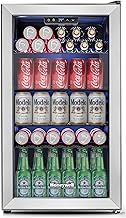
hOmeLabs Beverage Refrigerator, 120 Cans
The most sensible all-rounder here: generous capacity, genuinely adjustable removable shelving, and a reversible door that solves most awkward corner placements. It’s the model we’d specify for a home office or a den bar where the fridge needs to be useful daily and quiet enough to forget about.
Honeywell 116 Can Beverage Cooler
Built to a commercial-grade standard with a heavier door and steadier temperature recovery, which matters if the unit gets opened twenty times during a party. The slightly lower can count buys you better build quality and a cleaner, more restrained front face.
EUHOMY 15 Inch Beverage Refrigerator
The pick for anyone integrating into cabinetry. At 15 inches with true built-in capability, it slots under a counter and sits flush, and the LED lighting is soft enough to work as ambient light in a finished bar run. Capacity is surprisingly high for the footprint.
Nutrichef 108 Can Beverage Refrigerator
A wide 21°F to 64°F range makes this the most flexible option for mixed storage — beer cold, wine at cellar temperature. The compact 19 x 17 x 33 inch body suits apartments and narrow galley layouts where a full 24-inch unit would dominate.
Freestanding 120 Can Beverage Cooler (KB02 FLB-60)
A straightforward black freestanding cooler that covers the fundamentals without the price premium: adjustable shelving, clear glass, and enough capacity for regular hosting. Best treated as a workhorse for a garage bar, basement lounge, or rental where finish is secondary.
Frequently Asked Questions
Can a freestanding beverage cooler be installed under a counter?
Not safely. Freestanding units vent from the back or sides and will overheat in an enclosed cabinet, shortening compressor life. Only choose a model explicitly rated for built-in installation, which vents through the front grille.
How cold do these get compared to a standard refrigerator?
Most beverage coolers bottom out around the low 30s to upper 30s Fahrenheit, which is fine for drinks but not intended for raw food storage. Treat them as beverage-only appliances.
What if I need more capacity for regular entertaining?
Step up to a commercial display fridge. A 24.5-inch, 15 cu. ft. glass door unit with five adjustable shelves and an auto-rebound door handles volume far better than any mini fridge, though it needs a dedicated wall and reads as retail rather than residential.
Does the glass door waste energy?
Single-pane glass loses more than a solid door, but modern units offset this with better insulation and tighter gaskets. Keep the fridge out of direct sunlight and away from heat sources like ovens or radiators to reduce workload.
Final Thoughts
For most homes, the hOmeLabs 120 can cooler is the right default: capable, quiet, and easy to place. If your beverage station is part of finished millwork, the EUHOMY 15 inch built-in is the only one here that will sit flush and look intentional. And if you want the sturdiest door and the most stable temperatures for a room that sees real traffic, the Honeywell 116 can is worth the trade in capacity.