Key takeaways
- Rip capacity: Anything under 24 inches means you’ll be breaking down sheet goods before they reach the saw. A 32-inch rip lets you take a full sheet of plywood down the middle in one pass, which matters enormously for casework, cabinet backs, and wardrobe panels.
- Fence quality: This is the single biggest predictor of whether your cuts close up cleanly at the miter. Look for a rack-and-pinion fence that stays parallel across its full travel and locks without deflecting when you lean on stock.
- Stand and mobility: A rolling stand with a gravity-assisted or single-lever fold is not a luxury if your shop doubles as a parking spot. Test the setup motion honestly: a saw that takes three minutes to deploy is a saw you’ll avoid using for a two-minute cut.
- Dust management: Furniture-grade finishing starts with a shop that isn’t coated in fines. A shrouded blade with a proper 2-1/2-inch port pulls far more than an open throat, and it keeps your sightline to the cut line clear.
- Safety hardware: Riving knife, anti-kickback pawls, and a blade guard that is genuinely quick to remove and reinstall. If the guard is annoying to reattach, it lives on the shelf, and that’s how accidents happen.
What's inside
Anyone who has tried to build a slab console or a run of floating shelves in a garage bay knows the bottleneck is rarely the design. It’s the rip cut. Plywood arrives at 4×8 feet, hardwood arrives rough and wandering, and a circular saw with a clamped straightedge only gets you so close before the joinery starts telling on you. A 10-inch table saw is the tool that turns “close enough” into repeatable, square, glue-ready stock, which is exactly what furniture work demands.
The trouble is that the 10-inch category has quietly split into two very different animals. There are compact jobsite saws built to fold, roll, and live in a corner between projects, and there are heavier portable saws that trade convenience for rip capacity and a more forgiving fence. This guide covers the models worth your bench space in 2026, what actually separates them once you’re cutting real material, and a couple of hand tools that finish what a table saw can’t reach.
As an Amazon Associate we earn from qualifying purchases.


How to Choose a/an 10in Table Saw (2026)
- Rip capacity: Anything under 24 inches means you’ll be breaking down sheet goods before they reach the saw. A 32-inch rip lets you take a full sheet of plywood down the middle in one pass, which matters enormously for casework, cabinet backs, and wardrobe panels.
- Fence quality: This is the single biggest predictor of whether your cuts close up cleanly at the miter. Look for a rack-and-pinion fence that stays parallel across its full travel and locks without deflecting when you lean on stock.
- Stand and mobility: A rolling stand with a gravity-assisted or single-lever fold is not a luxury if your shop doubles as a parking spot. Test the setup motion honestly: a saw that takes three minutes to deploy is a saw you’ll avoid using for a two-minute cut.
- Dust management: Furniture-grade finishing starts with a shop that isn’t coated in fines. A shrouded blade with a proper 2-1/2-inch port pulls far more than an open throat, and it keeps your sightline to the cut line clear.
- Safety hardware: Riving knife, anti-kickback pawls, and a blade guard that is genuinely quick to remove and reinstall. If the guard is annoying to reattach, it lives on the shelf, and that’s how accidents happen.
The Best 10in Table Saw (2026)s Reviewed
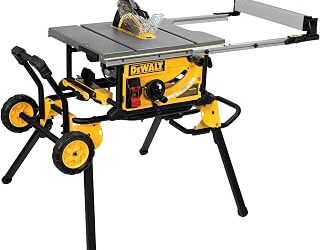
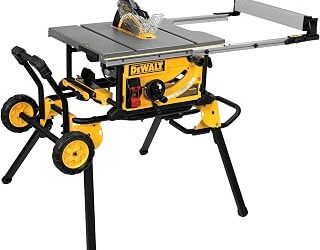
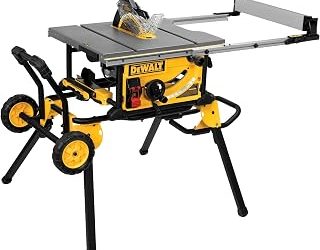
DEWALT DWE7491RS 10-Inch with Rolling Stand
This is the default recommendation for a reason: 32-1/2 inches of rip capacity, a rack-and-pinion fence that tracks true, and a rolling stand that deploys without wrestling. If you build case goods or anything involving full sheets, it removes the most frustrating limitation in a small shop.
BOSCH GTS15-10 with Gravity-Rise Stand
The Gravity-Rise stand is the standout here, unfolding in one fluid motion and rolling over thresholds and gravel without complaint. Rip capacity sits at 32-1/8 inches and the arbor runs smooth under load, making it the pick if you move between a shop and an install site.
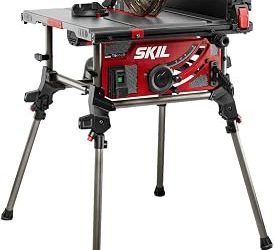
SKIL TS6307-00 15 Amp Portable Jobsite Saw
The value play, and a legitimate one. You get a rack-and-pinion fence and a folding stand at a noticeably lower entry point, which makes it a sensible first table saw for someone building their first few pieces rather than running production.
DEWALT DWE7485 8-1/4 in. Compact Saw
Not a 10-inch saw, but worth knowing about: it’s the lightest way into accurate ripping, and the fence quality carries over from its bigger sibling. Choose it only if storage space or carrying weight genuinely outranks capacity, since the smaller blade limits depth on thicker hardwood.
JORGENSEN 10-Inch Japanese Pull Saw
Every table saw project eventually needs a cut the table saw can’t make, usually trimming a proud dowel or a plug flush with a finished surface. This double-edge pull saw, with 7-12 and 18 TPI sides and a flexible replaceable blade, handles that final pass without scarring the workpiece.
Frequently Asked Questions
Is a 10-inch blade necessary, or will 8-1/4 inches do?
Eight-and-a-quarter is fine for sheet goods and 3/4-inch stock. A 10-inch blade gives you the depth of cut for 2x material, thick hardwood, and taller tenon cheeks, plus far wider blade availability.
Do I need a cabinet saw for furniture work?
Not to start. A well-tuned portable 10-inch saw with a quality blade produces joinery-ready cuts. Cabinet saws buy you mass, quieter operation, and better dust extraction rather than fundamentally better accuracy.
What blade should I upgrade to?
Swap the stock blade for a 40 to 50-tooth combination blade for general furniture work, and add a dedicated 80-tooth for veneered plywood and melamine where tearout ruins the panel.
How much space does one of these actually need?
Plan for roughly eight feet of clearance in front and behind the blade for full-sheet work, though outfeed support and a roller stand can compress that considerably.
Final Thoughts
For most people building furniture at home, the DEWALT DWE7491RS is the saw that solves the widest range of problems, and the BOSCH GTS15-10 is the one to choose if mobility is the deciding factor. Add the JORGENSEN Japanese pull saw for flush trimming and you can take a project from raw sheet to finished piece without borrowing anyone’s shop.