Key takeaways
- Reach math, not raw height: Measure to your eave, then add at least three feet of ladder above that line. A single-story roof usually wants 16 feet or more of extended length; a 12.5-foot ladder suits low eaves, sheds, and attic hatches.
- Duty rating and materials: A 330 lb capacity covers your body weight plus tools and materials with margin. Aluminum keeps the carry weight manageable, though it should never go near live electrical service lines.
- Roof hooks and stabilizers: Detachable hooks lock the top of the ladder to the ridge or gutter edge; a stabilizer bar widens the base and stops side-to-side sway. On uneven ground these two features do more for safety than any other upgrade.
- Locking mechanism quality: Look for auto-locking rungs with clear indicators and a controlled retraction that will not pinch fingers. ANSI or EN 131 certification is your shortcut to knowing the locks were load-tested rather than eyeballed.
- How it stores: Collapsed length, weight, and whether it stands upright in a closet determine if you actually use it. Multi-position frames earn their keep on stairs and interior work; straight telescoping models win on compactness.
What's inside
Roof access is the one household task where the tool matters more than the technique. Most homeowners own a six-foot step stool and a vague plan, then discover that a single-story eave sits around 10 feet up, the gutter line needs three feet of overlap above it, and the ladder has to land on a surface that is rarely flat. The result is the classic bad setup: too short, too steep, planted on soft turf, and flexing under load. It is also why ladder falls remain one of the most common serious injuries in home maintenance.
This guide looks at roof-capable ladders through a design-minded lens: reach and stability first, then how the thing lives in your home when the job is done. Telescoping and multi-position aluminum ladders have improved considerably, and the current crop folds down to something that fits a hall closet, a garage shelf, or an RV storage bay instead of dominating a wall. Below are the models worth your attention in 2026, plus the specs that actually predict a safe climb.
As an Amazon Associate we earn from qualifying purchases.




How to Choose a Ladder For Getting On Roof (2026)
- Reach math, not raw height: Measure to your eave, then add at least three feet of ladder above that line. A single-story roof usually wants 16 feet or more of extended length; a 12.5-foot ladder suits low eaves, sheds, and attic hatches.
- Duty rating and materials: A 330 lb capacity covers your body weight plus tools and materials with margin. Aluminum keeps the carry weight manageable, though it should never go near live electrical service lines.
- Roof hooks and stabilizers: Detachable hooks lock the top of the ladder to the ridge or gutter edge; a stabilizer bar widens the base and stops side-to-side sway. On uneven ground these two features do more for safety than any other upgrade.
- Locking mechanism quality: Look for auto-locking rungs with clear indicators and a controlled retraction that will not pinch fingers. ANSI or EN 131 certification is your shortcut to knowing the locks were load-tested rather than eyeballed.
- How it stores: Collapsed length, weight, and whether it stands upright in a closet determine if you actually use it. Multi-position frames earn their keep on stairs and interior work; straight telescoping models win on compactness.
The Best Ladder For Getting On Roof (2026)s Reviewed
LANBITOU 14 FT Multi-Position Folding Ladder
The most versatile option here: it works as a 4-step A-frame, a straight extension to 14 feet, or a staggered configuration for staircases, all at a 330 lb rating. That flexibility makes it the pick if one ladder has to handle gutters, ceiling fixtures, and paint touch-ups in a narrow stairwell.
12.5 FT Heavy-Duty Telescoping Extension Ladder
A straightforward, no-frills telescoping ladder aimed at attic hatches, low eaves, and interior renovation work, with wide anti-slip steps that feel more secure underfoot than thin round rungs. Best suited to single-story homes with a genuinely low roofline rather than tall two-story access.
SINMEIRUN 12.5 FT Pro Telescoping Ladder
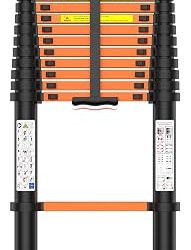
ANSI certification and detachable roof hooks are the headline features, and the hooks are what elevate this from a general-purpose ladder to a roof-specific one. The orange finish is a visibility feature more than a style choice, and it earns points for RV and travel use where compact storage is non-negotiable.
20.3 FT Telescoping Ladder with Hooks, Stabilizer & Wheels
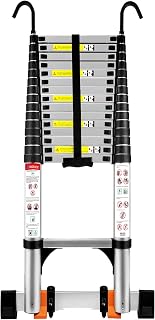
The reach champion of the group, with enough extended length for two-story gutters, plus auto-lock rungs, a stabilizer bar, and wheels that make repositioning a long ladder manageable solo. This is the serious choice for exterior wall and gutter maintenance on a taller house.
SocTone 12.5 FT Telescoping Ladder with Stabilizers
Stabilizers at this price point are unusual and genuinely useful on lawns, gravel drives, and older uneven patios. A sensible all-rounder for household and outdoor tasks where the ground, not the height, is the main variable.
Frequently Asked Questions
What length ladder do I need to reach my roof?
Measure ground to eave, then add three to four feet. Most single-story eaves sit at 9 to 11 feet, which points to a 16-foot ladder; two-story access typically needs 20 feet or more.
Are telescoping ladders safe for roof access?
Certified models with auto-locking rungs and a 330 lb rating are safe when set up correctly. Confirm every rung is locked before climbing, set the base at roughly a 75-degree angle, and use roof hooks or a stabilizer whenever the surface is uneven.
Do I need roof hooks or a stabilizer bar?
If you are stepping off the ladder onto the roof, yes. Hooks anchor the top rail so it cannot slide sideways at the exact moment your weight shifts, which is when most ladder falls happen.
Can one ladder handle both indoor and roof work?
A multi-position model like the LANBITOU comes closest, since it converts between A-frame, stairway, and extension setups. Dedicated tall telescoping ladders are better outdoors but awkward for interior tasks.
Final Thoughts
For most homes, the LANBITOU 14 FT multi-position ladder is the smartest single purchase, covering interior and low-roof work in one compact frame. If your priority is genuine roof access, the SINMEIRUN 12.5 FT Pro adds certified hardware and detachable hooks, while the 20.3 FT telescoping model with stabilizer and wheels is the one to buy for two-story gutters and exterior walls.