Key takeaways
- CFM at 40 PSI: Match the compressor’s sustained output to your gun’s requirement, then add roughly 30% headroom. An LVLP gun asking 4 CFM wants a compressor delivering 5.5 or better, or the pump never gets a chance to catch up.
- Tank volume vs. run time: Small tanks recover constantly, which means heat, moisture, and pressure swings mid-pass. Eight gallons lets you cross a full cabinet door on stored air; 2 to 3 gallons suits touch-ups, trim, and small pieces.
- Noise floor: Anything over 80 dBA is unbearable in a finished room. The 60 to 70 dBA class runs quiet enough to hold a conversation beside, which matters when you’re spraying inside an occupied house.
- Oil-free and moisture-managed: Oil-free pumps eliminate the worst finish contaminant and skip maintenance. Add an inline water separator regardless — humid compressed air causes blush and fisheye in waterborne and solvent finishes alike.
- Gun architecture: HVLP with a pressure pot gives the finest atomization and largest capacity. LVLP is friendlier to modest compressors. Airless and handheld electric trade some finish refinement for speed and zero air-supply math.
What's inside
Most finish failures don’t start at the gun. They start at the air supply. A designer-grade lacquer on a walnut credenza needs a steady, dry, high-volume stream of air, and a compressor that can only sustain that for forty seconds before the pressure sags will telegraph every dropout as orange peel, dry spray, or a tiger-striped sheen. The frustrating part is that sprayers and compressors are sold in separate aisles, described in separate units, and almost never matched for you. Horsepower on the box tells you very little; CFM at working pressure tells you nearly everything.
This guide pairs the two halves properly. Below you’ll find compressor-and-gun systems we’d trust on cabinetry, built-ins, and furniture, plus airless and handheld options for anyone who wants to skip compressed air entirely. We cover the specs that actually govern finish quality, review five standouts, and answer the questions that come up once the drop cloths are already down.
As an Amazon Associate we earn from qualifying purchases.



How to Choose a Paint Sprayer Air Compressor (2026)
- CFM at 40 PSI: Match the compressor’s sustained output to your gun’s requirement, then add roughly 30% headroom. An LVLP gun asking 4 CFM wants a compressor delivering 5.5 or better, or the pump never gets a chance to catch up.
- Tank volume vs. run time: Small tanks recover constantly, which means heat, moisture, and pressure swings mid-pass. Eight gallons lets you cross a full cabinet door on stored air; 2 to 3 gallons suits touch-ups, trim, and small pieces.
- Noise floor: Anything over 80 dBA is unbearable in a finished room. The 60 to 70 dBA class runs quiet enough to hold a conversation beside, which matters when you’re spraying inside an occupied house.
- Oil-free and moisture-managed: Oil-free pumps eliminate the worst finish contaminant and skip maintenance. Add an inline water separator regardless — humid compressed air causes blush and fisheye in waterborne and solvent finishes alike.
- Gun architecture: HVLP with a pressure pot gives the finest atomization and largest capacity. LVLP is friendlier to modest compressors. Airless and handheld electric trade some finish refinement for speed and zero air-supply math.
The Best Paint Sprayer Air Compressors of 2026, Reviewed
California Air Tools 8010 PK Compressor & LVLP Kit
The most sensible entry point into real compressed-air finishing: an 8-gallon oil-free tank at 60 dBA, bundled with an LVLP gun already sized to its output, so the guesswork disappears. The wheeled frame moves between rooms easily, and the tank reserve is generous enough to spray a run of shaker doors without audible cycling mid-pass.
Binks Trophy Series HVLP Pressure Pot Outfit
This is professional cabinet-shop equipment. The 2.8-gallon galvanized pot feeds the Trophy Series gun through 25 feet of hose, meaning you carry a light gun instead of a full cup and never break rhythm to refill on large casework. The 1.4 mm nozzle atomizes waterborne lacquers and pigmented finishes beautifully, though you’ll need a compressor sized to feed it properly.
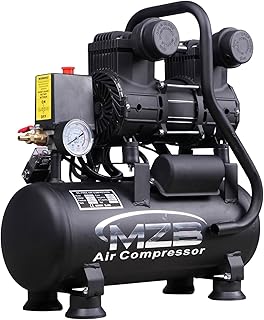
MZB 2.4-Gallon Ultra Quiet Compressor
At 5.65 CFM and 70 dBA from a 2.4-gallon oil-free steel tank, this punches noticeably above its footprint and stores in a closet between projects. The compact tank means more frequent recovery cycles, so treat it as ideal for furniture, trim, and detail work rather than continuous whole-room spraying.
InoKraft NEO Airless Paint Sprayer Kit
For latex on walls and stain on exterior work, 3000 PSI airless coverage simply moves faster than any compressor setup, and the 10-minute cleanup removes the usual reason people abandon airless. It’s genuinely approachable for first-timers, with onboard accessory storage that keeps tips and guards from vanishing between jobs.
1000W Electric Spray Gun, 47 oz Container
Six nozzles and three spray patterns from a single self-contained unit make this the practical choice for weekend refinishing — dressers, chairs, fence panels, a single accent cabinet. The oversized 47 oz reservoir cuts refill stops meaningfully, and there’s no hose, tank, or moisture trap to manage.
Frequently Asked Questions
What size compressor does a paint sprayer need?
For HVLP work, look for 4 to 6 CFM sustained at 40 PSI and at least 6 gallons of tank. LVLP guns manage on less. Undersizing shows up as inconsistent film build long before the compressor sounds strained.
Do I need a compressor at all?
No. Airless and handheld electric sprayers are self-contained. Compressed air earns its place when you want the finest atomization on visible furniture and cabinetry, or when you’re spraying long enough that ergonomics and refill intervals start to matter.
How do I keep water out of the finish?
Install an inline desiccant or water separator at the gun, drain the tank after every session, and let hot compressed air cool before it reaches the gun. Oil-free pumps handle the other half of the contamination problem for you.
Can I spray cabinets indoors?
Yes, with a quiet compressor, cross-ventilation, plastic containment, and appropriate respiratory protection. Waterborne finishes make this far more manageable than solvent lacquers in an occupied home.
Final Thoughts
For most readers refinishing cabinetry or furniture, the California Air Tools 8010 PK is the balanced pick — quiet, correctly matched, and ready to spray out of the box. Step up to the Binks Trophy Series pressure pot outfit if finish quality on large casework is the priority, or reach for the InoKraft NEO when the job is walls and square footage rather than fine detail.