Key takeaways
- Delivered CFM at 90 PSI: Read the gun’s requirement first, then add roughly 30 percent headroom. An LVLP detail gun may want 2 to 4 CFM, while a full-size HVLP for cabinet doors can ask 6 or more. Peak CFM figures are marketing; the 90 PSI number is the one your finish feels.
- Tank volume as a buffer: Small twin-stack tanks recover fast but cycle constantly. Eight to thirteen gallons is the sweet spot for furniture, giving you a continuous pass across a door face without the pump interrupting flow.
- Noise in a lived-in space: Anything at or below 70 dB is conversation-level. Dual-piston quiet pumps around 60 dBA let you spray in a basement shop on a weekday evening without clearing the house.
- Oil-free versus lubricated: Oil-free pumps eliminate any chance of oil mist reaching a lacquer or waterborne topcoat, and they need no maintenance schedule. Lubricated pumps run cooler and last longer under heavy duty cycles, but demand an inline filter and discipline.
- Moisture control and portability: Plan on a desiccant dryer or at minimum a water separator, since compressed air carries condensate that fisheyes a finish. Wheels and a sub-80-pound frame matter if the compressor moves between garage, driveway, and install site.
What's inside
Refinishing a mid-century sideboard or laying down a flawless satin coat on built-in cabinetry lives or dies on air supply, not on the gun. Most first-time sprayers buy a compressor sized for nail guns and tire valves, then watch the finish orange-peel the moment the motor kicks out and pressure sags. The gap is CFM, not horsepower marketing, and it is the single most common reason a home spray project looks sprayed instead of finished.
This guide looks at compressors through the lens of interior work: quiet enough to run in a garage attached to a nursery wall, oil-free so overspray does not pick up carryover, and steady enough in delivered air to feed an HVLP or LVLP gun through a full cabinet door without pausing. Below are six units worth considering in 2026, followed by how to match a tank and pump to the kind of furniture and trim work you actually do.
As an Amazon Associate we earn from qualifying purchases.



How to Choose a/an Air Compressor For Spraying Paint (2026)
- Delivered CFM at 90 PSI: Read the gun’s requirement first, then add roughly 30 percent headroom. An LVLP detail gun may want 2 to 4 CFM, while a full-size HVLP for cabinet doors can ask 6 or more. Peak CFM figures are marketing; the 90 PSI number is the one your finish feels.
- Tank volume as a buffer: Small twin-stack tanks recover fast but cycle constantly. Eight to thirteen gallons is the sweet spot for furniture, giving you a continuous pass across a door face without the pump interrupting flow.
- Noise in a lived-in space: Anything at or below 70 dB is conversation-level. Dual-piston quiet pumps around 60 dBA let you spray in a basement shop on a weekday evening without clearing the house.
- Oil-free versus lubricated: Oil-free pumps eliminate any chance of oil mist reaching a lacquer or waterborne topcoat, and they need no maintenance schedule. Lubricated pumps run cooler and last longer under heavy duty cycles, but demand an inline filter and discipline.
- Moisture control and portability: Plan on a desiccant dryer or at minimum a water separator, since compressed air carries condensate that fisheyes a finish. Wheels and a sub-80-pound frame matter if the compressor moves between garage, driveway, and install site.
The Best Air Compressor For Spraying Paint (2026)s Reviewed
California Air Tools 8010 PK with LVLP Spray Kit
The most sensible entry point for furniture work, pairing a 60 dBA oil-free pump with an 8-gallon tank and a matched LVLP gun, so the air supply and the gun are already speaking the same language. The 1.0 HP motor is modest, but LVLP guns sip air, and the combination lays down waterborne finishes on chairs, frames, and cabinet fronts convincingly.
VEVOR 13-Gallon Oil-Free Compressor
The largest tank here at 13 gallons and the quietest rating at 66 dB, which is an unusual pairing and makes it the pick for anyone spraying full cabinet sets or a dining table in one session. At 4.6 SCFM at 90 PSI it comfortably feeds most HVLP conversion guns, and the wheeled steel body moves without a second person.
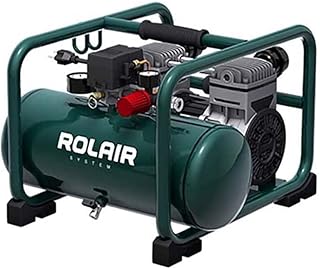
Rolair JC20 Hand Carry 2HP
A commercial-grade pump in a hand-carry frame, running 70 dB on a standard 115V circuit with the build quality that keeps Rolair units in trim carpenters’ vans for a decade. The small tank means more cycling on large panels, so treat this as the choice for on-site trim, moulding, and touch-up rather than batch spraying.
Rolair FC2002 Twin Stack
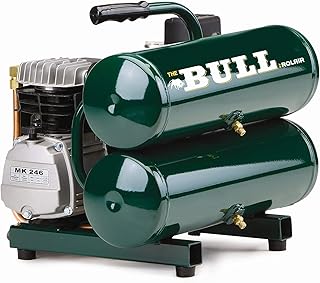
The twin-stack format trades quiet operation for fast recovery and a genuinely rugged 2 HP pump with overload protection and manual reset, which is what you want if the compressor also drives brad nailers all day. Bring hearing protection and a good regulator, then let its recovery speed carry you through longer spray runs.
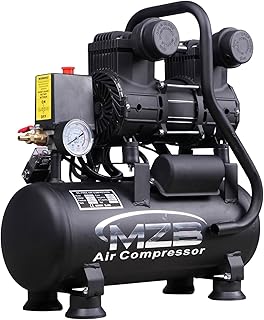
MZB 2.4 Gallon Ultra Quiet
At 70 dB and 5.65 CFM peak from a 1.2 HP oil-free pump, this is a compact unit for detail spraying: drawer fronts, spindles, hardware, and small refinishing jobs on a balcony or spare room. The 2.4-gallon tank is the limiting factor, so keep it to short passes and let it catch up.
Frequently Asked Questions
How much CFM do I actually need to spray furniture?
Plan for 4 to 6 CFM at 90 PSI for most HVLP guns handling cabinet doors and table tops, or 2 to 3 CFM if you are using an LVLP detail gun on smaller pieces. Check the gun’s spec sheet rather than the compressor’s peak claim.
Is an oil-free compressor good enough for a fine finish?
Yes, and it removes a real risk. Oil-free pumps cannot introduce oil mist into your air line, which is the cause of many mystery fisheyes in clear coats. The tradeoff is a shorter service life under continuous heavy use.
Do I need an air dryer or is a water trap sufficient?
A water separator at the tank plus a small inline filter at the gun handles most conditions. In humid climates or for high-gloss lacquer, add a desiccant dryer, since moisture in the line will blush and blister an otherwise perfect coat.
Can a small pancake compressor spray paint at all?
For small pieces and touch-up work with an LVLP gun, yes, provided you accept frequent pump cycling. It becomes unworkable on large flat surfaces, where a pressure drop mid-pass shows up as visible banding.
Final Thoughts
For most home furniture projects, the California Air Tools 8010 PK is the easiest recommendation: quiet, oil-free, and shipped with a matched LVLP gun so there is no guesswork in pairing air to spray pattern. Step up to the VEVOR 13-Gallon if you are spraying full cabinet sets and want a tank large enough to finish a panel in one uninterrupted pass, or choose the Rolair JC20 if job-site durability and portability outweigh tank capacity.