Key takeaways
- Throat depth: This is the distance from blade to frame, and it caps how wide a panel you can cut into. An 8-inch throat handles drawer parts, chair components, and small curved brackets. A 10-inch throat opens up cabinet doors, wider seat blanks, and template work on shelf ends.
- Cutting height: Anything under 3 inches limits you to dimensioned stock. A 5-inch capacity means you can resaw — slicing thick boards into matched veneer or bookmatched panels, which is where a band saw earns its footprint in a furniture shop.
- Blade speed and material: Wood wants speed, roughly 2,000 to 3,000 FPM. Steel and aluminum want the opposite: variable-speed machines running 137–472 FPM. A wood saw will burn a blade on mild steel; a metal saw will leave fuzzy, scorched edges in maple.
- Tilting table and fence quality: A 0–45° table is standard, but check that it locks positively and returns to square. A double-sided fence and a real miter gauge turn a curve cutter into a machine that can also handle straight rips and repeat joinery cuts.
- Tension and blade access: Quick-tension levers and tool-free doors sound like conveniences. In practice they determine how often you swap to a narrow blade for tight radii, which is the difference between good curves and compromised ones.
What's inside
Curves are what separate furniture that looks designed from furniture that looks assembled. A tapered chair leg, a softened cabinet corner, an arched headboard rail, the gentle scoop of a bench seat — none of it comes off a miter saw. It comes off a band saw, and for anyone building in a garage bay or a spare-room shop, that means a benchtop model. The problem is that the benchtop category has quietly split in two: compact 8-inch machines built for detail work in hardwood, and heavier metal-cutting saws that run at a fraction of the speed. Buy across that line by accident and you’ll spend a weekend fighting a tool that was never meant for your material.
This guide sorts the current crop by what they’re actually good at. We look at throat depth against real project dimensions, cutting height against the stock thickness furniture makers actually use, blade speed against material, and the small ergonomics — tension levers, tool-free doors, tilting tables — that decide whether a saw gets used or gets shoved under the bench. Our picks for 2026 are below.
As an Amazon Associate we earn from qualifying purchases.


How to Choose a Benchtop Band Saw (2026)
- Throat depth: This is the distance from blade to frame, and it caps how wide a panel you can cut into. An 8-inch throat handles drawer parts, chair components, and small curved brackets. A 10-inch throat opens up cabinet doors, wider seat blanks, and template work on shelf ends.
- Cutting height: Anything under 3 inches limits you to dimensioned stock. A 5-inch capacity means you can resaw — slicing thick boards into matched veneer or bookmatched panels, which is where a band saw earns its footprint in a furniture shop.
- Blade speed and material: Wood wants speed, roughly 2,000 to 3,000 FPM. Steel and aluminum want the opposite: variable-speed machines running 137–472 FPM. A wood saw will burn a blade on mild steel; a metal saw will leave fuzzy, scorched edges in maple.
- Tilting table and fence quality: A 0–45° table is standard, but check that it locks positively and returns to square. A double-sided fence and a real miter gauge turn a curve cutter into a machine that can also handle straight rips and repeat joinery cuts.
- Tension and blade access: Quick-tension levers and tool-free doors sound like conveniences. In practice they determine how often you swap to a narrow blade for tight radii, which is the difference between good curves and compromised ones.
The Best Benchtop Band Saws (2026), Reviewed
WOODSKIL 10-Inch Benchtop Bandsaw with Stand
The most capable saw here for furniture work: a 10-inch throat and 5-1/8-inch cutting height put resawing and cabinet-door curves genuinely within reach, and the dual 2,360/3,000 FPM speeds cover hardwood and softer stock. The included stand and quick tension system make it feel like a small floor saw rather than a benchtop compromise.
SEESII 8″ Benchtop Band Saw
A well-specified detail machine, with a 0–45° tilting worktable, miter gauge, and double-sided fence out of the box — an unusually complete kit at this size. The 3-1/8-inch cutting height keeps it in dimensioned-stock territory, so treat it as a curve and joinery saw rather than a resaw.
PeakPursuit 8-Inch Band Saw
The pure copper motor running at 1,800 RPM gives this one steady, low-drama torque through hardwood, and it handles aluminum without protest. A sensible pick if your work leans toward chair parts, small brackets, and mixed-material projects.
BUCKTOOL 5-Inch Metal Band Saw
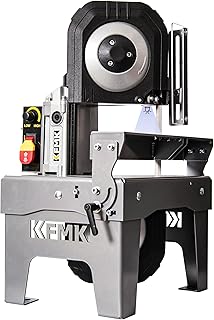
A different tool for a different job: 1.5 HP, 10-amp, and variable speed from 137 to 472 FPM for clean cuts in steel and aluminum. The adjustable worktable and extension table make it a legitimate choice for anyone fabricating metal bases, brackets, or frames for mixed-media furniture.
8-Inch 3-Amp Benchtop Bandsaw
The value entry, with a 1,800 FPM fixed speed, 0–45° tilting range, fence, and miter gauge. The removable safety key is a real advantage in a shared or family workspace, and it’s a reasonable first band saw if your projects are small-format.
Frequently Asked Questions
Can one band saw handle both wood and metal?
Only if it has variable speed. Fixed-speed wood saws run far too fast for steel. Variable-speed machines like the 5-inch metal saws can slow down for metal and are workable in wood and PVC, though they’re not optimized for fine woodworking.
Is an 8-inch throat enough for furniture?
For chair parts, drawer components, curved rails, and small templates, yes. If you plan to shape cabinet doors, wide seat blanks, or resaw for veneer, step up to 10 inches.
What blade should I start with?
A 1/4-inch, 6-TPI blade is the most useful general-purpose choice for wood — tight enough for moderate curves, aggressive enough for thicker stock. Add a 1/8-inch for tight radii and a wider blade for resawing.
Do I need dust collection?
Strongly recommended. Band saws throw fine dust below the table, and most benchtop models include a port sized for a shop vac. Connecting it also keeps the lower blade guides cleaner and cutting more accurately.
Final Thoughts
For most home furniture makers, the WOODSKIL 10-Inch is the saw to buy — its throat and cutting height cover the work that actually shows up in cabinet and seating projects. If your builds are smaller and detail-driven, the SEESII 8″ arrives better equipped than its price suggests, and the BUCKTOOL 5-Inch is the right answer if metal bases and frames are part of your design language.