Key takeaways
- Tooth count: For plywood, veneered panels, and melamine, 60 to 80 teeth is the sweet spot. More teeth means smaller bites, less veneer lift, and a cleaner exit edge. Below 40 teeth belongs on framing lumber, not cabinet stock.
- Grind geometry: Look for ATB (alternate top bevel). The angled teeth act like tiny knives, slicing the veneer fibers instead of chiseling them. A high-ATB grind is the single biggest factor in a tear-out-free edge.
- Kerf thickness: Thin-kerf blades (around 0.090″) remove less material and demand less of your motor, which matters on jobsite and hybrid saws under 2 HP. Full-kerf blades run stiffer and truer on cabinet saws.
- Arbor and diameter: Most 10-inch home saws use a 5/8-inch arbor. Industrial 12-inch machines typically want a 1-inch bore. Confirm both before ordering — an adapter is not a substitute for the correct fit.
- Carbide quality: Micrograin carbide tips hold an edge far longer through abrasive plywood glue lines and MDF. Expansion slots and laser-cut stabilizer vents keep the plate flat and quiet as it heats.
What's inside
Plywood punishes the wrong blade. The face veneer is thin, brittle, and glued cross-grain, so a coarse rip blade lifts it into a ragged fringe on the exit side of the cut — the kind of edge that reads as “shop project” the moment it lands in a finished room. If you are building floating shelves, a plywood wardrobe carcass, or a slab-front vanity, the blade is doing more design work than the finish ever will.
This guide looks at the table saw blades worth owning in 2026 for sheet goods: high-tooth-count finish blades, a heavy-duty 12-inch combination option, and a couple of multi-packs that cover ripping and crosscutting without a drawer full of spares. Below you will find our picks, followed by the specs that actually change your cut quality and answers to the questions that come up most often.
As an Amazon Associate we earn from qualifying purchases.


How to Choose a Plywood Table Saw Blade (2026)
- Tooth count: For plywood, veneered panels, and melamine, 60 to 80 teeth is the sweet spot. More teeth means smaller bites, less veneer lift, and a cleaner exit edge. Below 40 teeth belongs on framing lumber, not cabinet stock.
- Grind geometry: Look for ATB (alternate top bevel). The angled teeth act like tiny knives, slicing the veneer fibers instead of chiseling them. A high-ATB grind is the single biggest factor in a tear-out-free edge.
- Kerf thickness: Thin-kerf blades (around 0.090″) remove less material and demand less of your motor, which matters on jobsite and hybrid saws under 2 HP. Full-kerf blades run stiffer and truer on cabinet saws.
- Arbor and diameter: Most 10-inch home saws use a 5/8-inch arbor. Industrial 12-inch machines typically want a 1-inch bore. Confirm both before ordering — an adapter is not a substitute for the correct fit.
- Carbide quality: Micrograin carbide tips hold an edge far longer through abrasive plywood glue lines and MDF. Expansion slots and laser-cut stabilizer vents keep the plate flat and quiet as it heats.
The Best Plywood Table Saw Blades (2026) Reviewed
FOXBC 10-Inch 80-Tooth Ultra Finish Blade
An 80-tooth ATB finish blade with a 5/8-inch arbor, built for exactly the job most people buy a blade like this for: glass-smooth edges on plywood, veneer, and trim. Feed it slowly and steadily and the cut comes off the saw ready for edge banding with no sanding pass in between.
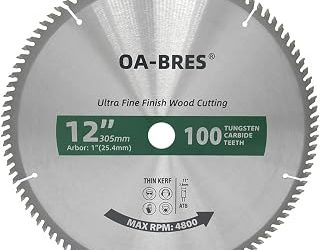
S55300 (XL4000) 12-Inch 60T Combo Blade
A 60-tooth ATB combination blade on a 1-inch bore, aimed at 12-inch cabinet saws where stability and long runs matter more than portability. It handles ripping hardwood and crosscutting sheet goods on a single setup, which makes it a smart choice for a shop that would rather not swap blades mid-build.
KENDO 10-Inch 40T + 60T 2-Pack
Two 10-inch ATB blades for the price of one premium unit: the 40-tooth for ripping solid stock, the 60-tooth for plywood, MDF, and laminate. It is the most sensible starting point for a new saw owner who is still figuring out which cuts they make most.
WORKPRO 10″ 80T Thin Kerf Blade
The thin-kerf plate is the story here — less resistance means a 15-amp portable or contractor saw can carry an 80-tooth blade through 3/4-inch ply without bogging or burning. A strong match for cabinetry and trim work on lighter machines.
10-Inch 80T Ultra-Fine Finish, 1-Inch Arbor
Same 80-tooth ATB finish geometry, but bored for 1-inch arbors, which quietly solves a real problem for anyone running an older or imported saw. Tungsten carbide tips keep it cutting cleanly through hardwood, softwood, plywood, and MDF alike.
Frequently Asked Questions
Does a higher tooth count always mean a better cut?
In sheet goods, generally yes. In thick solid wood, no — an 80-tooth blade removes chips slowly and can scorch the cut. Match the blade to the material, not to the highest number.
Do I still need a zero-clearance insert?
Yes. Even the best blade tears out on the underside if the throat plate leaves the veneer unsupported. A zero-clearance insert plus a fine-tooth blade eliminates nearly all of it.
Should the blade be raised high or low for plywood?
Keep it low, roughly a tooth-and-a-half above the panel. A lower blade attacks the veneer at a shallower angle and drops tear-out noticeably.
Can I sharpen these blades?
Carbide-tipped blades can be professionally resharpened several times, usually for less than replacement cost. Budget blades are often cheaper to simply swap out.
Final Thoughts
For most home shops cutting cabinet-grade plywood, the FOXBC 80-tooth is the clean, no-drama default. If your saw is a lighter portable, the WORKPRO thin-kerf 80T gets you the same edge quality without straining the motor, and the KENDO 40T/60T pair remains the best-value way to cover both ripping and finish cuts from day one.