Key takeaways
- Resaw height, stated honestly: Classic 14-inch designs give roughly 6 inches under the guides, and a riser block pushes that to about 12. Modern welded-frame saws often deliver 12 inches out of the box. Decide whether you’re slicing veneer and wide panels or mostly cutting curves before you pay for height you won’t use.
- Motor and voltage: Anything from 1 to 2 HP will handle furniture stock, but dual-voltage wiring is the feature that ages well. Running at 240V reduces amp draw and helps the saw hold speed through a deep cut in white oak.
- Two-speed drive: A low speed near 1,400 FPM lets you cut aluminum, brass, and plastics without loading the blade. If you mix metal hardware fabrication into your woodworking, dual-speed is worth the premium.
- Guides and tension: Ball-bearing guides above and below the table, plus a tension mechanism you can actually reach and read, determine whether a blade drifts. Quick-release tension saves your blades between sessions and saves your patience.
- Table and dust control: A ground cast-iron table that stays flat is non-negotiable for accurate joinery. Then check the dust port: 4-inch collection below the table keeps fine dust off your work and out of your lungs.
What's inside
A 14-inch band saw is the machine that quietly changes what you’re able to build. It’s the threshold where curved chair backs, bookmatched drawer fronts, and shop-sawn veneer stop being aspirational and start being Tuesday night. But it’s also the size class where marketing gets slippery: two saws can both claim 14 inches of throat and 1 HP on the plate, then behave nothing alike once you feed them 6 inches of hard maple. Frame rigidity, wheel mass, guide design, and honest resaw height matter far more than the number stamped on the casting.
This guide looks at the 14-inch band saws worth putting in a furniture-focused shop in 2026, from budget cast-iron workhorses to the cabinet-grade machines that hold a straight resaw cut all day. We’ve weighted the picks toward the things that show up in finished work: cut quality, blade tracking stability, table flatness, dust extraction, and how much fuss it takes to change blades when you switch from a 1/8-inch scroll blade to a 3/4-inch resaw blade.
As an Amazon Associate we earn from qualifying purchases.


How to Choose a 14-Inch Band Saw (2026)
- Resaw height, stated honestly: Classic 14-inch designs give roughly 6 inches under the guides, and a riser block pushes that to about 12. Modern welded-frame saws often deliver 12 inches out of the box. Decide whether you’re slicing veneer and wide panels or mostly cutting curves before you pay for height you won’t use.
- Motor and voltage: Anything from 1 to 2 HP will handle furniture stock, but dual-voltage wiring is the feature that ages well. Running at 240V reduces amp draw and helps the saw hold speed through a deep cut in white oak.
- Two-speed drive: A low speed near 1,400 FPM lets you cut aluminum, brass, and plastics without loading the blade. If you mix metal hardware fabrication into your woodworking, dual-speed is worth the premium.
- Guides and tension: Ball-bearing guides above and below the table, plus a tension mechanism you can actually reach and read, determine whether a blade drifts. Quick-release tension saves your blades between sessions and saves your patience.
- Table and dust control: A ground cast-iron table that stays flat is non-negotiable for accurate joinery. Then check the dust port: 4-inch collection below the table keeps fine dust off your work and out of your lungs.
The Best 14-Inch Band Saws (2026) Reviewed
JET JWBS-14SFX-BLK, 1.75 HP
The most complete 14-inch package here, with a tall steel frame, generous resaw capacity, and blade tracking that stays put once you dial it in. If you build case goods and want a saw you’ll never outgrow, this is the one to buy first and stop shopping.
Powermatic PWBS-14CS, 1-1/2 HP
A cast-iron classic executed with unusual care, from the machined table to the fit of the trunnions. It rewards good setup with clean, repeatable curves, and it holds resale value better than almost anything in the category.
JET JWBS-14CS, 1 HP
The traditional two-wheel cast-iron design at its most sensible price, with a riser-block path if your ambitions grow. Ideal for chairmaking, template work, and anyone whose cut list leans toward curves rather than thick resaw.
WEN BA1411 Industrial, 1 HP Dual-Voltage
Genuinely well-specified for the money: dual voltage, two speeds, ball-bearing guides, and a solid cast-iron table. Expect to spend an hour on initial alignment, after which it punches well above its price bracket.
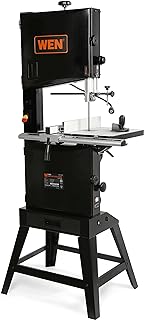
WEN BA1487 with Stand, Two-Speed
The practical choice for a garage shop or a compact studio, arriving with its own stand so it’s ready to work without extra fabrication. Curve cutting and light resaw are its comfort zone rather than production veneer.
Frequently Asked Questions
What does “14-inch” actually measure?
It’s the throat width, meaning the distance from the blade to the frame, which sets how wide a workpiece you can swing. It says nothing about how thick a board you can resaw.
Do I need a riser block?
Only on traditional cast-iron saws, and only if you plan to resaw stock taller than about 6 inches. Newer welded-frame designs already offer roughly 12 inches of height.
Which blade should I start with?
A 1/2-inch, 3 TPI hook-tooth blade for resawing and a 1/4-inch, 6 TPI blade for curves covers most furniture work. Swapping blades matters more than raw horsepower for cut quality.
Is 1 HP enough for hardwood?
Yes for curve work and moderate resaw in a hobby shop, especially wired for 240V. Regular deep cuts in dense hardwood go smoother with 1-1/2 HP or more.
Final Thoughts
For a shop building real furniture, the JET JWBS-14SFX-BLK is the safest long-term investment thanks to its resaw height and rock-steady frame, while the Powermatic PWBS-14CS is the choice for anyone who values traditional cast-iron feel and precise curve work. If the budget is tight, the WEN BA1411 delivers a surprising amount of the same capability once it’s properly tuned.