Key takeaways
- SCFM at 90 PSI: This is the number that determines what you can run and for how long. Around 2.6 SCFM comfortably feeds a brad or finish nailer for trim, cabinetry, and paneling. Step up toward 4 CFM if you want to run a framing nailer or keep two people working off one tank.
- Maximum PSI and recovery: Higher tank pressure means more usable air stored in the same 6 gallons, so the motor kicks on less often. Models topping out at 165 to 200 PSI give you noticeably longer stretches of quiet work than 150 PSI units.
- Oil-free pump: For indoor and occasional use, oil-free is the clear choice. No oil changes, no risk of misting residue near finished surfaces or fabric, and reliable cold starts if the unit lives in an unheated garage.
- Noise and placement: Compressors are loud, and in an open-plan home that matters. Check the decibel rating, plan on a long air hose so the tank can sit in another room, and put a scrap of carpet or a rubber mat underneath to keep vibration out of hardwood.
- Accessory kit or bare tank: A bundled kit with hose, couplers, blow gun, and inflation tips saves a separate shopping trip and usually costs less than buying the pieces individually. If you already own a hose and fittings, skip the kit and spend the difference on pump quality.
What's inside
Anyone who has installed picture rail, tacked down loose upholstery, or fitted baseboard around a newly refinished floor knows the moment where enthusiasm meets equipment. A hammer works. A brad nailer works better, faster, and leaves a hole small enough to disappear under a dab of filler. But nailers need air, and the compressor market speaks almost entirely in jobsite language: CFM, duty cycle, tank geometry, decibels. For someone whose priority is a clean reveal on a cabinet face rather than framing a roof deck, that vocabulary can feel like it belongs to somebody else’s project.
Six gallons is the size that resolves this. It stores enough air to run trim and finish work continuously without the constant motor cycling of a smaller pancake tank, and it still fits in a hall closet or under a workbench between projects. This guide covers what actually matters when you are buying for interior work, then walks through the leading 6-gallon models for 2026, from budget kits that include everything you need on day one to jobsite-grade units built to feed multiple nailers at once.
As an Amazon Associate we earn from qualifying purchases.


How to Choose a/an 6-Gallon Air Compressor (2026)
- SCFM at 90 PSI: This is the number that determines what you can run and for how long. Around 2.6 SCFM comfortably feeds a brad or finish nailer for trim, cabinetry, and paneling. Step up toward 4 CFM if you want to run a framing nailer or keep two people working off one tank.
- Maximum PSI and recovery: Higher tank pressure means more usable air stored in the same 6 gallons, so the motor kicks on less often. Models topping out at 165 to 200 PSI give you noticeably longer stretches of quiet work than 150 PSI units.
- Oil-free pump: For indoor and occasional use, oil-free is the clear choice. No oil changes, no risk of misting residue near finished surfaces or fabric, and reliable cold starts if the unit lives in an unheated garage.
- Noise and placement: Compressors are loud, and in an open-plan home that matters. Check the decibel rating, plan on a long air hose so the tank can sit in another room, and put a scrap of carpet or a rubber mat underneath to keep vibration out of hardwood.
- Accessory kit or bare tank: A bundled kit with hose, couplers, blow gun, and inflation tips saves a separate shopping trip and usually costs less than buying the pieces individually. If you already own a hose and fittings, skip the kit and spend the difference on pump quality.
The Best 6-Gallon Air Compressor (2026)s Reviewed
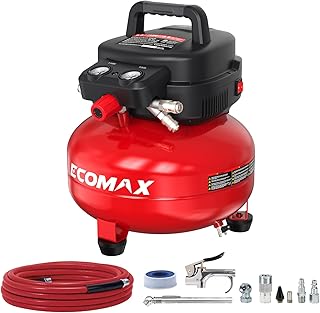
ECOMAX 6 Gallon 150 PSI Pancake with 10-Piece Accessory Kit
The most sensible entry point for someone whose projects are trim, shelving, and light upholstery: 150 PSI is plenty for finish work, and the ten-piece kit means the box contains everything needed to start nailing the same afternoon. Treat it as a capable weekend tool rather than a daily driver.
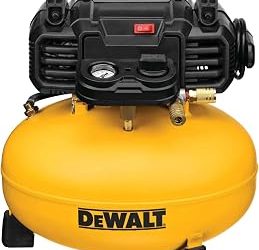
DEWALT Pancake Air Compressor, 6 Gallon, 165 PSI (DWFP55126)
The benchmark, and deservedly so. The 165 PSI ceiling and 2.6 SCFM at 90 PSI keep the motor quiet between cycles, the oil-free pump asks nothing of you, and it starts reliably in cold weather, which matters if it lives in a detached garage. Buy this if you want one compressor for the next decade.
Metabo HPT Portable Pancake, 6 Gallon 200 PSI (EC914S)
At 200 PSI and 4 CFM, this is the pick when the work scales up, whether that means running framing and roofing nailers or having two people working simultaneously off a single tank. Overkill for a gallery wall, exactly right for a full renovation.
CRAFTSMAN 6 Gallon Pancake Air Compressor Kit, 150 PSI
A genuinely well-considered bundle: the compressor arrives with an 18-gauge brad nailer and a ten-piece accessory set, which covers nearly every interior trim and cabinetry task without a second purchase. Best value for a first-time buyer building out a home workshop.
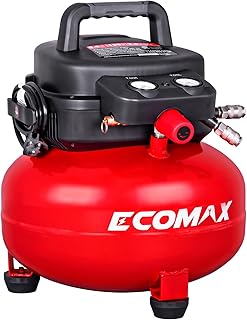
ECOMAX 6 Gallon Pancake, 150 PSI, Red
Dual quick couplers are the standout feature here, letting you leave an inflation line connected while a nailer stays hooked up on the other port. The 1.5 HP oil-free pump handles finish work, tire top-ups, and general shop air without fuss.
Frequently Asked Questions
Is 6 gallons enough for interior trim and cabinetry?
Comfortably. A 6-gallon tank paired with a brad or finish nailer will let you work through a room of baseboard or crown molding with only occasional motor cycling. It is the sweet spot between portability and endurance.
Can I use one indoors?
Yes, and oil-free models are the ones to use. Expect real noise, so run a 25- or 50-foot hose and park the tank in a hallway or adjacent room. A rubber mat underneath prevents vibration from transmitting through finished floors.
Do I need to drain the tank?
Every session. Compressing air produces condensation, and standing water rusts the tank from the inside. Open the drain valve at the bottom until it stops hissing, then close it. It takes under a minute and roughly doubles the life of the unit.
Will a 6-gallon compressor run a paint sprayer?
For small pieces, yes. Spraying a chair or a cabinet door in stages works fine, but continuous-demand HVLP spraying of a large surface will outrun the tank. Choose a model with higher CFM if finishing is your main goal.
Final Thoughts
For most homes, the DEWALT DWFP55126 is the compressor worth owning: quiet enough for indoor work, robust enough to outlast several rounds of renovation. The CRAFTSMAN 6-Gallon Kit makes more sense if you need a brad nailer and hose in the same purchase, and the Metabo HPT EC914S is the one to choose when the projects get ambitious and a single tank has to feed more than one tool.