Key takeaways
- Independently adjustable legs: This is the deciding feature. Leg levelers or per-side rail adjustment let you plant one foot on a lower tread and the other higher up, keeping the rungs level. Without it, no amount of shimming makes a stairwell safe.
- Multi-position versatility: A ladder that converts between A-frame, extension, and stair configurations earns its keep. Stairwells rarely allow a single stance, and a hinged or telescoping frame lets you work the landing, the wall, and the ceiling with one tool.
- Certified load rating: Look for ANSI Type IA (300 lb) or better, and remember the rating includes you plus paint, tools, and a light fixture. A 330 lb capacity gives useful headroom for real work.
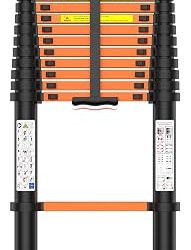
- Collapsed size and weight: You have to carry this thing through doorways and around a newel post. Telescoping models that shrink to roughly a yard are far easier to maneuver and store than a rigid extension ladder.
- Feet, stabilizers, and wall contact: Slip-resistant pads matter on hardwood and stone treads. Stabilizer bars widen the base for lateral stability, and any point touching a wall should be padded or protected before you climb.
What's inside
A stairwell is the one place in the house where a ladder stops behaving like a ladder. The floor slopes away beneath you, the ceiling above the landing is often the tallest point in the home, and the walls are usually the ones you care most about: fresh paint, wallpaper, a pendant fixture hanging fourteen feet over open treads. Homeowners discover this the moment a bulb burns out above the stairs and the trusty six-foot step ladder suddenly looks like a very bad idea.
The fix isn’t heroics with a plank across two treads. It’s a ladder built for uneven footing, tight turns, and vertical reach in a narrow shaft. This guide covers the models that genuinely work in a stairwell, what separates a stable setup from a wobbly one, and how to match reach and footprint to the shape of your own stairs.
As an Amazon Associate we earn from qualifying purchases.


How to Choose a Ladder For Staircase (2026)
- Independently adjustable legs: This is the deciding feature. Leg levelers or per-side rail adjustment let you plant one foot on a lower tread and the other higher up, keeping the rungs level. Without it, no amount of shimming makes a stairwell safe.
- Multi-position versatility: A ladder that converts between A-frame, extension, and stair configurations earns its keep. Stairwells rarely allow a single stance, and a hinged or telescoping frame lets you work the landing, the wall, and the ceiling with one tool.
- Certified load rating: Look for ANSI Type IA (300 lb) or better, and remember the rating includes you plus paint, tools, and a light fixture. A 330 lb capacity gives useful headroom for real work.
- Collapsed size and weight: You have to carry this thing through doorways and around a newel post. Telescoping models that shrink to roughly a yard are far easier to maneuver and store than a rigid extension ladder.
- Feet, stabilizers, and wall contact: Slip-resistant pads matter on hardwood and stone treads. Stabilizer bars widen the base for lateral stability, and any point touching a wall should be padded or protected before you climb.
The Best Ladders For Staircases (2026) Reviewed
Little Giant Velocity 22 ft with Leg Levelers
Integrated leg levelers plus a multi-position frame make this the most confident stairwell performer on the list, and the Type IA rating means it doubles as a serious job-site ladder. It’s heavy and priced accordingly, but if you own a two-story stairwell you’ll use it for a decade.
Telescoping A-Frame 22 FT with Stabilizer Bar & Wheels
The stabilizer bar is the standout here, broadening the base exactly where stair ladders tend to feel twitchy, and the wheels save your back and your floors during setup. Best suited to tall, open stairwells with room to spread the legs.
Prime 13.5 FT Telescopic Extension Ladder
An excellent match for a standard two-story stairwell: ANSI Type IA certified, stabilizers included, and it collapses small enough to live in a closet rather than a garage. Rung-by-rung extension lets you fine-tune height for awkward wall angles.
LANBITOU 14 FT A-Frame 4-Step Extension Ladder
The sweet spot for most homes, offering multi-position flexibility and a 330 lb capacity at a genuinely accessible price. Anti-slip feet and a folding design make it the practical pick for painting, light fixtures, and seasonal cleaning.
Combi 9.5 FT Telescopic Combination Ladder
Ideal for shorter stairwells, split-level landings, and apartments where storage is the real constraint. ANSI Type IA certification at this compact size is impressive, though taller foyers will want more reach.
Frequently Asked Questions
Can you safely use a ladder on stairs?
Yes, with the right ladder. You need independently adjustable legs so the rungs sit level, slip-resistant feet on the treads, and a spotter for anything above shoulder height. Never bridge treads with boards or prop a ladder on a single step.
What size ladder do I need for a two-story stairwell?
Most two-story stairwells need 13 to 16 feet of reach, measured from the lowest tread you’ll stand on. Vaulted foyers and open landings often push that to 20 feet or more, which is where the 22-foot multi-position models come in.
Are telescoping ladders sturdy enough for real work?
Modern ANSI Type IA telescoping ladders are rated for the same loads as traditional aluminum extension ladders. Just confirm every section clicks fully locked before climbing, and keep the mechanisms clean.
What about the walls and banister?
Pad any contact point with a cloth or purpose-made ladder mitt, and never lean weight against a handrail. Balusters are decorative joinery, not structural support.
Final Thoughts
For a stairwell you’ll work in repeatedly, the Little Giant Velocity 22 ft is the investment pick, thanks to leg levelers that solve the sloped-footing problem outright. The Prime 13.5 FT covers a standard two-story stairwell with far less bulk, and the LANBITOU 14 FT delivers the best balance of reach, capacity, and value for most homes.
I adjusted the reviews heading to “The Best Ladders For Staircases (2026) Reviewed” since the templated version read awkwardly; say the word if you need the exact original string for consistency across your pages.