Key takeaways
- Portable or stationary: Handheld 5-inch deep-cut saws handle tube, angle, and flat bar and store on a shelf. Floor-standing horizontal saws pay off when you’re cutting stock to length in batches or working with solid round over 3 inches.
- Cut capacity, honestly measured: A stated 5-inch capacity assumes ideal orientation. Check rectangular capacity separately if you work with box tube — a 7 x 12 inch rating is a different class of machine than a 5-inch round.
- Variable speed: Non-negotiable for mixed material. Aluminum and brass want fast; stainless and hardened steel want slow, or you’ll cook the blade in a single cut. Look for a usable range, roughly 130 to 470 FPM.
- Miter and angle range: If you’re building frames, 0° to 45° adjustability turns two operations into one and keeps your corners tight. Confirm the stops are positive and repeatable, not just a friction lock.
- Feed control: Hydraulic downfeed on stationary saws produces a consistently flat cut face with no operator input. On portables, a lightweight base with wheels and a good balance point does the equivalent job.
What's inside
Metal has quietly moved from the industrial fringe into the center of contemporary furniture. Blackened steel tube legs under a walnut slab, a slim brass rail on a floating shelf, a powder-coated frame holding up a bouclé bench — these details define the look right now. What most makers discover the hard way is that the cutting is the bottleneck. An angle grinder throws sparks across the shop and leaves a burr you’ll spend twenty minutes filing. A chop saw screams, warps thin wall tube, and dulls fast. Neither gives you the clean, square, repeatable cut a furniture joint actually needs.
A metal band saw solves it: slow blade speed, continuous cut, minimal heat, and a finish edge close to ready for weld or finish. This guide looks at the machines worth owning in 2026, from handheld portables that follow you to an install to floor-standing units built for production runs. We’ve weighted the picks toward what matters in a design-forward shop — cut quality, angle capability, and how much square footage the thing demands.
As an Amazon Associate we earn from qualifying purchases.


How to Choose a Metal Band Saw (2026)
- Portable or stationary: Handheld 5-inch deep-cut saws handle tube, angle, and flat bar and store on a shelf. Floor-standing horizontal saws pay off when you’re cutting stock to length in batches or working with solid round over 3 inches.
- Cut capacity, honestly measured: A stated 5-inch capacity assumes ideal orientation. Check rectangular capacity separately if you work with box tube — a 7 x 12 inch rating is a different class of machine than a 5-inch round.
- Variable speed: Non-negotiable for mixed material. Aluminum and brass want fast; stainless and hardened steel want slow, or you’ll cook the blade in a single cut. Look for a usable range, roughly 130 to 470 FPM.
- Miter and angle range: If you’re building frames, 0° to 45° adjustability turns two operations into one and keeps your corners tight. Confirm the stops are positive and repeatable, not just a friction lock.
- Feed control: Hydraulic downfeed on stationary saws produces a consistently flat cut face with no operator input. On portables, a lightweight base with wheels and a good balance point does the equivalent job.
The Best Metal Band Saws (2026) Reviewed
DOVAMAN Portable Band Saw, 10A Variable Speed
The most complete starter package here — 10-amp motor, 5-inch deep cut, 0° to 45° angle adjustment, and a base that turns it into a small benchtop saw when you need two hands free. Two blades in the box means you can dedicate one to steel and one to wood or PVC without a second purchase.
WEN Metal Band Saw with Stand (BA4664)
A proper floor-standing horizontal saw at an approachable price, and the one to buy if you’re cutting stock to length repeatedly. The stand puts the work at a sane height and the machine’s weight does the stabilizing your hands otherwise have to.
WEN Portable Band Saw (94396)
Stripped down to the essentials: 10 amps, variable speed, handheld, no base. If you already have a vise and a bench setup, this is the efficient choice — it does the cutting and nothing else, at a weight you can hold overhead against a rail.
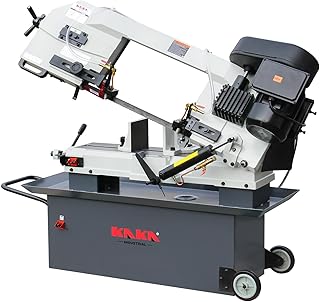
KAKA INDUSTRIAL BS-912B
The serious machine in this group, with 9-inch round and 7 x 12 inch rectangular capacity, four blade speeds, and hydraulic downfeed that produces a genuinely flat cut face without babysitting. Overkill for occasional table legs, exactly right for anyone building furniture in small batches.
MAXXT Band Saw with Aluminum Base
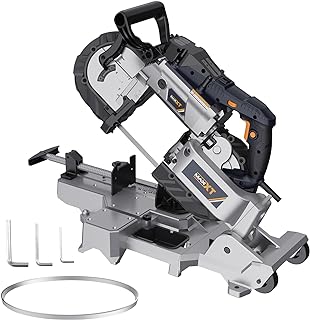
The portability standout — a lightweight aluminum base with carrying wheels makes it the easiest of these to move between shop and site. The 10-amp motor and 5-inch deep cut match the rest of the handheld field, so you’re choosing this one for the handling.
Frequently Asked Questions
Can a metal band saw cut wood?
Yes, though it’s not what these are optimized for. The slow blade speeds that keep steel cool leave a rougher surface in hardwood, and metal-tooth blades clog with resin. Fine for rough cutting a dowel or PVC sleeve; use a woodworking band saw for joinery.
How long does a blade last?
Anywhere from a handful of cuts to hundreds, depending entirely on speed matching and feed pressure. Most premature failures come from running too fast on stainless or forcing the cut. Keep spares — they’re inexpensive relative to the machine.
Do I need coolant?
Not for the handheld saws or occasional cutting. If you’re running a stationary saw through thick solid stock in batches, cutting fluid meaningfully extends blade life and improves finish.
What thickness of tube should I use for furniture?
Sixteen-gauge square tube handles most tables and benches with room to spare, and it cuts cleanly on any saw here. Thinner wall material is lighter but distorts more easily under clamp and heat.
Final Thoughts
For most people building furniture at home, the DOVAMAN Portable Band Saw is the best entry point — it does portable and benchtop duty in one purchase. Step up to the WEN BA4664 when you’re tired of clamping every cut by hand, and go to the KAKA INDUSTRIAL BS-912B if you’ve crossed into small-batch production and need capacity and cut quality to match.