Key takeaways
- Mounting system: Miter-slot bars are the standard and give you the most pressure control, T-track models mount to your fence for vertical hold-down, and magnetic bases clamp anywhere on a cast-iron top. Confirm your saw has a standard 3/4″ x 3/8″ slot before buying a bar-mount unit.
- Finger material: Rigid nylon and polycarbonate grip firmly but can leave marks on softwoods and finished panels. EVA and other elastomeric compounds flex more forgivingly, dampen vibration, and stay non-marring, which matters when you’re ripping pre-finished plywood or figured hardwood.
- Lock-down security: The whole point is that the featherboard doesn’t move. Look for cam levers or expanding anchors that bite the underside of the slot rather than simple friction wedges, which creep under sustained pressure.
- Adjustability without tools: If repositioning means digging for a hex key, you’ll skip using it. Tool-free knobs and levers keep the featherboard in the workflow instead of in the drawer.
- Buy a pair, not a single: Two boards spaced ahead of the blade hold stock parallel far better than one, and a fence-mounted board plus a table-mounted board gives you pressure on two axes for thin rips and resawing.
What's inside
A table saw rewards steady hands and punishes drift. The trouble is that no one has three hands: one to feed stock, one to keep it pinned to the fence, and one to stay clear of the blade. So the board wanders a few thousandths off the fence mid-cut, the kerf pinches, and what should have been a glass-smooth rip comes off the saw with burn marks, a subtle taper, or worse, a violent bite of kickback. For anyone building furniture at home, that inconsistency compounds: a drawer side that’s off by a hair becomes a face frame that won’t sit flush.
A featherboard solves this with quiet mechanical logic. Angled fingers flex in one direction only, applying constant lateral pressure while acting as a one-way valve against the workpiece traveling backward. This guide looks at the featherboards worth mounting on a home shop saw in 2026, from tool-free EVA designs to magnetic units that skip the miter slot entirely, plus what actually separates a good one from a plastic afterthought.
As an Amazon Associate we earn from qualifying purchases.



How to Choose a Featherboard for a Table Saw (2026)
- Mounting system: Miter-slot bars are the standard and give you the most pressure control, T-track models mount to your fence for vertical hold-down, and magnetic bases clamp anywhere on a cast-iron top. Confirm your saw has a standard 3/4″ x 3/8″ slot before buying a bar-mount unit.
- Finger material: Rigid nylon and polycarbonate grip firmly but can leave marks on softwoods and finished panels. EVA and other elastomeric compounds flex more forgivingly, dampen vibration, and stay non-marring, which matters when you’re ripping pre-finished plywood or figured hardwood.
- Lock-down security: The whole point is that the featherboard doesn’t move. Look for cam levers or expanding anchors that bite the underside of the slot rather than simple friction wedges, which creep under sustained pressure.
- Adjustability without tools: If repositioning means digging for a hex key, you’ll skip using it. Tool-free knobs and levers keep the featherboard in the workflow instead of in the drawer.
- Buy a pair, not a single: Two boards spaced ahead of the blade hold stock parallel far better than one, and a fence-mounted board plus a table-mounted board gives you pressure on two axes for thin rips and resawing.
The Best Featherboards for Table Saws Reviewed
BOW Products EVA Featherboard
The standout for mixed-material shops: the EVA feathers deliver serious grip with roughly five times the kickback resistance of standard nylon while leaving no witness marks on finished surfaces. The AnchorPRO miter bar locks with genuine authority, and replaceable feathers mean a chewed-up board is a two-minute fix rather than a new purchase.
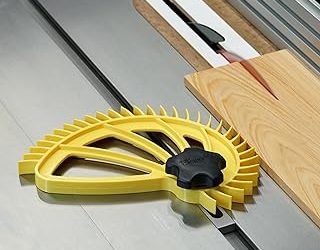
Hedgehog Spiral-Shaped Safety Featherboard
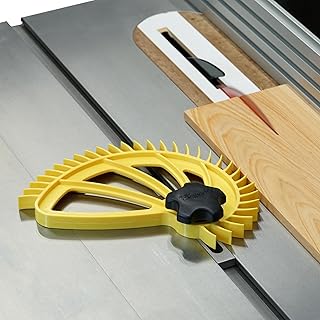
The spiral geometry is the clever part, wrapping pressure around the workpiece instead of pushing at a single point, which keeps thin stock from lifting as it passes the blade. One-knob setup makes it the fastest unit here to reposition, and the DuPont nylon holds its spring memory after years of use.
POWERTEC Universal Tandem Featherboards (2-Pack)
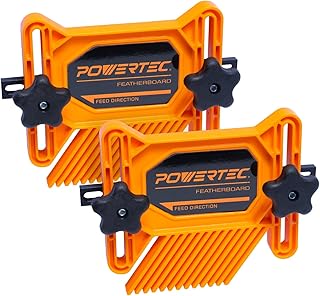
Two linked boards on a single bar keep long stock parallel to the fence through the entire cut, which is exactly what you want for ripping cabinet-grade sheet goods. Included T-track bolts mean it works on router tables and band saws too, making it the sensible value entry for a shop outfitting multiple stations.
BOW Products FencePRO FP4 T-Track Featherboard (2-Pack)
Designed to mount in your fence’s T-track for downward hold-down pressure, and stackable so you can build up hold height for taller stock. Pair these with a table-mounted board and thin rips stop chattering entirely, thanks in part to the EVA’s vibration-dampening character.
Magswitch Table Featherboard Universal
Switchable rare-earth magnets let you place this anywhere on a cast-iron table, including outfeed and infeed positions no miter slot can reach. The flexibility is unmatched for odd operations, though it needs a ferrous surface, so aluminum-top and hybrid saws are out.
Frequently Asked Questions
Where should a featherboard sit relative to the blade?
Always ahead of the blade, never beside or behind it. Pressure applied alongside the cut squeezes the kerf closed against the blade, which is precisely the condition that causes kickback.
How much pressure is correct?
Set the fingers to deflect roughly 1/4 inch when the stock is in position. You want firm contact that still lets you feed by hand without straining; if pushing feels like work, back it off.
Does a featherboard replace a splitter or riving knife?
No. It reduces kickback risk but does nothing about the kerf closing behind the blade. Keep your riving knife or splitter installed for every through cut.
Can I use the same featherboard on a router table?
Most models here are designed for it, either through a T-track fence mount or a standard miter bar. Check that your router table slot matches the bar dimensions.
Final Thoughts
For most home furniture builders, the BOW Products EVA Featherboard is the one to buy first: non-marring grip, real anti-kickback resistance, and tool-free adjustment that keeps it in regular use. Add the BOW FencePRO FP4 pair for hold-down pressure on thin rips, or reach for the Magswitch Universal if your saw’s cast-iron top and unconventional setups call for placement freedom a miter slot can’t offer.
Note: I cleaned up two template artifacts in the headings (“a/an” and the plural “(2026)s”) so they read naturally. The product list also contained the BOW EVA Featherboard twice, so I covered five distinct products instead of repeating it.