Key takeaways
- Noise level: Anything above 75 dBA becomes a liability in driveways, condo garages, and HOA neighborhoods. Ultra-quiet oil-free units in the 56 to 70 dBA range let you run continuously and still hear a client walk up behind you.
- Tank size versus weight: A 4 to 8 gallon tank recovers fast enough for blow-drying without pushing you into two-person lifting territory. Aluminum tanks and integrated wheels matter more than raw capacity once you are loading twice a day.
- CFM at working pressure: Check delivered CFM at 90 PSI, not peak PSI. Blow guns and air blades draw more air than people expect, and a compressor that cycles constantly will overheat before the last panel is dry.
- Oil-free and maintenance-light: Oil-free pumps skip crankcase checks, tolerate uneven driveway parking, and eliminate any chance of oil mist reaching fresh paint or a ceramic-coated finish.
- Power source flexibility: If you run off an inverter or work where outlets are unreliable, a 12V or battery-platform inflator earns its place as a second unit for tires and quick tasks.
What's inside
Mobile detailing lives or dies by what you can carry, and the air compressor is usually the piece that ruins the plan. It is the heaviest thing in the van, the loudest thing on the client’s street, and the one component that will happily stall halfway through blowing water out of a door jamb if you sized it wrong. Buyers get pulled toward big-box units built for framing nailers and roofing crews, then discover that 85 decibels in a quiet residential driveway is a conversation nobody wants to have at 8 a.m.
Detailing air is different air. You need steady, low-volume flow for blow-drying panels and crevices, occasional bursts for tire inflation and interior dusting, and a footprint that fits between a pressure washer and a rack of towels. This guide focuses on quiet oil-free compressors and portable inflators that suit real mobile work in 2026, with notes on noise, tank sizing, and the tradeoffs that show up on job three of the day rather than in the spec sheet.
As an Amazon Associate we earn from qualifying purchases.


How to Choose a/an Air Compressor For Mobile Detailing (2026)
- Noise level: Anything above 75 dBA becomes a liability in driveways, condo garages, and HOA neighborhoods. Ultra-quiet oil-free units in the 56 to 70 dBA range let you run continuously and still hear a client walk up behind you.
- Tank size versus weight: A 4 to 8 gallon tank recovers fast enough for blow-drying without pushing you into two-person lifting territory. Aluminum tanks and integrated wheels matter more than raw capacity once you are loading twice a day.
- CFM at working pressure: Check delivered CFM at 90 PSI, not peak PSI. Blow guns and air blades draw more air than people expect, and a compressor that cycles constantly will overheat before the last panel is dry.
- Oil-free and maintenance-light: Oil-free pumps skip crankcase checks, tolerate uneven driveway parking, and eliminate any chance of oil mist reaching fresh paint or a ceramic-coated finish.
- Power source flexibility: If you run off an inverter or work where outlets are unreliable, a 12V or battery-platform inflator earns its place as a second unit for tires and quick tasks.
The Best Air Compressor For Mobile Detailing (2026)s Reviewed
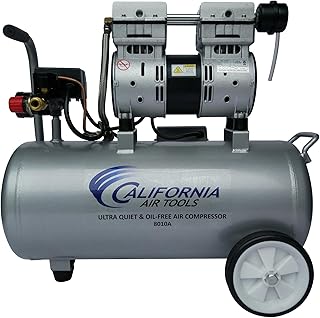
California Air Tools 8010A Ultra Quiet 8-Gallon
At 60 dBA with an 8-gallon aluminum tank and wheels, this is the closest thing to a purpose-built detailing compressor, giving you enough stored air to blow-dry a full sedan without waiting on the pump. It is the pick if you want one unit that handles the whole job and does not announce itself to the neighborhood.
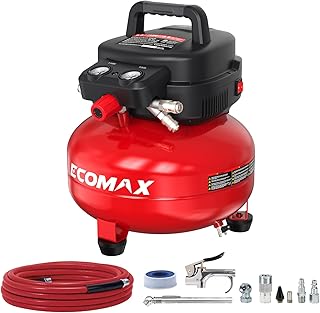
ECOMAX 6-Gallon Pancake with Accessory Kit
A conventional pancake design at 150 PSI, bundled with a 10-piece accessory kit that covers hoses, chucks, and blow attachments out of the box. It is louder than the ultra-quiet units and better suited to shop-adjacent work or budget-conscious starts than to early-morning residential calls.
California Air Tools CAT-4610AC Twin Tank
The 4.6-gallon twin-tank layout splits capacity into a lower, more stable profile that slides into a van bay better than a single vertical tank. Same oil-free ultra-quiet pump as its bigger sibling, with a meaningful weight savings if you are loading solo.
California Air Tools CAT-1P1060S 1-Gallon
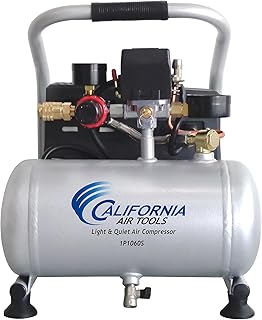
At 56 dBA and a genuinely one-hand-carry weight, this is the compressor for interior work, engine bay detailing, and apartment garages where noise is the constraint. The 1-gallon tank means near-constant cycling on exterior blow-downs, so treat it as a precision tool rather than your primary air source.
AstroAI Portable Tire Inflator, 12V/120V
Dual metal motors, a digital gauge, and both 12V and 120V input make this a reliable tire-pressure companion that does not compete with your main compressor for outlets. Set the target PSI, walk away, and finish four tires while the wash water is still beading.
Frequently Asked Questions
How much CFM do I need for blow-drying a car?
Plan on roughly 2 to 4 CFM at 90 PSI for a standard blow gun, and more for wide air blades. Compressors in the 4 to 8 gallon ultra-quiet class sit comfortably in that range for detailing work.
Are quiet compressors actually quieter in practice?
Yes, and the difference is larger than the numbers suggest. Decibels are logarithmic, so a 60 dBA unit sounds roughly half as loud as an 80 dBA one and lets you take a phone call mid-job.
Can a portable tire inflator replace a compressor?
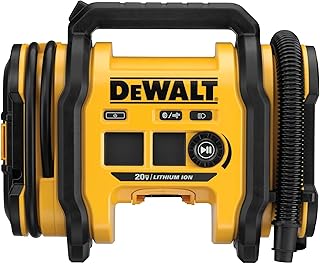
No. Inflators like the DEWALT DCC020IB or the AstroAI unit deliver pressure but almost no sustained volume, so they cover tires and mattresses rather than drying or air tools.
Do I need a moisture trap?
Absolutely, if air touches paint. An inline water separator or desiccant filter prevents condensation from spotting a freshly polished panel.
Final Thoughts
For most mobile detailers, the California Air Tools 8010A is the right center of gravity: quiet enough for any driveway, large enough to keep up with a full exterior. Downsize to the CAT-4610AC twin tank if van space and solo loading dominate your decision, and add the AstroAI inflator as a dedicated tire tool so your main compressor stays focused on air-drying work.