Key takeaways
- Match CFM, not PSI: Almost every compressor here clears the 90 PSI most tools want. Sustained airflow is the real constraint—brad nailers sip around 0.3 CFM, while sanders and paint guns can demand 6 or more. Check the tool’s rating before the tank size.
- Treat decibels as a design spec: A conventional pump runs near 80 dB, loud enough to end conversation in an attached garage. Units in the 60–70 dB range change how often you actually reach for the tool, especially in open-plan homes or shared walls.
- Decide portable or resident: Pancake and hot-dog tanks tuck under shelving and travel to job sites. Vertical 30-gallon tanks claim a permanent corner but keep floor area minimal—often the smarter trade in a tight two-car garage.
- Oil-free versus oil-lubed: Oil-free pumps skip maintenance and tolerate cold storage, ideal for occasional use. Oil-lubricated pumps run cooler and quieter over long sessions, at the cost of periodic oil changes and level checks.
- Audit your circuit and your hose: Larger single-stage units draw hard on startup and can nuisance-trip a shared 15-amp line. Confirm the outlet, and budget for a quality hose and fittings—cheap couplers leak away performance you paid for.
What's inside
Air compressors sit in an awkward spot for anyone who cares about how their home looks and sounds. The tool aisle sells them on raw numbers—PSI, gallons, horsepower—while the reality of owning one is much more domestic: it lives in a garage bay next to bicycles, it fires up while someone is on a call upstairs, and it either fits neatly under a workbench or becomes an obstacle you shuffle around for years. Buyers end up over-specced and under-satisfied, with a loud drum of a machine that trips the shop breaker every time it cycles.
This guide reads compressors the way we read furniture: footprint, finish, noise, and how gracefully they handle daily use. Below are six machines that cover the honest range of home need—from a cordless inflator that lives in a glovebox to a stationary 30-gallon unit for a serious workshop—plus the selection criteria that actually predict whether you’ll like living with one.
As an Amazon Associate we earn from qualifying purchases.


How to Choose a/an Who Makes The Best Air Compressor (2026)
- Match CFM, not PSI: Almost every compressor here clears the 90 PSI most tools want. Sustained airflow is the real constraint—brad nailers sip around 0.3 CFM, while sanders and paint guns can demand 6 or more. Check the tool’s rating before the tank size.
- Treat decibels as a design spec: A conventional pump runs near 80 dB, loud enough to end conversation in an attached garage. Units in the 60–70 dB range change how often you actually reach for the tool, especially in open-plan homes or shared walls.
- Decide portable or resident: Pancake and hot-dog tanks tuck under shelving and travel to job sites. Vertical 30-gallon tanks claim a permanent corner but keep floor area minimal—often the smarter trade in a tight two-car garage.
- Oil-free versus oil-lubed: Oil-free pumps skip maintenance and tolerate cold storage, ideal for occasional use. Oil-lubricated pumps run cooler and quieter over long sessions, at the cost of periodic oil changes and level checks.
- Audit your circuit and your hose: Larger single-stage units draw hard on startup and can nuisance-trip a shared 15-amp line. Confirm the outlet, and budget for a quality hose and fittings—cheap couplers leak away performance you paid for.
The Best Who Makes The Best Air Compressor (2026)s Reviewed
DEWALT 20V MAX Tire Inflator (DCC020IB)
This is the compressor for people who don’t want a compressor—cordless, glovebox-sized, with an automatic shutoff that hits your target pressure and stops without babysitting. The LED light and multiple power sources make it genuinely useful on a dark shoulder, though it’s built for tires and sports gear, not pneumatic tools.
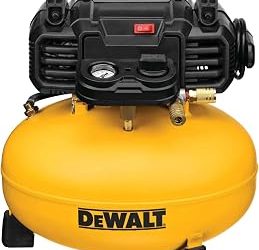
DEWALT 6-Gallon Pancake, 165 PSI (DWFP55126)
The default recommendation for trim work, crown molding, and general home carpentry: 2.6 SCFM at 90 PSI keeps a finish nailer fed comfortably, and the oil-free pump asks nothing of you between projects. The low, wide profile slides onto a shelf or under a bench, which matters more than the spec sheet suggests.
DEWALT 4.5-Gallon Hand Carry, 225 PSI (D55146)
A 225 PSI ceiling means more usable air stored in a smaller tank, so recovery feels quicker than the gallon count implies. The wheel-and-handle format borrows from luggage design and moves easily across a driveway—our pick for renovators who need real capacity without a permanent installation.
DEWALT 30-Gallon Vertical, 175 PSI
The stationary choice for a workshop that runs sanders, impact wrenches, or spray equipment. The oil-lubricated pump handles long duty cycles calmly, and the vertical tank keeps its footprint close to a filing cabinet—just confirm your circuit and plan on a fixed home for it.
California Air Tools 8010A, 60 dBA
At roughly conversational volume, this is the compressor that earns a place in a finished garage or studio. The aluminum 8-gallon tank keeps weight manageable and resists corrosion, and the oil-free pump makes it low-fuss for woodworking and inflation duty.
Frequently Asked Questions
How quiet is quiet enough for an attached garage?
Under 70 dB is the practical threshold—comparable to a dishwasher. The 68 dB oil-free unit and the 60 dBA California Air Tools model both fall in that range and won’t carry through the house the way an 80 dB pump does.
What size tank do I need for a finish nailer?
Six gallons is ample. Nailers use short bursts, so recovery time rarely becomes an issue. Continuous-demand tools like sanders and spray guns are what push you toward 20 gallons and up.
Do I need to drain the tank?
Yes—open the bottom valve after each session. Condensation collects inside the tank and causes rust that shortens its life and can contaminate air lines.
Can one compressor cover both tires and tools?
A pancake or hot-dog unit handles both well. A cordless inflator like the DCC020IB is tire-only, so treat it as a complement rather than a replacement.
Final Thoughts
For most homes, the DEWALT 6-gallon pancake is the balanced answer—quiet enough, capable enough, and easy to store. Choose the California Air Tools 8010A if noise is your primary concern, or the 30-gallon DEWALT if your workshop runs air-hungry tools all afternoon.