Key takeaways
- Pressure ceiling: 4500 PSI (300 bar) covers nearly every airgun and paintball tank on the market. Higher-rated units around 5800 PSI aren’t about overfilling — they’re about running well below their maximum, which means less heat and less strain.
- Cooling design: This is the single best predictor of lifespan. Fan-only cooling is fine for short top-offs; combined water and fan cooling is what lets a compressor run for hours without a forced cool-down break.
- Auto shut-off: Set your pressure, walk away, come back to a filled tank. Manual-stop models cost less and work perfectly well, but they require you to stand there watching a gauge.
- Power flexibility: Dual 12V DC and 110/220V AC operation means the same unit works on your bench and in the field off a car battery. Check whether the AC converter is built in or a separate brick you have to store.
- Oil-free and moisture handling: Water and oil-free designs skip the maintenance ritual and keep contaminants out of your rifle’s valve seals. Pair one with a good filter and replace the desiccant on schedule.
What's inside
Anyone who keeps a PCP air rifle in the house learns the same lesson twice: the shooting is the easy part, and the filling is what quietly decides whether the hobby stays in your routine. Hand pumps turn a fifteen-minute session into an arm workout, and hauling a scuba tank to a dive shop every other weekend gets old fast. The result is a rifle that sits in the cabinet looking handsome and doing nothing, which is the worst outcome for a piece of gear you actually care about.
A dedicated PCP compressor solves that, but the category is crowded with near-identical listings and specs that read like a spreadsheet. This guide cuts through it: what genuinely matters in a 2026 compressor, which models earn their footprint in a garage, workshop, or utility closet, and where the meaningful differences hide — cooling design, auto-stop reliability, power flexibility, and how quietly the thing can run while you fill a tank.
As an Amazon Associate we earn from qualifying purchases.


How to Choose a PCP Air Compressor (2026)
- Pressure ceiling: 4500 PSI (300 bar) covers nearly every airgun and paintball tank on the market. Higher-rated units around 5800 PSI aren’t about overfilling — they’re about running well below their maximum, which means less heat and less strain.
- Cooling design: This is the single best predictor of lifespan. Fan-only cooling is fine for short top-offs; combined water and fan cooling is what lets a compressor run for hours without a forced cool-down break.
- Auto shut-off: Set your pressure, walk away, come back to a filled tank. Manual-stop models cost less and work perfectly well, but they require you to stand there watching a gauge.
- Power flexibility: Dual 12V DC and 110/220V AC operation means the same unit works on your bench and in the field off a car battery. Check whether the AC converter is built in or a separate brick you have to store.
- Oil-free and moisture handling: Water and oil-free designs skip the maintenance ritual and keep contaminants out of your rifle’s valve seals. Pair one with a good filter and replace the desiccant on schedule.
The Best PCP Air Compressors (2026) Reviewed
GOYOJO PCP Air Compressor, 4500 PSI
A clean entry point at 300W with auto shut-off, dual 12V/120V power, and a built-in cooling fan, making it a sensible choice for airgunners who fill one or two tanks a week rather than running marathon sessions. The compact footprint is genuinely storable, which matters if your workspace doubles as living space.
SMACO PCP Air Compressor 4500 PSI
The 350W oil-free motor and included spare filter signal a brand thinking past the first month of ownership, and the built-in converter with 12V/110V/220V support makes it travel-friendly. A strong all-rounder for airgun, paintball, and small scuba tank duty.
GX-E-CS4 PCP Air Compressor, 5800 PSI
Combined water and fan cooling plus a rated five hours of continuous operation put this in a different tier than fan-only units — you’re buying headroom, not just a bigger number on the box. Best suited to anyone filling large tanks or shooting often enough that cool-down cycles become annoying.
GX-E-CS4-I PCP Air Compressor, Quiet Fill
Essentially the CS4 with a built-in 12V converter and meaningfully lower noise, which is the version to choose if the compressor lives anywhere near people. Same water-and-fan cooling and five-hour endurance, with far less reason to apologize to the household.
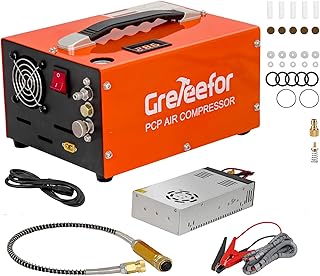
PCP Air Compressor 4500 PSI with LCD Display
The LCD readout and built-in 600W adapter make this the most legible unit here — useful when you’re dialing in exact fill pressures rather than eyeballing a needle. Water and oil-free internals keep upkeep minimal, and the orange housing is easy to find on a cluttered bench.
Frequently Asked Questions
How long does it take to fill a PCP rifle?
Topping off a rifle’s onboard cylinder typically takes one to three minutes with a 350W unit. Filling an empty 6L tank from scratch is a longer job, generally 30 to 60 minutes depending on target pressure.
Do I need a separate moisture filter?
Yes, and use it every time. Even water-free compressors push ambient humidity into the tank, and dry air is what protects your rifle’s seals over the long run.
Is auto shut-off worth paying extra for?
For most people, yes. It prevents overfilling and frees you up during longer fills. Manual-stop models like the 250W retractable-handle unit remain a fair value if you don’t mind supervising.
Can I run one off my car battery?
Any of the dual-power models will run on 12V DC, but keep the engine running on longer fills — these draw enough current to drain a battery quickly.
Final Thoughts
For serious, frequent use, the GX-E-CS4-I is the pick — water and fan cooling, five-hour endurance, and noise levels you can live with indoors. The SMACO 4500 PSI is the balanced middle choice with its spare filter and universal power support, while the LCD-equipped 4500 PSI model suits anyone who wants precise, readable control over every fill.