Key takeaways
- Match reach to your ceilings, not your ambition: A 12.5 ft ladder comfortably serves standard 8–9 ft rooms, single-storey soffits and RV roofs. Reserve 20 ft models for two-storey gutters and stairwell voids, since longer ladders are heavier and less pleasant to reposition.
- Look for EN 131 or ANSI Type 1A marking: Certification means the ladder has been fatigue and deflection tested, not simply labelled with a number. A 330 lb capacity rating should always arrive with one of those standards attached.
- Decide between straight and multi-position: Straight telescoping ladders lean against a wall and reach highest. A-frame designs stand free, which is what you want for interior painting, light fixtures and stair landings where there is no surface to lean on.
- Check the retraction mechanism: Independent rung-by-rung release with clear locking indicators is far safer and gentler on fingers than a single-drop collapse. This is the detail that separates a ladder you use weekly from one you dread.
- Measure the folded dimensions before you buy: Collapsed length, width and weight determine whether the ladder lives in a hall closet or ends up permanently outdoors. Stabilizer bars add security but also add stored bulk, so factor them in.
What's inside
Every well-considered home eventually asks something awkward of its owner: change the bulb in the double-height stairwell pendant, touch up the trim above the kitchen cabinets, clear the gutter that has quietly become a planter. The furniture is handsome, the paint is right, and yet the vertical half of the house stays out of reach. Most people solve this with a borrowed step stool and a bad idea, or with a full-size extension ladder that spends 51 weeks a year leaning against the garage wall like an unwelcome sculpture.
Telescoping and multi-position ladders have quietly resolved that tension. They collapse to roughly the footprint of a carry-on bag, store upright in a closet or under a stair, and still open to two-storey working heights. This guide looks at the models worth owning in 2026 for genuine household use, judged on reach, load rating, certification, folded size, and how they actually behave on stair landings and uneven patios rather than on a showroom floor.
As an Amazon Associate we earn from qualifying purchases.


How to Choose a/an Extension Ladder For Home Use (2026)
- Match reach to your ceilings, not your ambition: A 12.5 ft ladder comfortably serves standard 8–9 ft rooms, single-storey soffits and RV roofs. Reserve 20 ft models for two-storey gutters and stairwell voids, since longer ladders are heavier and less pleasant to reposition.
- Look for EN 131 or ANSI Type 1A marking: Certification means the ladder has been fatigue and deflection tested, not simply labelled with a number. A 330 lb capacity rating should always arrive with one of those standards attached.
- Decide between straight and multi-position: Straight telescoping ladders lean against a wall and reach highest. A-frame designs stand free, which is what you want for interior painting, light fixtures and stair landings where there is no surface to lean on.
- Check the retraction mechanism: Independent rung-by-rung release with clear locking indicators is far safer and gentler on fingers than a single-drop collapse. This is the detail that separates a ladder you use weekly from one you dread.
- Measure the folded dimensions before you buy: Collapsed length, width and weight determine whether the ladder lives in a hall closet or ends up permanently outdoors. Stabilizer bars add security but also add stored bulk, so factor them in.
The Best Extension Ladder For Home Use (2026)s Reviewed
SINMEIRUN 20.3 FT Telescoping Ladder
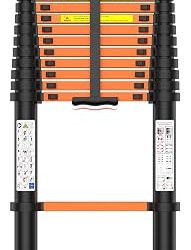
At 20.3 feet this is the reach specialist of the group, capable of second-storey gutters, roof access and tall stairwell fixtures that shorter ladders simply cannot serve. The EN 131 certification and 330 lb rating inspire confidence, and the orange anodising makes the extended rungs easy to read in low light, though expect real weight when carrying it fully collapsed.
LANBITOU 14 FT A-Frame Multi-Position Ladder
The most versatile pick for interiors, converting between a free-standing four-step A-frame and a 14 ft straight extension, which makes it the rare ladder that handles both a stair landing and a soffit. Anti-slip feet and the multi-position hinge give it genuine stability where there is nothing to lean against.
Prime 13.5 FT Telescopic Extension Ladder
ANSI Type 1A certification is the stricter of the two common standards, and the included stabilizer bar widens the base meaningfully on gravel, decking and lawn. The 13.5 ft reach hits a sensible middle ground for most suburban homes without becoming unwieldy to store.
12.5 FT Silver Telescoping Ladder
Dual EN 131 and ANSI certification on a compact 12.5 ft aluminium frame makes this the tidiest everyday option, particularly for apartments, RVs and homes with generous but not soaring ceilings. The brushed silver finish also reads less industrial if the ladder ends up stored somewhere visible.
SocTone 12.5 FT Telescoping Ladder with Stabilizers
Effectively the value proposition in the 12.5 ft class, pairing a 330 lb heavy-duty rating with a stabilizer bar that noticeably reduces side-to-side flex at full extension. A sound choice for mixed household and outdoor work where the ladder will see regular, varied use.
Frequently Asked Questions
Are telescoping ladders safe for regular home use?
Yes, provided the model carries EN 131 or ANSI certification and every rung is fully locked before you climb. Verify the locking indicators visually each time rather than by sound alone.
What height ladder do I need for a two-storey house?
Second-storey gutters typically sit 18–22 feet up, so a 20 ft class ladder like the SINMEIRUN is the practical minimum. For anything higher, hire a professional.
Can I use these ladders on stairs?
Only multi-position A-frame designs such as the LANBITOU are intended for stair use, since their adjustable legs accommodate uneven surfaces. Straight telescoping ladders should never be footed on a step.
How should I store a telescoping ladder?
Collapse it fully, store it upright in a dry interior space, and keep the rung channels free of grit. Debris and moisture are the main causes of sticky, uneven retraction.
Final Thoughts
For most homes, the LANBITOU 14 FT multi-position ladder is the smartest single purchase, since it covers both free-standing interior work and straight extension duties. If your priority is reaching second-storey gutters, step up to the SINMEIRUN 20.3 FT; if compact storage and certification matter most, the Prime 13.5 FT with stabilizers is the refined choice.