Key takeaways
- Runner material and fit: UHMW plastic bars glide smoothly, resist humidity swings, and will not rust or gall your cast iron. Adjustable aluminum runners with set screws let you dial out slop in the miter slot, which is where most repeatability is won or lost.
- Zero-clearance support: A sled base that the blade cuts its own kerf into supports wood fibers right up to the tooth line. That is the difference between crisp shoulders on a tenon and fuzzy edges you have to sand away.
- Scale versus capacity: A small-parts sled excels at dowels, tenons, and trim offcuts under a few inches. Cabinet panels and wide aprons need a full-size sled with a long fence and generous base — decide which job dominates your builds before you buy.
- Kit or finished unit: Hardware kits with T-track, miter bars, and predrilled parts let you size the base to your saw and your work. Ready-made sleds get you cutting the same afternoon. Both are valid; one costs shop time, the other costs flexibility.
- Safety and hold-down: Look for a fence tall enough to keep hands clear, a stop system for repeat cuts, and some way to capture the offcut. Small pieces should never be pinched between blade and fence with fingers nearby.
What's inside
Anyone who has built a floating shelf, a slatted bench, or a run of drawer boxes knows the moment of truth arrives at the crosscut. The rip fence handles length all day, but the second you ask a table saw to square a short workpiece, the miter gauge starts to feel like a suggestion rather than a reference. Edges creep out of square by a degree, tearout blooms on the show face, and small offcuts pitch toward the blade. On furniture, those errors compound: a cabinet carcass that is a hair out of square telegraphs into every door reveal you cut afterward.
A crosscut sled fixes the geometry problem at the source by carrying the workpiece past the blade on a rigid platform that rides the miter slots. This guide looks at what actually matters when you buy one in 2026 — runner material, zero-clearance support, capacity, and whether a kit or a finished sled makes more sense for your shop — then reviews the standouts, from compact small-parts sleds to full hardware kits you build around your own saw.
As an Amazon Associate we earn from qualifying purchases.


How to Choose a Crosscut Sled For Table Saw (2026)
- Runner material and fit: UHMW plastic bars glide smoothly, resist humidity swings, and will not rust or gall your cast iron. Adjustable aluminum runners with set screws let you dial out slop in the miter slot, which is where most repeatability is won or lost.
- Zero-clearance support: A sled base that the blade cuts its own kerf into supports wood fibers right up to the tooth line. That is the difference between crisp shoulders on a tenon and fuzzy edges you have to sand away.
- Scale versus capacity: A small-parts sled excels at dowels, tenons, and trim offcuts under a few inches. Cabinet panels and wide aprons need a full-size sled with a long fence and generous base — decide which job dominates your builds before you buy.
- Kit or finished unit: Hardware kits with T-track, miter bars, and predrilled parts let you size the base to your saw and your work. Ready-made sleds get you cutting the same afternoon. Both are valid; one costs shop time, the other costs flexibility.
- Safety and hold-down: Look for a fence tall enough to keep hands clear, a stop system for repeat cuts, and some way to capture the offcut. Small pieces should never be pinched between blade and fence with fingers nearby.
The Best Crosscut Sled For Table Saw (2026)s Reviewed
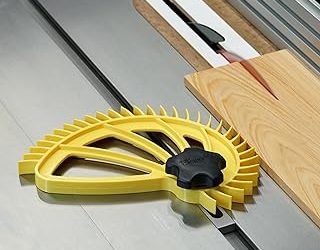
Rockler Small Parts Crosscut Sled
This is the sled I reach for when a project turns into a hundred small components — shelf pins, spacers, mitered trim, tenon cheeks. The zero-clearance support and captured cut path mean short offcuts stay put instead of launching, and the fit and finish justify the premium over generic options.
POWERTEC 71403 Table Saw Crosscut Sled Kit
A well-considered jig and hardware kit for woodworkers who want a full-size sled sized to their own saw and stock. You supply the plywood or MDF base; POWERTEC supplies the fence hardware and runners, which is the right split since base dimensions are the part that should be customized.
Small Crosscut Sled with Zero-Gap Support and Aluminum Rails
Built specifically for 90-degree cuts on thin dowels, tenons, and decorative moldings, with aluminum slide rails that keep the action tight. If your work skews toward small-scale detail — inlay strips, gallery rails, drawer dividers — this is a focused tool at a sensible price.
21P Table Saw Sled Kit with T-Track and UHMW Bars
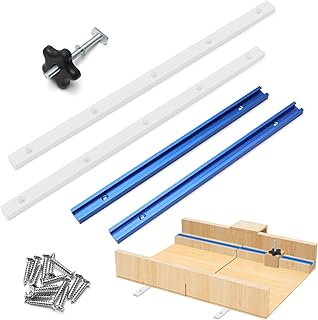
The most complete DIY package here: two aluminum T-tracks, two predrilled UHMW miter bars, plus knobs and screws for adding stops and hold-downs. Excellent value for a weekend build, and the T-track opens the door to flip stops for repeatable furniture parts.
UHMW Miter Bars, 3/4″ x 3/8″ x 17″ (4-Pack)
If you already have a sled design in mind, these four UHMW bars are the foundation. They run slick and stable in standard 3/4″ slots and are equally useful for tenoning jigs, taper jigs, and other fixtures you build over time.
Frequently Asked Questions
Do I still need a miter gauge if I have a sled?
Yes, for angled and beveled cuts on longer stock a good miter gauge remains useful. The sled owns the square crosscut; the gauge covers the rest.
Will a sled fit any table saw?
Most kits target standard 3/4″ x 3/8″ miter slots found on contractor and cabinet saws. Measure your slots first — some compact and older saws use non-standard dimensions.
How much cutting capacity do I lose?
Expect to give up roughly the thickness of the sled base, often 1/2″ to 3/4″ of blade height. Plan accordingly if you routinely cut thick hardwood.
Can a sled cut miters for picture frames?
A dedicated 45-degree sled or an adjustable fence handles miters best. A standard crosscut sled is optimized for 90 degrees, and forcing it out of square defeats its purpose.
Final Thoughts
For most furniture makers, the Rockler Small Parts Crosscut Sled is the safest, fastest answer to small-component accuracy, while the POWERTEC 71403 kit is the better investment if you want a full-size sled matched to your saw. Builders who enjoy making their own jigs should start with the 21P Sled Kit and its T-track hardware — it scales with your shop rather than limiting it.