Key takeaways
- Rip capacity over raw power: Almost every 15-amp saw has enough motor. What separates them is how far the fence travels. Anything under 24 inches means you’ll be breaking down plywood by hand before it ever reaches the table.
- Fence quality, first and last: A rack-and-pinion fence that locks parallel every time is the single biggest upgrade in cut accuracy. Cheap single-lock fences drift under pressure, and no amount of technique fixes that.
- Match the scale to the work: Mini precision saws handle acrylic, PCB, veneer, and model stock beautifully but will stall on hardwood. If you’re building furniture, you need an 8-1/4 or 10-inch blade. If you’re building dollhouses and inlay, you don’t.
- Stand and storage reality: A rolling folding stand turns a 90-pound machine into something one person moves alone. Benchtop saws are lighter but need a dedicated surface, which is often the real space cost.
- Dust and guarding: Look for a functional dust port, a riving knife, and anti-kickback pawls that are quick to remove and reinstall. Guards you can’t easily reattach are guards you stop using.
What's inside
There’s a particular kind of frustration that sets in around the third weekend of a build. The joinery is sound, the finish plan is decided, and then a rip cut wanders a sixteenth of an inch and the whole panel reads crooked in the room. Hobbyist woodworkers rarely fail because of ambition. They fail because a circular saw and a straightedge can’t hold a line across four feet of walnut, and because the table saw market is split between machines too small for furniture and machines too heavy for a shared garage.
This guide sorts through that gap. We looked at what actually matters when you’re building side tables, floating shelves, and bed frames in a space that also parks a car: rip capacity that clears a plywood sheet, a fence that stays square after it’s been bumped, and a footprint you can fold away. Below are the saws worth your bench space in 2026, from palm-sized precision units for model work to full jobsite saws that punch above their price.
As an Amazon Associate we earn from qualifying purchases.




How to Choose a/an Hobbyist Table Saw (2026)
- Rip capacity over raw power: Almost every 15-amp saw has enough motor. What separates them is how far the fence travels. Anything under 24 inches means you’ll be breaking down plywood by hand before it ever reaches the table.
- Fence quality, first and last: A rack-and-pinion fence that locks parallel every time is the single biggest upgrade in cut accuracy. Cheap single-lock fences drift under pressure, and no amount of technique fixes that.
- Match the scale to the work: Mini precision saws handle acrylic, PCB, veneer, and model stock beautifully but will stall on hardwood. If you’re building furniture, you need an 8-1/4 or 10-inch blade. If you’re building dollhouses and inlay, you don’t.
- Stand and storage reality: A rolling folding stand turns a 90-pound machine into something one person moves alone. Benchtop saws are lighter but need a dedicated surface, which is often the real space cost.
- Dust and guarding: Look for a functional dust port, a riving knife, and anti-kickback pawls that are quick to remove and reinstall. Guards you can’t easily reattach are guards you stop using.
The Best Hobbyist Table Saw (2026)s Reviewed
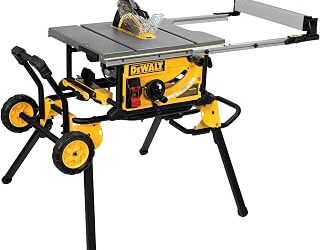
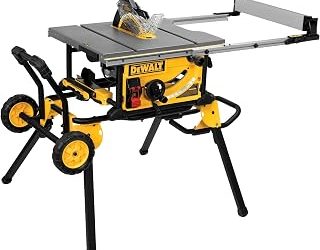
DEWALT DWE7491RS 10-Inch with Rolling Stand
This is the saw most serious hobbyists end up buying eventually, so there’s an argument for starting here. The 32-1/2-inch rip capacity swallows a full sheet split down the middle, the rack-and-pinion fence is genuinely trustworthy, and the folding rolling stand means it lives against a wall between projects rather than in the middle of your floor.
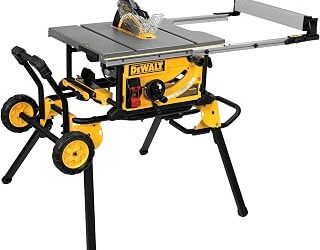
DEWALT DWE7485 8-1/4 in. Compact Jobsite Saw
The smart compromise for tight shops: same fence engineering philosophy as its bigger sibling in a package light enough to carry up basement stairs. The 8-1/4-inch blade limits depth of cut slightly, which matters for thick stock but almost never for cabinet-grade plywood and dimensional lumber.
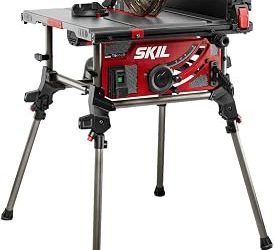
SKIL TS6307-00 10-Inch with Folding Stand
A strong value play with a rack-and-pinion fence and an integrated folding stand at a friendlier price point. The onboard dust port and clean bevel adjustment make it a comfortable first real table saw for someone graduating from a circular saw and a track.
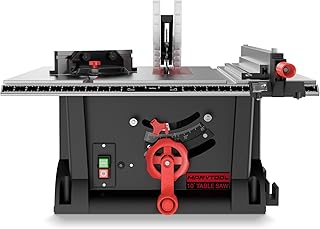
15Amp Portable 10-Inch Compact Table Saw
A budget benchtop option that covers the fundamentals: 4600 RPM, a 36-tooth blade out of the box, and 0–45 degree bevels for mitered frames and angled shelf supports. Expect to spend a little time tuning the fence and miter gauge, then treat the savings as a blade-and-accessory budget.
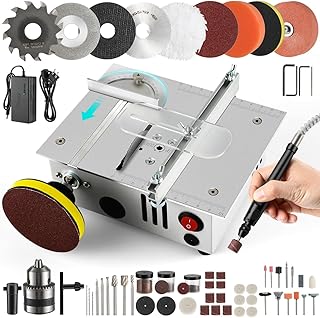
MXBAOHENG Mini Precision Table Saw, 96W 7-Speed
Different tool, different job. With a 1/2-inch cut depth and seven speeds, this is the right machine for thin hardwood, acrylic, PCB, and model stock where a 10-inch blade would be absurd. The included chuck and sanding disc make it closer to a small multi-purpose bench station than a scaled-down saw.
Frequently Asked Questions
Can I build real furniture with a portable table saw?
Yes. Most contemporary furniture is built from sheet goods and dimensional lumber under two inches thick, all well within a jobsite saw’s range. The limitation is capacity for very large panels, which a simple outfeed support solves.
Is a mini table saw worth it if I already own a full-size saw?
For anyone doing inlay, marquetry, model work, or electronics enclosures, absolutely. Small stock on a big blade is both inaccurate and unsafe, and a dedicated precision unit removes that risk entirely.
How important is the included blade?
Less than you’d think. Stock blades are usually general-purpose 24 to 36 tooth designs. A quality 40-tooth combination blade is the cheapest meaningful accuracy improvement you can make to any saw on this list.
Do I need a dedicated dust collection setup?
A shop vacuum connected to the dust port captures the majority of debris and keeps sightlines clear. Full collection systems are nice, not necessary, at hobbyist volumes.
Final Thoughts
If you’re building furniture and have room for one machine, the DEWALT DWE7491RS is the saw that stops being a compromise, with the SKIL TS6307-00 delivering most of that capability for meaningfully less. Choose the DEWALT DWE7485 if portability outranks depth of cut, and add the MXBAOHENG mini saw alongside either one if your work includes small-scale precision pieces.