Key takeaways
- Tooth count and grind: The classic combination pattern is 50 teeth arranged in sets of four ATB teeth plus one flat raker, with a deep gullet between groups. That geometry is what lets a single blade evacuate rip chips and still shear crosscut fibers. Straight 48T or 50T ATB blades cut beautifully across the grain but work harder in thick rips.
- Kerf width versus your motor: Thin kerf around .098″ removes roughly 20% less material, which matters enormously on a contractor saw or portable unit under 1.75HP. Full kerf near .125″ is stiffer and tracks better through 8/4 maple if you have the power to feed it.
- Plate quality and vibration control: Look for a tensioned, laser-cut plate around .071″ with expansion or anti-vibration slots. This is the least glamorous spec and the one you feel most in the finished edge — a flat, quiet plate is what gives you glue-ready surfaces straight off the saw.
- Carbide grade: Micrograin or high-density carbide holds a keener edge through abrasive material like MDF and melamine, and survives more sharpenings. Cheap carbide chips at the tips and never resharpens well.
- Coatings and hook angle: A nonstick coating limits pitch buildup, which is the hidden cause of burn marks on cherry and maple. A 15° hook angle is the sweet spot for table saw feed rates; steeper is aggressive, shallower is slower but calmer.
What's inside
Anyone who has built a dining table from rough stock knows the moment of truth arrives at the saw. A blade that wanders leaves you chasing gaps in your glue-ups, and a blade that tears out on plywood veneer turns a $180 sheet of walnut ply into shop scrap. The frustration is usually not skill — it is asking a 24-tooth ripper to behave like a crosscut blade, or swapping blades four times in an afternoon because nothing on the arbor does both jobs well.
That is the case for a proper combination blade: one 10-inch disc that rips solid hardwood cleanly and crosscuts case sides without shredding the edge. This guide looks at the blades furniture makers actually keep mounted, what separates a genuine combination grind from a marketing label, and which specs matter when your saw is a jobsite unit rather than a 3HP cabinet machine.
As an Amazon Associate we earn from qualifying purchases.




How to Choose a/an 10-Inch Combination Table Saw Blade (2026)
- Tooth count and grind: The classic combination pattern is 50 teeth arranged in sets of four ATB teeth plus one flat raker, with a deep gullet between groups. That geometry is what lets a single blade evacuate rip chips and still shear crosscut fibers. Straight 48T or 50T ATB blades cut beautifully across the grain but work harder in thick rips.
- Kerf width versus your motor: Thin kerf around .098″ removes roughly 20% less material, which matters enormously on a contractor saw or portable unit under 1.75HP. Full kerf near .125″ is stiffer and tracks better through 8/4 maple if you have the power to feed it.
- Plate quality and vibration control: Look for a tensioned, laser-cut plate around .071″ with expansion or anti-vibration slots. This is the least glamorous spec and the one you feel most in the finished edge — a flat, quiet plate is what gives you glue-ready surfaces straight off the saw.
- Carbide grade: Micrograin or high-density carbide holds a keener edge through abrasive material like MDF and melamine, and survives more sharpenings. Cheap carbide chips at the tips and never resharpens well.
- Coatings and hook angle: A nonstick coating limits pitch buildup, which is the hidden cause of burn marks on cherry and maple. A 15° hook angle is the sweet spot for table saw feed rates; steeper is aggressive, shallower is slower but calmer.
The Best 10-Inch Combination Table Saw Blade (2026)s Reviewed
Diablo D1050X 50-Tooth Combination Blade
The .098″ thin kerf and 15° hook make this the most forgiving pick for underpowered saws, and the Perma-Shield coating genuinely keeps resin off the plate through a full day of cherry. For the price, it delivers surfaces that need nothing more than a light pass with a card scraper before finish.
CMT Orange Tools 256.050.10
CMT’s 4 ATB + 1 flat grind on a .102″ kerf splits the difference between thin and full kerf, giving you noticeably better tracking in thick rips without bogging a mid-range saw. The carbide is generous and takes resharpening well, which makes this a sensible long-term blade for a shop cutting a lot of solid stock.
Freud LU83R010 Industrial Thin Kerf
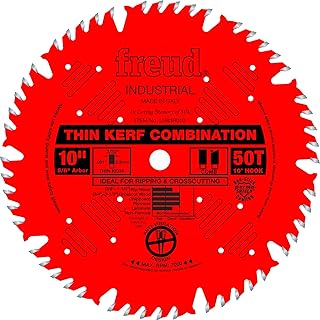
This is the reference blade for furniture work — Freud’s TiCo carbide blend and laser-cut anti-vibration slots produce a quiet cut and an edge clean enough to go straight into a glue-up. If you build case goods in hardwood and veneered ply and want one blade to trust, this is the one worth the premium.
US1048ATBFK 48-Tooth Combination Blade
An American-made full kerf blade at 1/8″ with 48 ATB teeth, biased slightly toward crosscut refinement. Best suited to a cabinet saw with power to spare, where the stiffer plate rewards you with dead-square cuts on wide panels.
50-Tooth Thin Kerf Combination Blade
A capable budget entry with 50T ATB carbide, a nonstick coating, and a 6,000 RPM rating that covers any standard 10-inch saw. It handles hardwood and plywood cleanly enough for shop furniture and jigs, making it a smart spare to keep on the wall.
Frequently Asked Questions
Is a combination blade good enough for fine furniture?
For most joinery, yes. A quality 50-tooth combination blade produces glue-ready rip edges and clean crosscuts, which covers the vast majority of casework and table construction.
When should I switch to a dedicated crosscut blade?
When you are cutting a lot of pre-finished plywood, melamine, or delicate veneer. A high-tooth blade like the FOXBC 80-tooth leaves a glassier edge with far less chipout on brittle faces.
Does thin kerf hurt cut quality?
Not on its own. Thin kerf plates can flex more in deep rips, but a properly tensioned plate with anti-vibration slots holds line well and saves your motor real strain.
How often should I sharpen?
Watch for burning, increased feed pressure, and fuzzy edges rather than counting cuts. Two or three professional sharpenings are typical before a quality blade retires.
Final Thoughts
For serious furniture work, the Freud LU83R010 is the blade to build a shop around — clean, quiet, and consistently glue-ready. The Diablo D1050X is the value pick for anyone running a contractor or portable saw, while the CMT 256.050.10 suits makers who rip a lot of thick hardwood and want a stiffer plate that resharpens for years.