Key takeaways
- Tooth count: Higher counts remove less material per tooth, so the cut face comes out cleaner. Think 40T for general crosscutting and ripping, 60T for plywood and MDF, and 80T or more for veneer, melamine, and finish trim where tearout is unforgivable.
- Grind and hook angle: An ATB (alternate top bevel) grind slices wood fibers like a knife and is the default for furniture work. A low or negative hook angle keeps a sliding miter saw from grabbing the workpiece and self-feeding.
- Kerf and plate quality: Thin-kerf blades waste less stock and ask less of your motor, but a flimsy plate will flutter and wander. Look for laser-cut expansion slots and a body that stays flat when it heats up.
- Arbor size: Nearly every ten-inch miter saw uses a 5/8-inch (16mm) arbor. Confirm it before you buy, and skip blades that need a reducer bushing to fit.
- Material match: Wood blades and non-ferrous metal blades are not interchangeable. Cutting aluminum with a standard ATB blade is loud, dangerous, and hard on the teeth. Buy the right tool for the job.
What's inside
Most chipped edges don’t come from a bad saw. They come from a blade that was never right for the material in the first place. You cut a length of prefinished oak for a floating shelf, and the underside splinters. You crosscut walnut for a bench seat and get a scorch line you have to sand out. The miter saw is fine. The 24-tooth framing blade that shipped in the box is doing exactly what it was built to do, which is chew through construction lumber fast and leave the tidying up to someone else.
For furniture and interior work, the blade is the finish. This guide looks at ten-inch blades that suit the way people actually build at home in 2026: plywood carcasses, hardwood face frames, veneered panels, trim, and the occasional aluminum extrusion for a table base. Below you’ll find how to read the specs that matter, then honest notes on the blades worth your money.
As an Amazon Associate we earn from qualifying purchases.


How to Choose a 10 Inch Miter Saw Blade
- Tooth count: Higher counts remove less material per tooth, so the cut face comes out cleaner. Think 40T for general crosscutting and ripping, 60T for plywood and MDF, and 80T or more for veneer, melamine, and finish trim where tearout is unforgivable.
- Grind and hook angle: An ATB (alternate top bevel) grind slices wood fibers like a knife and is the default for furniture work. A low or negative hook angle keeps a sliding miter saw from grabbing the workpiece and self-feeding.
- Kerf and plate quality: Thin-kerf blades waste less stock and ask less of your motor, but a flimsy plate will flutter and wander. Look for laser-cut expansion slots and a body that stays flat when it heats up.
- Arbor size: Nearly every ten-inch miter saw uses a 5/8-inch (16mm) arbor. Confirm it before you buy, and skip blades that need a reducer bushing to fit.
- Material match: Wood blades and non-ferrous metal blades are not interchangeable. Cutting aluminum with a standard ATB blade is loud, dangerous, and hard on the teeth. Buy the right tool for the job.
The Best 10 Inch Miter Saw Blades Reviewed
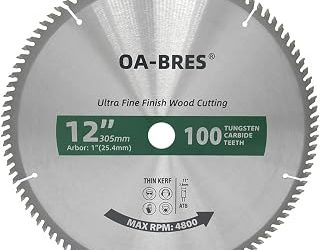
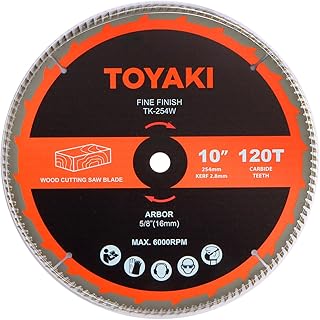
120-Tooth Fine-Finish Woodworking Blade
At 120 teeth, this is a specialist, and it earns that role on veneered plywood, melamine, and prefinished trim where a single chip means a wasted board. Feed it slowly and let the tooth count do the work; it isn’t the blade for thick hardwood or rough stock.
WEN BL1080 80-Tooth Carbide-Tipped
The sweet spot for most furniture makers, with enough teeth for a glue-ready crosscut in oak, maple, or poplar and enough clearance to keep moving. Carbide tips hold their edge through a full project, and WEN’s pricing makes it easy to keep a spare on the shelf.
KENDO 2-Pack, 40T and 60T
The most sensible starter kit here: a 40-tooth for ripping and general cutting, a 60-tooth for sheet goods and laminate. If you’re outfitting a first shop, this pair covers roughly nine out of ten cuts a cabinet or table project will throw at you.
Benchmark Abrasives 10″ TCT, 100 Teeth
Built for aluminum and other non-ferrous metals, which makes it genuinely useful if your designs lean on tubular steel-look legs, extrusion frames, or metal edge banding. Use cutting wax, clamp everything, and wear a face shield, because metal chips travel.
ANGELSWORD 60T, 2 Pack
A practical value play: two 60-tooth blades for less than many single premium blades, which means you can swap to a fresh edge mid-project instead of pushing a dull one. Finish quality on plywood and softwood is solid, though a top-tier blade still edges it out on dense hardwood.
Frequently Asked Questions
How many teeth do I need for trim and molding?
Eighty teeth handles almost all painted and stained trim cleanly. Step up to 100 or more only for prefinished or veneered material, where the surface layer is thin enough to chip.
Can I cut aluminum with a regular wood blade?
No. The tooth geometry is wrong, the blade can grab and throw the workpiece, and the teeth load up with metal. Use a dedicated non-ferrous TCT blade with a negative hook angle.
Is a thin-kerf blade a good idea on a sliding miter saw?
Usually yes. Thin kerf reduces strain and leaves a smoother cut, provided the plate is well made. On very long slide cuts in thick hardwood, a standard kerf tracks more predictably.
Sharpen or replace?
Carbide-tipped blades can be professionally sharpened several times, and it’s worth doing on premium blades. For budget blades, replacement is generally cheaper than the service.
Final Thoughts
If you build furniture and want one blade that just works, the WEN BL1080 is the easy call. Starting from scratch, the KENDO 40T/60T pair covers more ground for the money, and if metal is part of your design vocabulary, add the Benchmark Abrasives TCT blade and keep it strictly for non-ferrous work.