Key takeaways
- Tooth count and its trade-off: Fewer teeth (24–40) clear waste fast and rip long boards without bogging the motor. More teeth (60–80) leave a glassy edge on plywood and hardwood but cut slower and generate more heat. Match the blade to the cut, not the other way around.
- Arbor and plate accuracy: Nearly every 10-inch consumer table saw uses a 5/8-inch arbor, so confirm that first. Then look for a flat, tensioned steel plate. A blade that wobbles a few thousandths will widen your kerf and ruin joinery no matter how sharp the carbide is.
- Carbide quality over carbide quantity: Micrograin carbide holds an edge through melamine and engineered flooring far longer than generic tips. Thicker brazed teeth also survive more resharpenings, which matters if you cut abrasive sheet goods regularly.
- Kerf thickness and your motor: Thin-kerf blades remove less material and are the right call for saws under 3 HP or for job-site models running on a 15-amp circuit. Full-kerf blades are stiffer and truer, but only if your saw has the power to drive them.
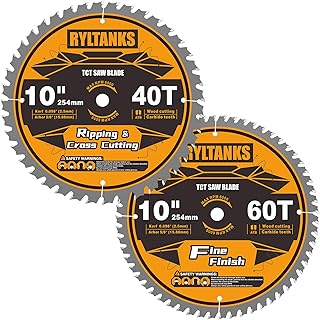
- Build a small set, not one perfect blade: Two purpose-built blades will outperform a single general-purpose blade at similar total cost. A ripping blade plus a fine-finish blade covers roughly everything a furniture project throws at you.
What's inside
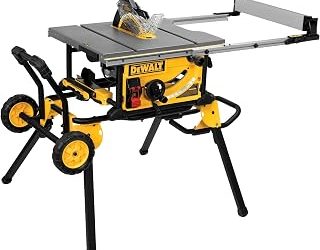
The blade that ships with a table saw is rarely the blade you want for furniture work. Stock blades are built to be adequate at everything: they rip, they cross-cut, they leave a fuzzy edge that needs sanding, and they burn hard maple if you push too fast. For anyone building a dining table, a floating shelf, or a run of cabinet doors, that compromise shows up in the finished piece as tear-out along veneer edges, glue lines that read as seams, and end grain that drinks stain unevenly.
A better 10-inch blade is the cheapest meaningful upgrade you can make to a saw you already own. This guide looks at six well-reviewed options across the price spectrum, from a single high-tooth finishing blade to two-packs that cover both rough ripping and clean cross-cuts. Below you’ll find the specs that actually matter, honest notes on where each blade earns its keep, and answers to the questions that come up most often once the sawdust settles.
As an Amazon Associate we earn from qualifying purchases.


How to Choose a 10 Inch Table Saw Blades (2026)
- Tooth count and its trade-off: Fewer teeth (24–40) clear waste fast and rip long boards without bogging the motor. More teeth (60–80) leave a glassy edge on plywood and hardwood but cut slower and generate more heat. Match the blade to the cut, not the other way around.
- Arbor and plate accuracy: Nearly every 10-inch consumer table saw uses a 5/8-inch arbor, so confirm that first. Then look for a flat, tensioned steel plate. A blade that wobbles a few thousandths will widen your kerf and ruin joinery no matter how sharp the carbide is.
- Carbide quality over carbide quantity: Micrograin carbide holds an edge through melamine and engineered flooring far longer than generic tips. Thicker brazed teeth also survive more resharpenings, which matters if you cut abrasive sheet goods regularly.
- Kerf thickness and your motor: Thin-kerf blades remove less material and are the right call for saws under 3 HP or for job-site models running on a 15-amp circuit. Full-kerf blades are stiffer and truer, but only if your saw has the power to drive them.
- Build a small set, not one perfect blade: Two purpose-built blades will outperform a single general-purpose blade at similar total cost. A ripping blade plus a fine-finish blade covers roughly everything a furniture project throws at you.
The Best 10 Inch Table Saw Blades (2026)s Reviewed
DEWALT 40-Tooth Fine Finish (DWA11040)
This is the balanced workhorse of the group, with enough teeth to leave a clean cross-cut edge and enough gullet to rip 3/4-inch stock without stalling a mid-range saw. The tungsten carbide tips stay sharp through construction lumber and plywood alike, which makes it the blade most likely to live on your saw between projects.
FOXBC 80-Tooth Ultra Finish
At 80 teeth this is a dedicated finishing blade, and it shows on veneered plywood and pre-finished panels where tear-out is unforgiving. Feed slowly and let the blade do the work; pushed too hard through thick hardwood it will heat up and leave burn marks.
WEN BL1080 80-Tooth Ultra-Fine Finish
A strong value pick for anyone who owns both a miter saw and a table saw, since it performs well in either. Trim carpentry, picture frames, and drawer fronts come off it needing little more than a light pass with a sanding block.
WEN BL1060 60-Tooth Fine Finish
Sixty teeth is the sweet spot for furniture builders who want smooth cross-cuts without the heat buildup of an 80-tooth blade. It handles solid hardwood more comfortably than its higher-tooth sibling while still leaving an edge clean enough for exposed joinery.
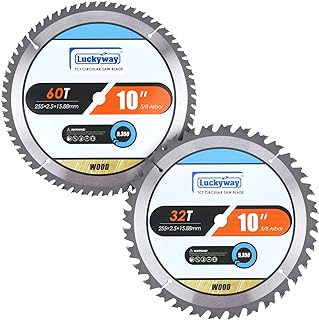
Luckyway 60-Tooth and 32-Tooth Two Pack
Buying a rip blade and a finish blade together is the smartest way to outfit a new saw, and this pairing covers both jobs at a genuinely accessible price. The 32-tooth blade tears through framing stock quickly, while the 60-tooth handles the visible cuts.
Frequently Asked Questions
Will a 10-inch blade fit my miter saw too?
Usually yes, provided the arbor matches and the blade’s maximum RPM rating meets or exceeds your saw’s speed. Check that a full-kerf blade won’t rub the throat plate or blade guard on smaller compound miter saws.
How many teeth do I need for plywood?
Sixty is the practical minimum for veneered plywood; 80 is better if the finished edge will be visible. A zero-clearance insert and a scoring pass will do more for chip-free results than tooth count alone.
When should I replace rather than sharpen?
If the carbide tips still have material left and the plate is flat, professional sharpening costs a fraction of a new blade and restores most of the performance. Replace when teeth are chipped, brazing has failed, or the plate has warped from heat.
Why is my blade burning the wood?
Burning is almost always misalignment, a dull edge, or too slow a feed rate rather than a bad blade. Check that your fence is parallel to the blade before assuming the blade is the problem.
Final Thoughts
For most home furniture makers, the DEWALT DWA11040 is the blade to buy first: it handles the widest range of cuts with the least fuss. Add the WEN BL1060 when you start caring about visible edges and joinery, or start with the Luckyway two-pack if you’d rather cover ripping and finishing in a single purchase.