Key takeaways
- Tooth count: For furniture work, 60 to 80 teeth is the sweet spot on a 10-inch blade. Move to 120 teeth when you’re crosscutting veneered plywood, hardwood trim, or anything where the cut face stays visible. Under 40 teeth belongs on a table saw for ripping, not on a miter saw.
- Grind and hook angle: An ATB (alternate top bevel) grind slices wood fibers cleanly and is what you want for general crosscuts. A TCG (triple-chip grind) with a low or negative hook is built for aluminum, laminate, and composites, and it resists the grabbing you get from an aggressive woodworking blade.
- Kerf width: Thin kerf, around 1/8 inch, removes less material and puts less strain on smaller motors, which matters on 10-inch and cordless saws. Full kerf blades track straighter on heavy-duty saws but demand more power.
- Carbide quality and body construction: Look for micro-grain carbide tips and a hardened, tensioned steel plate. Laser-cut expansion slots and anti-vibration features are the difference between a blade that stays flat and one that starts singing and drifting after a season.
- Arbor and saw compatibility: Nearly all 10-inch miter saws use a 5/8-inch (16mm) arbor, but confirm your maximum RPM rating before you spin any blade up. Also check the blade’s intended machines, since some are optimized for miter saws specifically rather than doing double duty on a table saw.
What's inside
The blade that ships with a miter saw is a placeholder, not a finish tool. It cuts, technically, but it also leaves a torn shoulder on your white oak, a fuzzy edge on the maple shelf you spent a weekend milling, and tear-out along the veneer of a cabinet panel that no amount of sanding will fully hide. For anyone building furniture rather than framing a wall, that gap between “cut” and “ready to join” is where projects quietly go sideways.
This guide looks at 10-inch miter saw blades through a furniture-maker’s lens: how clean the crosscut is on hardwood, how the blade behaves in soft plywood and melamine, and whether the tooth geometry actually earns its price. Below you’ll find the picks worth your money in 2026, a short buying framework, and answers to the questions that come up most often once a blade is in the box.
As an Amazon Associate we earn from qualifying purchases.


How to Choose a 10 Miter Saw Blades (2026)
- Tooth count: For furniture work, 60 to 80 teeth is the sweet spot on a 10-inch blade. Move to 120 teeth when you’re crosscutting veneered plywood, hardwood trim, or anything where the cut face stays visible. Under 40 teeth belongs on a table saw for ripping, not on a miter saw.
- Grind and hook angle: An ATB (alternate top bevel) grind slices wood fibers cleanly and is what you want for general crosscuts. A TCG (triple-chip grind) with a low or negative hook is built for aluminum, laminate, and composites, and it resists the grabbing you get from an aggressive woodworking blade.
- Kerf width: Thin kerf, around 1/8 inch, removes less material and puts less strain on smaller motors, which matters on 10-inch and cordless saws. Full kerf blades track straighter on heavy-duty saws but demand more power.
- Carbide quality and body construction: Look for micro-grain carbide tips and a hardened, tensioned steel plate. Laser-cut expansion slots and anti-vibration features are the difference between a blade that stays flat and one that starts singing and drifting after a season.
- Arbor and saw compatibility: Nearly all 10-inch miter saws use a 5/8-inch (16mm) arbor, but confirm your maximum RPM rating before you spin any blade up. Also check the blade’s intended machines, since some are optimized for miter saws specifically rather than doing double duty on a table saw.
The Best 10 Miter Saw Blades (2026)s Reviewed
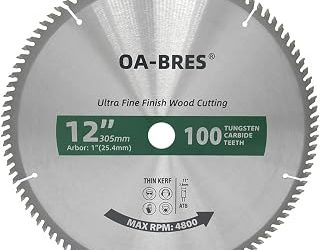
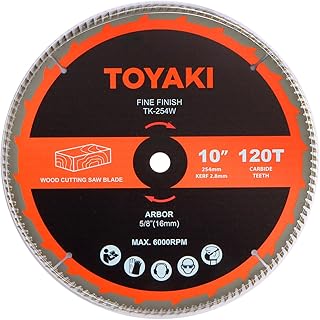
10-Inch 120-Tooth Fine-Finish Professional Blade
With 120 teeth on a 10-inch plate, this is the blade you reach for when the cut edge is the finished edge, and it leaves hardwood trim and veneered panels close to glue-ready. Feed it slowly and let the tooth count do the work, since crowding a fine-finish blade is the fastest way to burn a cut.
WEN BL1080 10-Inch 80-Tooth Carbide-Tipped
Carbide-tipped, 80 teeth, and priced for people who go through blades on real projects, the BL1080 is the most sensible everyday upgrade over a stock blade. It handles oak, poplar, and plywood crosscuts with almost no cleanup, and it works just as well dropped into a table saw.
WEN BL1060 10-Inch 60-Tooth Fine-Finish
The BL1060 gives up a little polish for a faster, cooler cut, which makes it the better pick for long build days and thicker stock. If you’re batching out table aprons or bed rails, this is the blade that stays sharp and doesn’t bog your saw down.
USA-Made 10-Inch 80-Tooth Miter Blade (US1080-MTR)
Built in the USA with 80-tooth geometry tuned specifically for crosscuts and miters, plus a 1/8-inch kerf and 5/8-inch arbor, this one is engineered for the machine it’s named after. Miters close tightly and repeat well, which is exactly what you want when frames and case joints have to line up.
10-Inch TCG 120-Tooth Aluminum-Working Blade
The triple-chip grind makes this the right blade for aluminum extrusion, laminate, and melamine, where a standard woodworking grind would chip or grab. Furniture makers working with metal legs, edge banding, or mixed-material builds should keep one on the shelf.
Frequently Asked Questions
Is a higher tooth count always better?
No. More teeth mean a smoother finish but slower feed rates and more heat, especially in thick or resinous stock. A 60-tooth blade often outperforms a 120-tooth blade on 2-inch hardwood simply because it clears chips better.
Can I use a miter saw blade on my table saw?
Usually yes, if the arbor and RPM rating match. Several blades here, including the WEN BL1060 and BL1080, are rated for both. Just don’t rip with a high-tooth-count crosscut blade, since it will burn and bind.
How do I stop tear-out on plywood?
Use a high-tooth-count blade, back the cut with a sacrificial fence or zero-clearance support, score the veneer line lightly first, and slow your feed through the last third of the cut. A 120-tooth blade plus a backer board solves most of it.
When should I replace a blade instead of sharpening it?
Carbide-tipped blades can typically be resharpened two or three times before the tips get too thin to hold geometry. Replace it outright if you see chipped or missing teeth, a warped plate, or burn marks that persist after cleaning off pitch.
Final Thoughts
For most furniture builders, the WEN BL1080 80-tooth is the best all-around value and the easiest recommendation, while the USA-made US1080-MTR is worth the step up if tight, repeatable miters are your priority. Keep a 120-tooth fine-finish blade nearby for veneered plywood and visible trim, and you’ll have almost every cut in the shop covered.