Key takeaways
- Crosscut capacity: A 10-inch slider handling roughly 3.5 x 13.4 inches covers nearly all cabinet stock, shelving, and 2×12 framing. Step up to 12 inches only if you routinely cut wide nested crown or thick hardwood slabs, since the larger blades cost more and can flex under load.
- Single vs. dual bevel: Single bevel is cheaper and perfectly capable if you are willing to flip the workpiece. Dual bevel earns its price on long trim runs and tall baseboard, where flipping a ten-foot board is how mistakes happen.
- Cut-line guidance: Lasers are fast to align but drift and wash out in bright shops. A shadow-line LED system projects the blade’s actual silhouette, so the reference cannot fall out of calibration.
- Rail design and bench depth: Traditional rails need clearance behind the saw. Compact glide or forward-rail designs let the tool sit flush against a wall, which matters more than most buyers expect in a garage or basement shop.
- Dust control and blade quality: Assume the included blade is a starting point and budget for an 80-tooth finish blade. Check the dust port diameter against your vacuum before you buy, not after.
What's inside
Anyone who has tried to install crown molding in an older house knows the moment the trouble starts: the wall corner reads 91 degrees, the baseboard has a slight cup to it, and the cut you made in the garage sits proud by a hair. Miter saws are supposed to remove that guesswork, but the machine you choose decides whether you spend the afternoon fitting trim or sanding away your own mistakes. Deflection in the slide rails, a fence that drifts out of square, a laser that lands beside the kerf instead of on it — these are the small failures that show up in finished rooms as gaps you learn to stop looking at.
This guide looks at sliding compound miter saws through the lens of finish work: casing, built-ins, shelving, bench-made furniture, and the occasional deck frame. We weigh cutting capacity against bench footprint, single bevel against dual, and honest usable accuracy against spec-sheet numbers. Below you will find current standouts from DEWALT, Makita, DOVAMAN, and NOVORIK, plus the criteria worth applying before you commit shop space to a tool this size.
As an Amazon Associate we earn from qualifying purchases.




How to Choose a 10 Sliding Compound Miter Saw (2026)
- Crosscut capacity: A 10-inch slider handling roughly 3.5 x 13.4 inches covers nearly all cabinet stock, shelving, and 2×12 framing. Step up to 12 inches only if you routinely cut wide nested crown or thick hardwood slabs, since the larger blades cost more and can flex under load.
- Single vs. dual bevel: Single bevel is cheaper and perfectly capable if you are willing to flip the workpiece. Dual bevel earns its price on long trim runs and tall baseboard, where flipping a ten-foot board is how mistakes happen.
- Cut-line guidance: Lasers are fast to align but drift and wash out in bright shops. A shadow-line LED system projects the blade’s actual silhouette, so the reference cannot fall out of calibration.
- Rail design and bench depth: Traditional rails need clearance behind the saw. Compact glide or forward-rail designs let the tool sit flush against a wall, which matters more than most buyers expect in a garage or basement shop.
- Dust control and blade quality: Assume the included blade is a starting point and budget for an 80-tooth finish blade. Check the dust port diameter against your vacuum before you buy, not after.
The Best 10 Sliding Compound Miter Saw (2026)s Reviewed
Makita LS1019L Dual-Bevel Sliding Compound Miter Saw
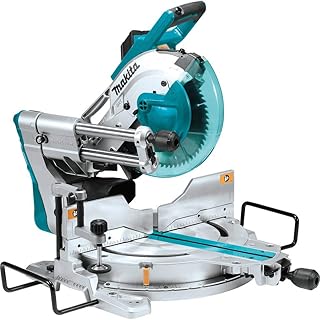
The LS1019L is the pick for anyone building furniture in a tight space: its forward-mounted rail system lets the saw sit close to the wall while still delivering full crosscut travel, and the dual-bevel head plus soft-start motor make repeat miters genuinely repeatable. Fit and finish on the detents and bevel stops is the reason this tool keeps showing up in cabinet shops.
DEWALT DWS780 12-Inch Double Bevel Sliding Miter Saw
The DWS780’s XPS shadow light is the most practical cut-line system on the market — no batteries, no calibration, just the blade’s own shadow falling on your pencil mark. Add 12-inch capacity, a genuinely effective dust collection setup, and a stainless miter detent plate, and it remains the default choice for trim carpenters who cut all day.
DEWALT DWS779 12-Inch Double Bevel Sliding Miter Saw
Mechanically close to the DWS780 but priced lower because it trades the shadow light for a conventional setup, the DWS779 is the value play if you already trust your eye or plan to add a laser. The 15-amp, 3,800 RPM motor and increased crosscut capacity handle wide boards without complaint.
DOVAMAN 10-Inch Sliding Miter Saw
DOVAMAN’s dual-speed motor — 5,000 RPM for wood, 3,200 for metal and plastic — plus three included TCT blades makes this the most versatile entry-level slider here, and the ambidextrous handle is a thoughtful touch for left-handed users. Nine positive stops and a 3.5 x 13.4-inch capacity cover the realistic range of a home furniture build.
NOVORIK Single Bevel Compound Sliding Miter Saw
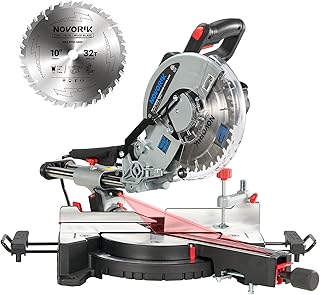
A straightforward 15-amp, 4,000 RPM single-bevel slider with a laser guide, best suited to weekend shelving, frames, and light trim rather than production work. If you can live with flipping stock for bevels, it delivers clean crosscuts for noticeably less money.
Frequently Asked Questions
Is a 10-inch saw enough for furniture work?
For almost all of it, yes. Most furniture stock is under an inch thick and well within a 10-inch slider’s crosscut width. The 12-inch models matter for tall baseboard and thick timber.
Do I need dual bevel?
Only if you cut long trim regularly. For shop projects where pieces are short enough to flip, single bevel saves money without costing accuracy.
How accurate are these out of the box?
Treat every new saw as unsquared. Check the fence and blade with a machinist square, verify the 45-degree stops, and adjust before the first real cut.
Can I use one indoors?
With a shop vacuum on the dust port, yes, though fine dust still escapes. A hood or a garage door left open is worth the trouble.
Final Thoughts
If your work is furniture and built-ins in a compact shop, the Makita LS1019L is the most refined tool here and the easiest to keep square. For trim-heavy projects and long boards, the DEWALT DWS780 and its shadow-line system remain hard to beat, with the DWS779 covering the same ground for less. Builders on a tighter budget should look at the DOVAMAN, whose dual-speed motor and blade selection punch well above its price.