Key takeaways
- Tooth count: 24–40 teeth clear waste fast for ripping solid stock; 60–80 teeth leave the polished edge you want on tabletops, drawer fronts, and plywood casework. Match the blade to the cut, not to the project.
- Kerf width: Thin-kerf blades ask less of underpowered saws and waste less material — worth it on figured hardwood. Full-kerf plates stay more rigid in deep rips if your saw has the horsepower.
- Arbor and plate quality: Confirm the 5/8-inch arbor fits your saw, then look at the plate itself. Laser-cut expansion slots and a flat, tensioned body do more for cut quality than tooth count alone.
- Grind geometry: ATB (alternate top bevel) grinds slice cross-grain fibers cleanly for finish work; flat-top and TCG grinds suit ripping, laminate, and melamine. Check the grind before assuming teeth equal smoothness.
- Carbide and upkeep: Micro-grain carbide holds an edge far longer than budget tips. Keep blades pitch-free, store them separated, and plan on sharpening rather than replacing good ones.
What's inside
Anyone building furniture at home eventually hits the same wall: the design is resolved, the material is beautiful, and the cut ruins it. Tearout along a walnut veneer edge, a burn mark on maple, miters that refuse to close cleanly on a floating shelf — almost none of that is a technique problem. It’s the blade. A stock blade shipped with a jobsite saw is tuned for framing lumber, not for the crisp, glue-ready edges that visible joinery demands.
This guide looks at ten-inch table saw blades through a furniture lens: which ones leave a surface you can finish straight off the saw, which handle sheet goods and pre-finished plywood without chipping, and where a multi-pack makes more sense than a single premium blade. Below you’ll find the current picks, a short buying framework, and answers to the questions that come up most in small-shop setups.
As an Amazon Associate we earn from qualifying purchases.


How to Choose a 10-Inch Table Saw Blade (2026)
- Tooth count: 24–40 teeth clear waste fast for ripping solid stock; 60–80 teeth leave the polished edge you want on tabletops, drawer fronts, and plywood casework. Match the blade to the cut, not to the project.
- Kerf width: Thin-kerf blades ask less of underpowered saws and waste less material — worth it on figured hardwood. Full-kerf plates stay more rigid in deep rips if your saw has the horsepower.
- Arbor and plate quality: Confirm the 5/8-inch arbor fits your saw, then look at the plate itself. Laser-cut expansion slots and a flat, tensioned body do more for cut quality than tooth count alone.
- Grind geometry: ATB (alternate top bevel) grinds slice cross-grain fibers cleanly for finish work; flat-top and TCG grinds suit ripping, laminate, and melamine. Check the grind before assuming teeth equal smoothness.
- Carbide and upkeep: Micro-grain carbide holds an edge far longer than budget tips. Keep blades pitch-free, store them separated, and plan on sharpening rather than replacing good ones.
The Best 10-Inch Table Saw Blades (2026) Reviewed
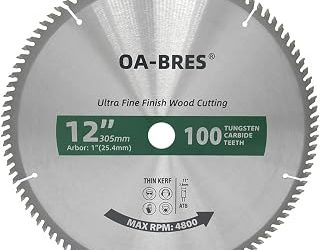
FOXBC 10-Inch 80-Tooth Ultra Finish Blade
Eighty teeth and a fine ATB grind make this the blade to mount when the cut will be seen — mitered frames, hardwood edging, cabinet-grade ply. Feed slowly and it leaves a surface that needs little more than a scuff sand before finish.
DEWALT DWA11040 10-Inch 40-Tooth Fine Finish
The most useful all-rounder here: forty teeth rip solid stock without bogging a contractor saw, yet cross-cut cleanly enough for most casework. If you keep one blade on the saw between projects, this is a sensible default.
WEN BL1080 10-Inch 80-Tooth Ultra-Fine Finish
A carbide-tipped finish blade that punches above its price, and it moves between miter saw and table saw without complaint. Best reserved for final dimensioning rather than heavy ripping, where the high tooth count generates more heat.
WEN BL1060 10-Inch 60-Tooth Fine Finish
Sixty teeth sit in the sweet spot for furniture work — smoother than a 40-tooth blade, faster and cooler than an 80. It’s my pick for anyone cutting a lot of plywood carcases and solid-wood shelving in the same session.
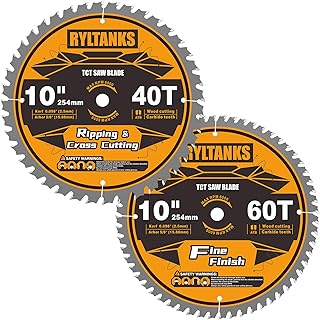
10-Inch 40T + 60T Combo, 2-Pack
A tidy way to cover ripping and fine cross-cutting without buying twice. Quality is solid rather than premium, which makes this pack a smart starter set or a backup pair you don’t mind putting through reclaimed lumber.
Frequently Asked Questions
How many teeth do I need for plywood?
Sixty to eighty. High tooth counts support the veneer fibers as they’re severed, which is what prevents chipping. A zero-clearance insert helps just as much as the blade.
Is a thin-kerf blade worth it?
On saws under about two horsepower, yes. Less material removed means less strain, cooler cuts, and fewer burn marks on dense hardwoods like hard maple and cherry.
Do I still need a dedicated rip blade?
Only if you rip thick hardwood regularly. For occasional four-quarter stock, a good 40-tooth blade handles it; beyond two inches, a 24-tooth rip blade saves your motor and your patience.
When should I replace a blade?
When feed pressure climbs, edges start burning, or the cut turns fuzzy. If the carbide is intact, sharpening is usually the cheaper answer.
Final Thoughts
For visible furniture edges, the FOXBC 80-tooth is the finish blade worth owning. The DEWALT DWA11040 is the most versatile single choice for a small shop, and the WEN BL1060 splits the difference beautifully if plywood casework dominates your build list.